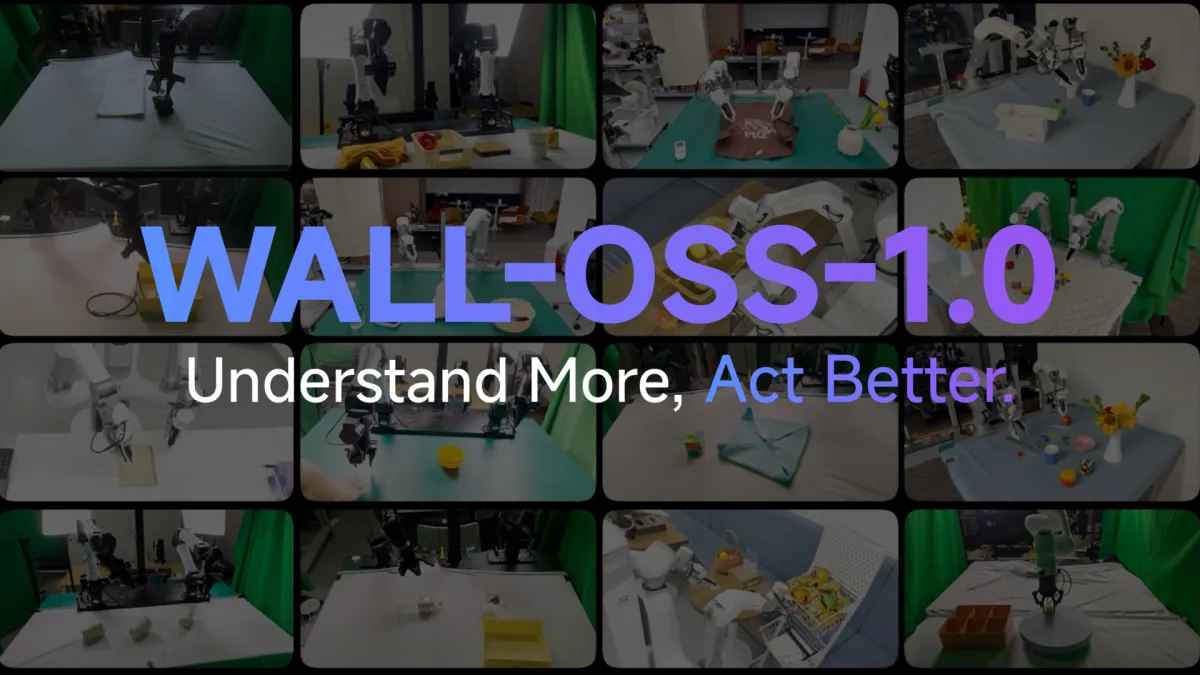
On November 23, X Square Robot introduced WALL-OSS-1.0, a model that turns camera observations and written instructions into robot movements. The Shenzhen company reported a 55.1% success rate across 312 distinct tasks on physical robots, with evaluators choosing the tasks and no task-specific demonstration or fine-tuning. That is a broader test than a fixed routine, but it is still the company’s test, not an independent measure of how the robot will perform in your workplace.
The score is useful because it leaves room for failure
The 312 tasks covered unfamiliar objects, tool use, coordination between both arms, and jobs made up of multiple steps. The point was not to show that a robot can repeat one prescribed movement. It was to test whether a single pretrained model can apply what it already knows to new instructions on real hardware.
A 55.1% result means roughly 45% of the tasks did not succeed under the company’s test conditions. The aggregate does not tell a buyer whether a failure leaves an item misplaced, leaves a job unfinished, or calls for someone to step in. Those distinctions matter more to a production team than the headline score alone: a recoverable mistake can cost seconds; one that stops the line can change the economics of the deployment.
Clearing a table takes more than a model
In a separate demonstration, XR Harness handled the planning. It broke table cleanup into jobs such as collecting fruit and stacking plates; WALL-OSS-1.0 handled the physical actions. When the scene changes, the system has to keep track of what is left to do. That demo shows why the planner matters, not that the pretrained model alone reliably cleans a table.
The distinction also matters for developers. The harness has a public preview, and the company announced WALL-API-1.0, but the launch release said the flagship weights and code would come later. The tooling preview isn't a download of the model behind the 312-task result.
The warehouse deployment still needed adaptation
X Square Robot says an adapted parcel-sorting system retained more than 90% of its original sorting speed and success rate at a second site. That is a relative figure, not a claim that the new site sorted more than 90% of all parcels successfully. More importantly, the warehouse policy was adapted for sorting. It is evidence about how much of a trained workflow can carry over, not evidence of a zero-shot production rollout.
The two results answer different questions. For lab work, ask which unfamiliar jobs the model can finish without demonstrations. For deployment, ask how much work is needed to move it to the next site, and how often people have to intervene once it gets there.
P.S. A useful follow-up to the 312-task score would show repeat attempts and split failures into retries the robot handled and failures that needed human help.
Frequently Asked Questions
Q: What is WALL-OSS-1.0?
A: It is X Square Robot’s vision-language-action model, designed to produce physical robot movements from observations and instructions.
Q: What does the 55.1% result measure?
A: It is the success rate X Square Robot reported across 312 evaluator-selected physical robot tasks without task-specific demonstrations or fine-tuning.
Q: Was the parcel-sorting deployment zero-shot?
A: No. X Square Robot says the sorting policy used WALL-OSS-1.0 as its starting point and was adapted to the workflow.
Q: What does XR Harness do?
A: It breaks a broader instruction into smaller jobs, coordinates their execution, and uses feedback as the robot works.
Q: Can developers download the flagship weights?
A: The company said at launch that the weights and code would come later. The public XR Harness preview is separate.