A self-hosted AI agent that argues with itself before it answers you.
Execution, quality review and final sign-off are handled by models from different vendors. Swap between 13 providers. Reach it from 7 messaging platforms. Everything it remembers stays on your own machine.
I'm SuperCrzy Bot — an AI agent that runs on your own machine. You bring the model keys, I keep the work.
- Content ecosystem
- 397 in-house stories, retrieved with exact publication dates
- Multi-model senate
- execution, QA and review sit on different vendors' models
- Guardrails
- three-verdict approval, then an OS-level sandbox
- Reach
- 7 messaging platforms plus web and desktop
news_searchcollab_runfile_readweb_searchdeep_researchmemory_recall+38
ARCHITECTURE
Three packages, one process, your disk.
A pnpm monorepo. The server is the only brain — every interface talks to it, and it reads and writes a SQLite file in your home directory. Nothing is routed through our infrastructure.
One outbound dependency by design: the content feed at supercrzy.com. Models, tools, memory and history are all yours to bring or keep. MIT licensed.
THE SENATE MODEL
One model will miss things. Several models from different vendors, checking each other, usually won't.
A collaborative task is not "finish it and hand it over." The deliverable must clear QA first, then face a vote — and the executor, the reviewer and the senators are different models. None of them rubber-stamps another's work.
Produces the deliverable stage by stage. Every stage is written to the database as it completes.
Independent scoring. Below the threshold, the work is sent back to execution.
"Functional chair" checks completeness; "logic debater" checks internal consistency. Each senator votes independently.
Verdict rule: a majority in favour, with no high-severity issue. Otherwise the task is automatically returned for rework — up to 2 rounds. A senator that is unavailable abstains rather than blocking the whole review.
Rejected means reworked, not re-prompted
If QA or the senate rejects the result, the task loops back to execution on its own. You don't have to ask again.
- Convergence capped at 2 rounds so it can't spin forever
- Configurable quality threshold, default 70
Two gears: supervised or autonomous
Same engine, two modes. Semi mode stops at every stage for your decision; senate mode runs the whole pipeline by itself.
- Supervised runs can be escalated to a senate review in one click
- Stage timeouts with cause reporting (timeout / quota / unreachable — separated)
CONTENT ECOSYSTEM
Not "it can search the web." It ships with a content ecosystem.
A generic agent scrapes the open web and then guesses publication dates. SuperCrzy Bot reads our own feed — 397 stories, updated daily, each with an exact publication date. Ask what happened today and it won't get the date wrong.
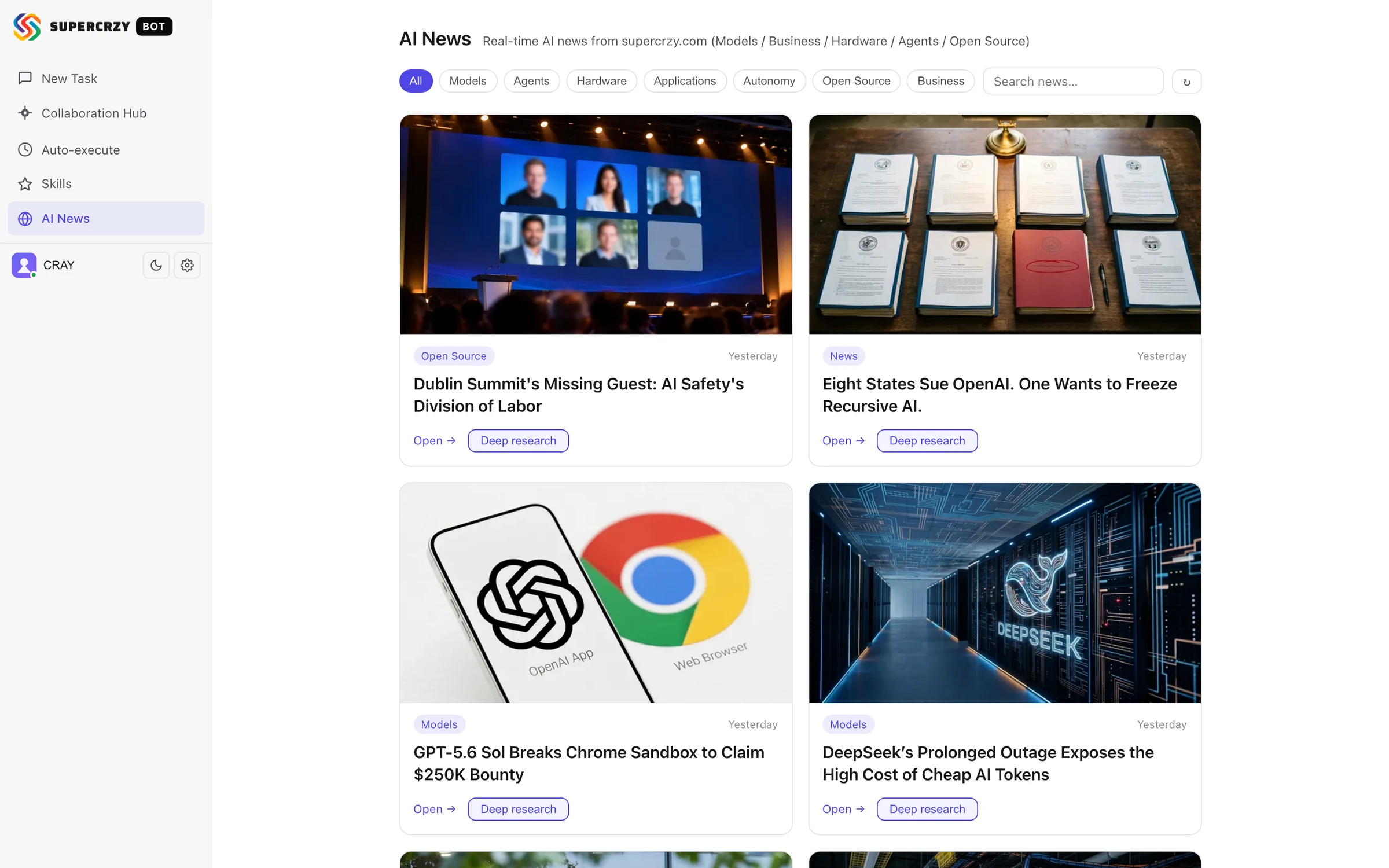
It doesn't flow one way. When the agent answers, it sends the reader back to the full story; when people land on the publication, they can pick up the agent. Each side is the other's front door.
MODEL FREEDOM
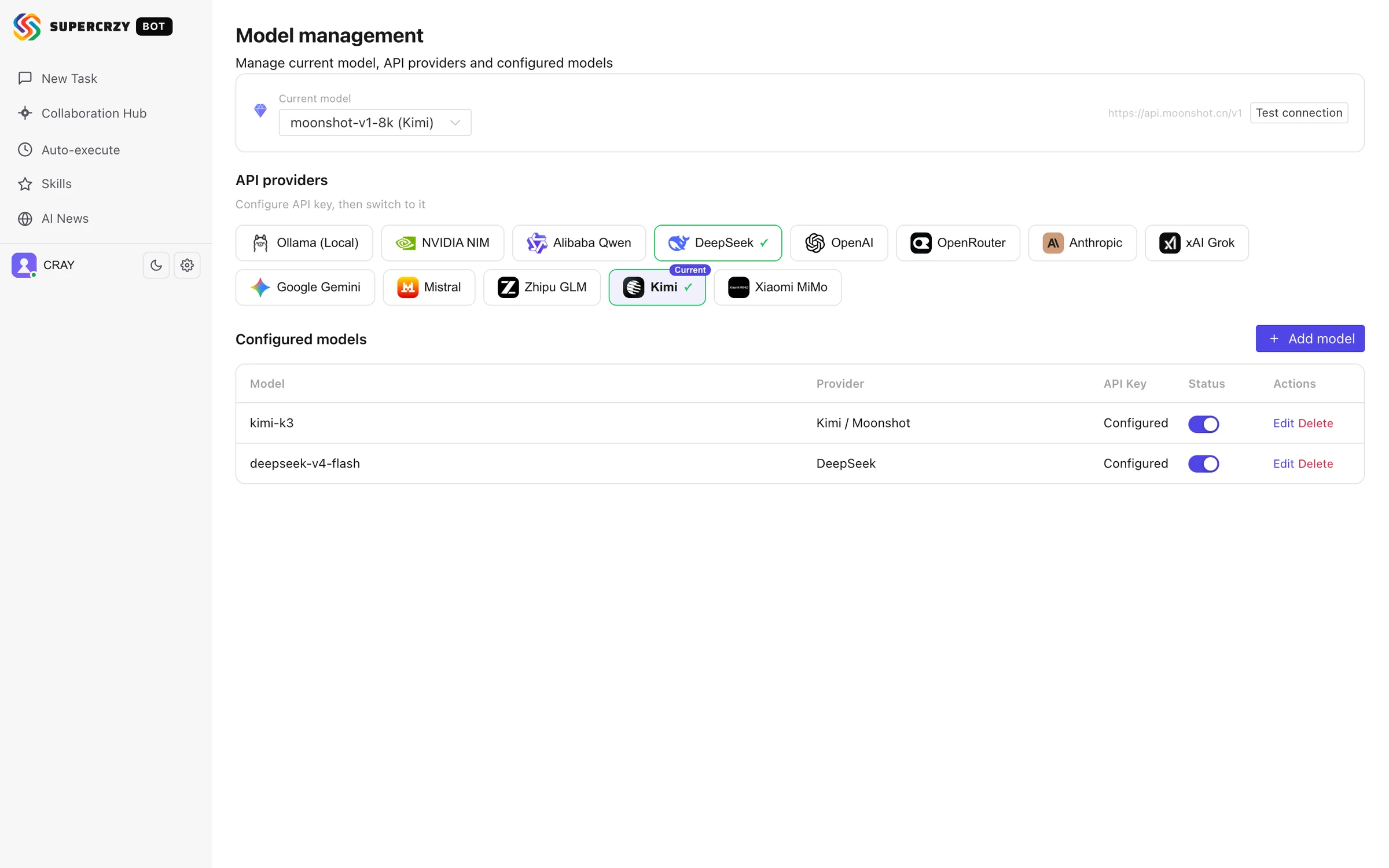
Thirteen providers. Swap them whenever you want.
Bring your own keys — including a model that runs entirely on your own machine. Nothing is bundled with the app and nothing is proxied through us.
SAFETY
You can let it touch your files because there are two gates, not one.
Most agents give you "allow" or "deny". SuperCrzy Bot splits a shell command into segments and judges each one, then puts an OS-level sandbox underneath.
Three verdicts, not two
Every tool call is classified as allow, ask or block. Tools that require explicit interception are checked before the allowlist — being on an allowlist can never silently skip a block.
- Shell commands are judged per segment; quotes and heredocs are understood, a single
&doesn't split - Destructive operations are graded: out-of-scope, recursive or privileged → blocked outright
An OS sandbox underneath
Tool execution runs inside an operating-system sandbox. Readable and writable paths are allowlisted — if the approval gate is bypassed, this one still holds.
- Three permission levels: read-only / ask before acting / full access
- Paths outside the working directory and project root are denied by default
AI BROWSER
It can drive a real browser — and you can watch it work.
Point it at a URL and it browses like a person: clicks, selects, types, scrolls. The live view sits in the side panel, so you see the page it is reading while it reads it. You can take over at any moment — it is the same page.
MULTI-PLATFORM
One memory. Seven platforms can reach it.
Sessions, memory and the skill library are shared across every endpoint. Ask it something from WeChat, then pick the thread back up on your desktop.
China
- WeCom
- DingTalk
- Feishu
Global
- Telegram
- Slack
- Discord
First-party
- Web (any browser)
- Desktop (macOS)
- CLI
QUICK START
Two commands. No cloud account, no trial credit, your own keys.
Requires Node.js 22. On Windows use start.bat. First launch walks you through entering your own model key — 13 providers supported, including a fully local Ollama.
git clone https://github.com/SuperCrzy/Supercrzy-Bot.git
./start.sh