On October 13, 2026, StepFun's terminal brand STEPX released the STEPX Neo, priced at 3,999 yuan, with sales beginning October 16. It runs Step AOS 1.0 and the Amoo agent, and StepFun calls it the first mass-market agent-native smartphone. The hardware is mid-range: Snapdragon 8 Gen 5, 16GB RAM, 256GB storage, a 6.36-inch 120Hz OLED display, and a 6260mAh battery. The value is not in the spec sheet. It is in whether the agent actually takes over the task flow.
After two weeks of hands-on reports, the answer is yes, within the ecosystem it supports. That ecosystem is Chinese.

The hardware is a carrier, not the point
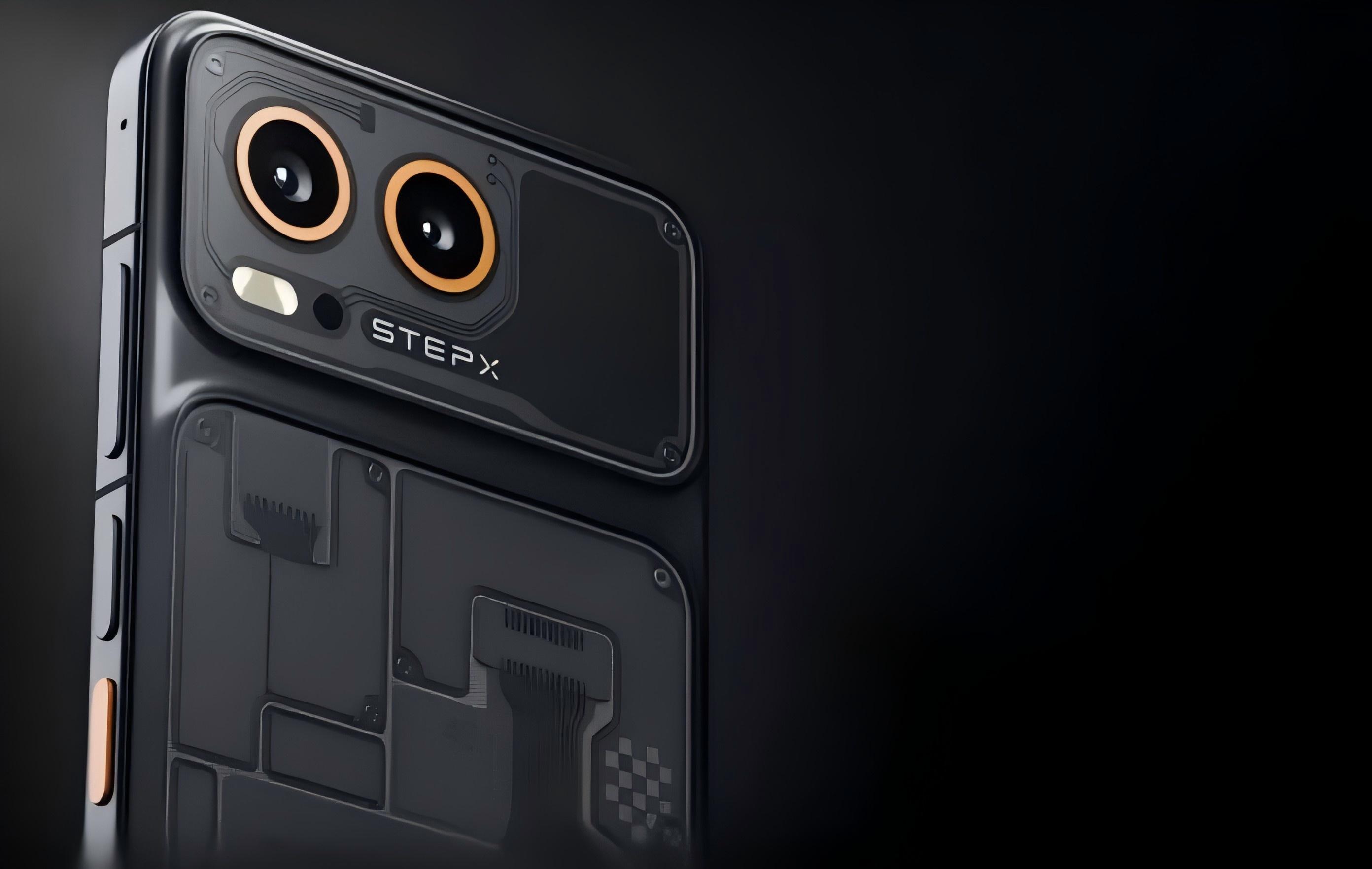
The back panel uses a transparent mechanical design with five easter eggs referencing AI history: "42," a line of code, Turing test binary, a chessboard pattern, and the Transformer architecture. It is a signal of identity, not an aesthetic argument.
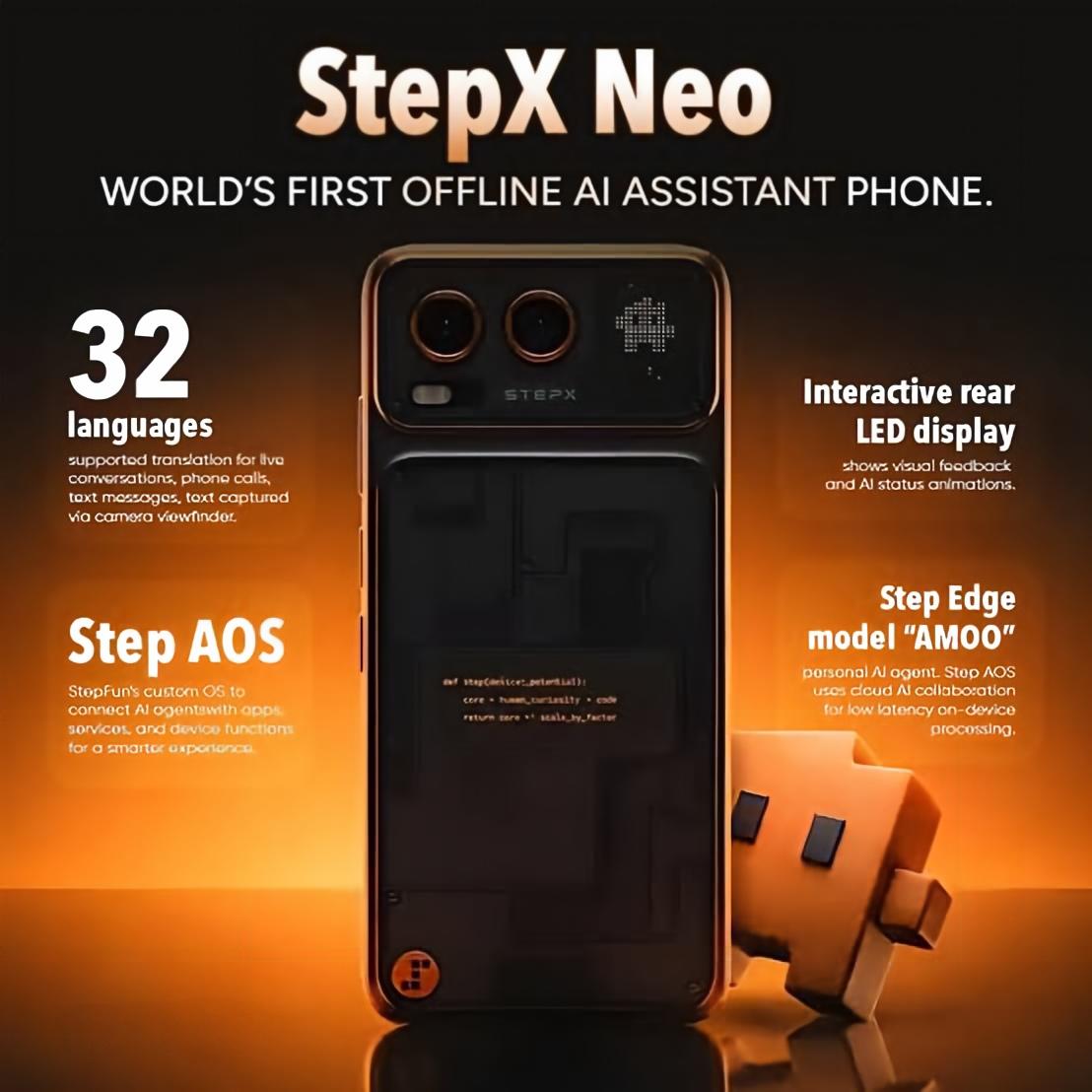
The more consequential hardware decision is the MiniLED dot-matrix back screen. It displays the agent's working state: thinking, tool call, output. This is not decoration. It solves a real problem: when an agent runs a long task in the background, the user has no idea what it is doing. The back screen gives the agent a physical expression without interrupting the main display.
The six-microphone array, low-power audio chip and Whisper 1.0 algorithm are designed for voice interaction. StepFun claims the dedicated chip consumes only 1.2% of battery over 24 hours of standby, a figure that has not been independently verified.
The 3,999 yuan price is not a hardware price. It bundles the phone, Step AOS, Step Studio, and the Step model series, plus 12 months of 10 billion tokens per month. StepFun calls it full-stack pricing. What happens after the first year has not been disclosed.
It can cross apps, but the app list is Chinese
This is the core capability, and the boundary overseas users need to see clearly.
Amoo does not open an app and operate it on your behalf. Step AOS exposes system-level atomic capabilities, and the agent calls service interfaces directly to complete cross-app tasks. The demos include booking a ride, ordering food, making a presentation, editing a video, planning a trip and booking tickets. It does not give you advice. It places the order.
The partner list includes Alipay, Tencent, Ctrip, Didi, Meituan, Amap, Jianying, JD, Baidu, Weibo and WPS, covering payments, local services, travel, office work and content creation.
For an overseas reader, the translation is simple: this is a Chinese super-app ecosystem. Alipay maps to payments and hundreds of life services. Meituan maps to local services. Didi maps to ride-hailing. Ctrip maps to travel. None of these have international equivalents in the phone's integration layer.
There is no announced international release date, price or carrier availability. The pre-integrated ecosystem is built around Chinese apps. Developer documentation for Step Studio is in Chinese.
The judgment: the cross-app capability is real, but the scenarios that validate it currently exist only in China. An overseas buyer would get a device with complete hardware and an empty ecosystem.
It writes its own tools, and then improves them without being asked
This is the most underrated capability, and the part technical readers will actually care about.
One reviewer asked Amoo to build a podcast transcription skill. The first version used a tiny model, and the output had too many typos. The agent noticed the quality problem on its own, switched to a base model for proofreading, and recorded the failure mode. On subsequent runs, the skill was over 80% faster. The user did not instruct the model switch or the optimization.
Another set of examples: the reviewer generated a "do not disturb while writing" mode, a photo scorer that selects the best shot from a burst, and a podcast summarizer that extracts ten quotes from a full episode, all through natural language.
The mechanism is Step Studio and MCP. Users describe a need in plain language, the agent generates a skill and calls system atomic capabilities. The system supports Loop execution and autonomous Tool Call, capabilities that approach what desktop coding agents can do.
The judgment: this is the real differentiation. It is not a phone with a bundle of pre-installed agent features. It is a phone where a sentence can produce the feature you need. This capability does not depend on the Chinese ecosystem in principle. An overseas user could ask it to write a skill calling Gmail or Google Calendar, if the MCP endpoint exists. The confirmed ecosystem is Chinese.
Memory works, but its ownership and portability are unanswered
The dual-domain memory is the core of Step AOS. The user domain records preferences, relationships and context. The agent domain accumulates knowledge, methods and experience. The claimed recall latency is as fast as 15 milliseconds.
In practice, the effect is that the second time you plan a similar task, you do not repeat your preferences. In one demo, five people planned a trip. The second time, "no seafood" did not need to be said again.
The judgment: memory is what turns an agent from a tool into an assistant. But STEPX Neo has not answered a question any technical reader will ask: can the experience accumulated in the agent domain move to another device? Step Studio supports MCP and A2A protocols, but protocol openness is a communication standard, not data portability. If memory is locked to the device, dual-domain memory is a more refined lock-in mechanism.
Reversible is a promise, but the system-level boundary is unclear
The stated safety architecture is trustworthy, visible, controllable and reversible. In practice, deleting a photo triggers a confirmation, operations are logged, and tapping undo brings the photo back.
But what does reversible mean at the system call layer? If the agent calls a payment interface and completes a transaction, does the user undo the action log, or the transaction itself? The public materials do not specify.
The judgment: this is the most important promise to verify and the one with the least public data. If reversible only means an audit log, the trust foundation for an agent phone has not been built.
What an overseas buyer actually gets
Three hard facts. There is no international version. The ecosystem is Chinese. Developer tools are in Chinese.
The judgment: STEPX Neo is an agent phone designed for the Chinese market, and its capabilities are real and verifiable within that ecosystem. An overseas buyer today would get complete hardware with a core capability set that sits idle. Is it worth watching? Yes. Is it worth buying now? No.
P.S. The price includes 12 months of 10 billion tokens per month. What happens in year two has not been disclosed. An agent phone that depends on continuous model calls has an unknown operating cost after the first year.
Frequently Asked Questions
Q: What is STEPX Neo?
A: An agent-native smartphone from StepFun's terminal brand STEPX, released in China on October 13, 2026, priced at 3,999 yuan. It runs Step AOS 1.0 with the Amoo agent, and is positioned as the first mass-market agent-focused phone.
Q: What can the agent actually do?
A: It can call across supported apps to complete tasks like booking rides, ordering food, planning trips, making presentations and editing video. It can also generate custom skills from natural language descriptions and optimize them over time.
Q: Can I use it outside China?
A: There is no announced international release date, price or carrier availability. Its pre-integrated ecosystem is built around Chinese apps including Alipay, Meituan, Didi and Ctrip. Developer documentation is in Chinese.
Q: What is the most compelling capability for technical users?
A: Skill generation. Users can describe a tool in plain language and the agent builds it, calls system capabilities, and refines it after use. One reviewer reported a skill becoming over 80% faster after the agent self-corrected its transcription model.
Q: What is unproven?
A: System-level reversibility. The phone claims reversible safety, but it is unclear whether undoing an agent action restores system state or only removes the action log. The H2A2A protocol is closed and has no independent security review.
Q: What happens after the bundled token plan ends?
A: The phone includes 12 months of 10 billion tokens per month. StepFun has not disclosed pricing or access terms after the first year.