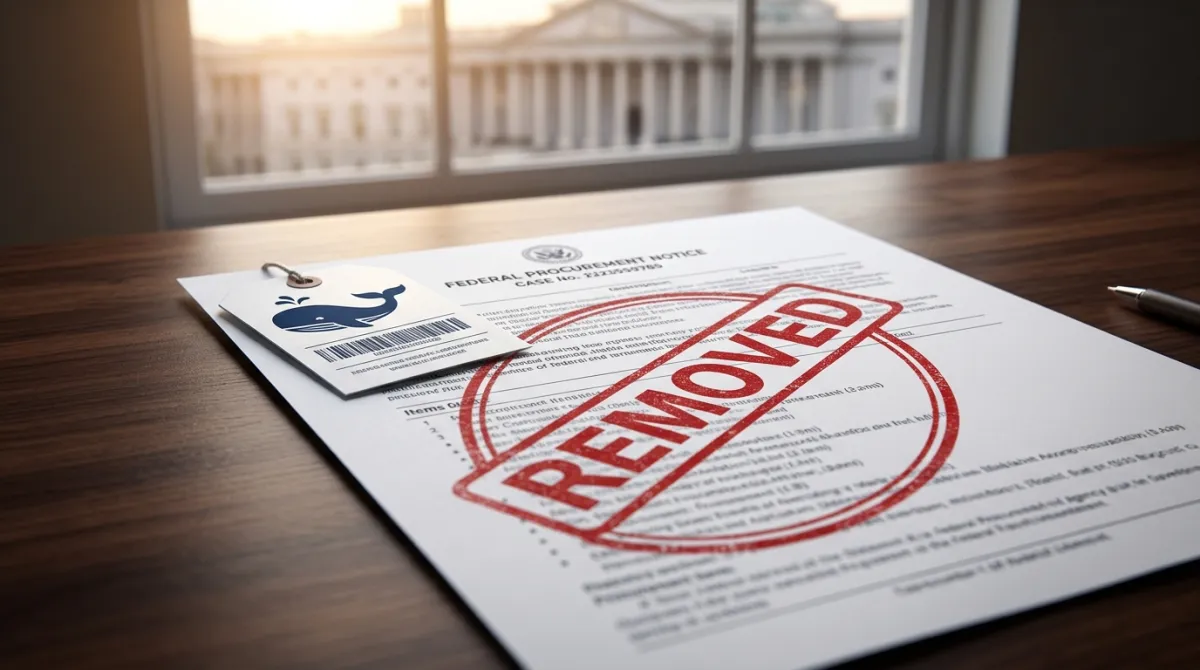
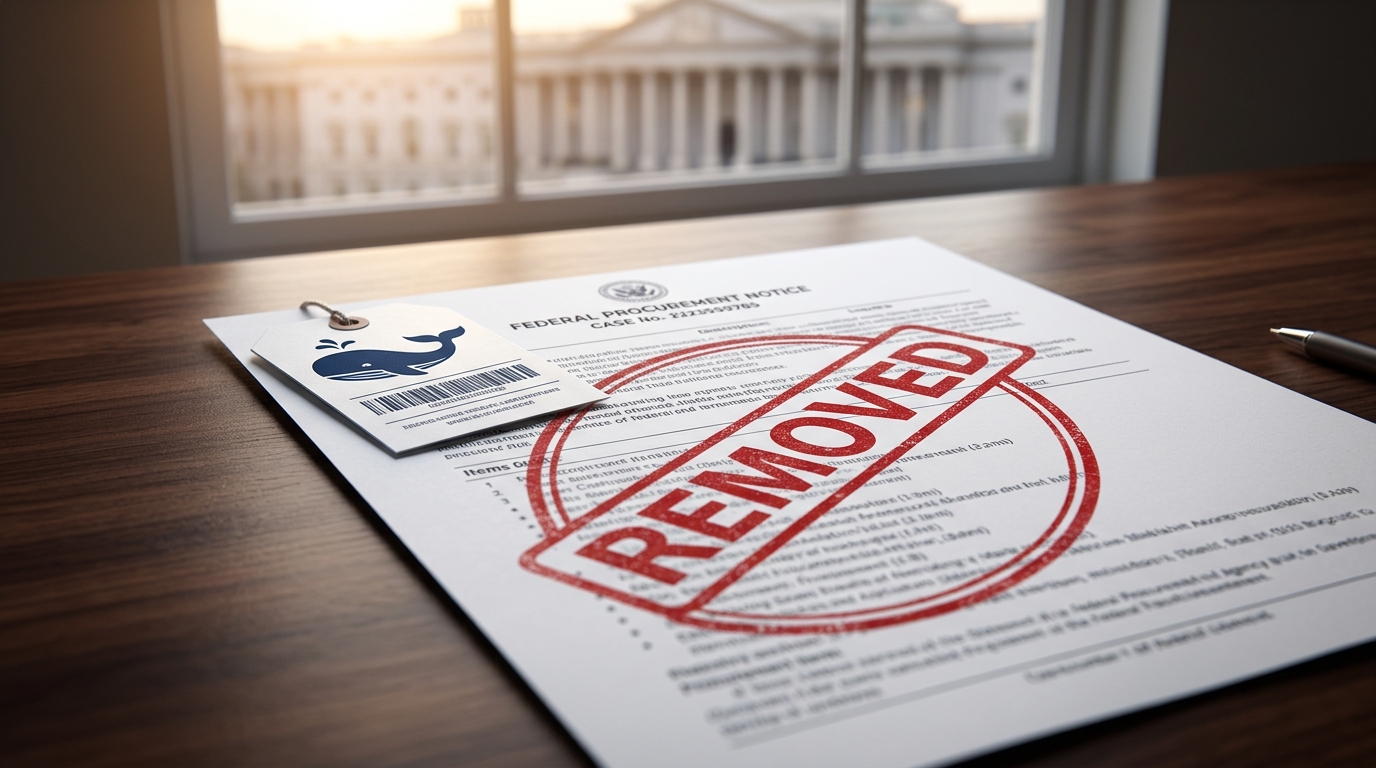
On October 19, 2026, the U.S. Department of Homeland Security issued an exclusion and removal order under the Federal Acquisition Supply Chain Security Act (FASCSA), barring federal civil executive agencies from procuring any DeepSeek or affiliate IT product and requiring removal of existing products, including "third-party products and services developed using DeepSeek technology." The order was signed by DHS Secretary Malin on July 24, published in the Federal Register on October 20, and took effect immediately.
It is the first time FASCSA has been applied to an AI model. The tool was built for routers, cameras and software supply chains. Now it points at a weight file.
"Developed using DeepSeek" cannot be executed
The sharpest clause in the order is the through-line removal: any third-party product or service implemented with a DeepSeek model falls inside the scope. A U.S. software company selling an AI assistant to a federal agency — its own brand, its own code — must pull the entire product if the underlying model calls DeepSeek.
The problem is that "developed using" is undefined. The order does not say whether fine-tuning and distillation count. A developer who used DeepSeek to generate a few lines of code — does that qualify? A product that routed to a DeepSeek model through OpenRouter without the developer knowing — does that qualify?
FASCSA's compliance logic rests on traceability. A router has a serial number, a manufacturer, a supply chain record. A model weight file has none. It is downloaded, fine-tuned, embedded and redistributed, and each layer can lose provenance. The order creates a compliance obligation without providing the tools to meet it. The first to feel the gap is not DeepSeek. It is the U.S. companies selling AI to federal agencies.
The Pentagon is exempt, so the security rationale does not hold
DHS cites "multiple threat vectors": sensitive data possibly transferring to the Chinese government, models possibly containing malware, possible collection of user information.
But the order explicitly excludes the Department of Defense and intelligence agencies. If DeepSeek truly poses "multiple threat vectors," why does the department handling the most sensitive data not need to remove it?
There are three possible explanations. The Pentagon had already blocked DeepSeek on its own, making the order redundant there. Or the Pentagon has separate procurement authority outside DHS jurisdiction. Or — the most direct explanation — the security rationale was packaged after the fact. The order discloses no specific breach case or technical audit. "May" functions as a conclusion in the document, not a qualifier.
The real damage is a compliance label, not revenue
DeepSeek's revenue exposure on the U.S. federal side is close to zero. It is not a government contractor, and its 2026 funding comes from private capital. The order does not touch its ability to sell to U.S. commercial customers or individual users, and it does not add DeepSeek to the Commerce Department entity list or impose export controls.
The indirect effect is structural. The DHS order hands every risk-averse buyer an official risk endorsement. System integrators and cloud providers with federal contracts may avoid DeepSeek in commercial projects too, for compliance reasons. Regulated industries — finance, healthcare, education — will see "federal supply chain risk" on the label, no matter how cheap the API is.
In June 2026, DeepSeek's paid adoption among 50,000 U.S. enterprises was about 0.1%, against 34.4% for Anthropic and 32.3% for OpenAI. The ban will not reverse an already thin commercial presence. It will cement a perception: DeepSeek does not fit U.S. compliance environments.
Meanwhile, DeepSeek's technical influence in developer communities is decoupled from its commercial revenue. In May 2026, its token share on Vercel jumped from under 1% to 17%. Cost-sensitive developers use it. Enterprise procurement departments do not. The ban deepens this high-usage, low-monetization structure.
P.S. The 60-day exception window, counted from the July 24 signing date, had already closed when the order became public on October 19. An agency that learned of the requirement that day was already too late — not an oversight, a design choice.
Frequently Asked Questions
Q: What exactly did DHS order?
A: An exclusion and removal order under FASCSA barring federal civil executive agencies from procuring DeepSeek or affiliate IT products and requiring removal of existing ones, including third-party products and services developed using DeepSeek technology. It took effect on October 20, 2026.
Q: Why are U.S. vendors affected more than DeepSeek?
A: DeepSeek has almost no federal revenue exposure. But U.S. companies selling AI to federal agencies must now prove their products do not use DeepSeek anywhere in the stack — and AI software has no standardized bill of materials to prove that.
Q: What does "developed using DeepSeek" mean?
A: The order does not define it. It is unclear whether fine-tuning, distillation, code generation, or automatic routing through a gateway counts. That ambiguity turns every vendor's model supply chain into an audit problem.
Q: Why is the Pentagon exempt?
A: The order covers civil executive agencies only; Defense and intelligence fall under separate authority. If DeepSeek posed a genuine threat, exempting the most sensitive departments is difficult to reconcile with the stated rationale.
Q: Can local deployment avoid the ban?
A: No. The order targets procurement and use, not possession. Running weights locally changes the data path but does not remove the product from scope, and the order provides no local-deployment exemption.
Q: What is the practical effect on DeepSeek?
A: Minimal direct revenue loss, but a structural compliance label. Regulated industries and federal-adjacent integrators will avoid DeepSeek regardless of price, cementing a high-usage, low-monetization split between developers and enterprise buyers.