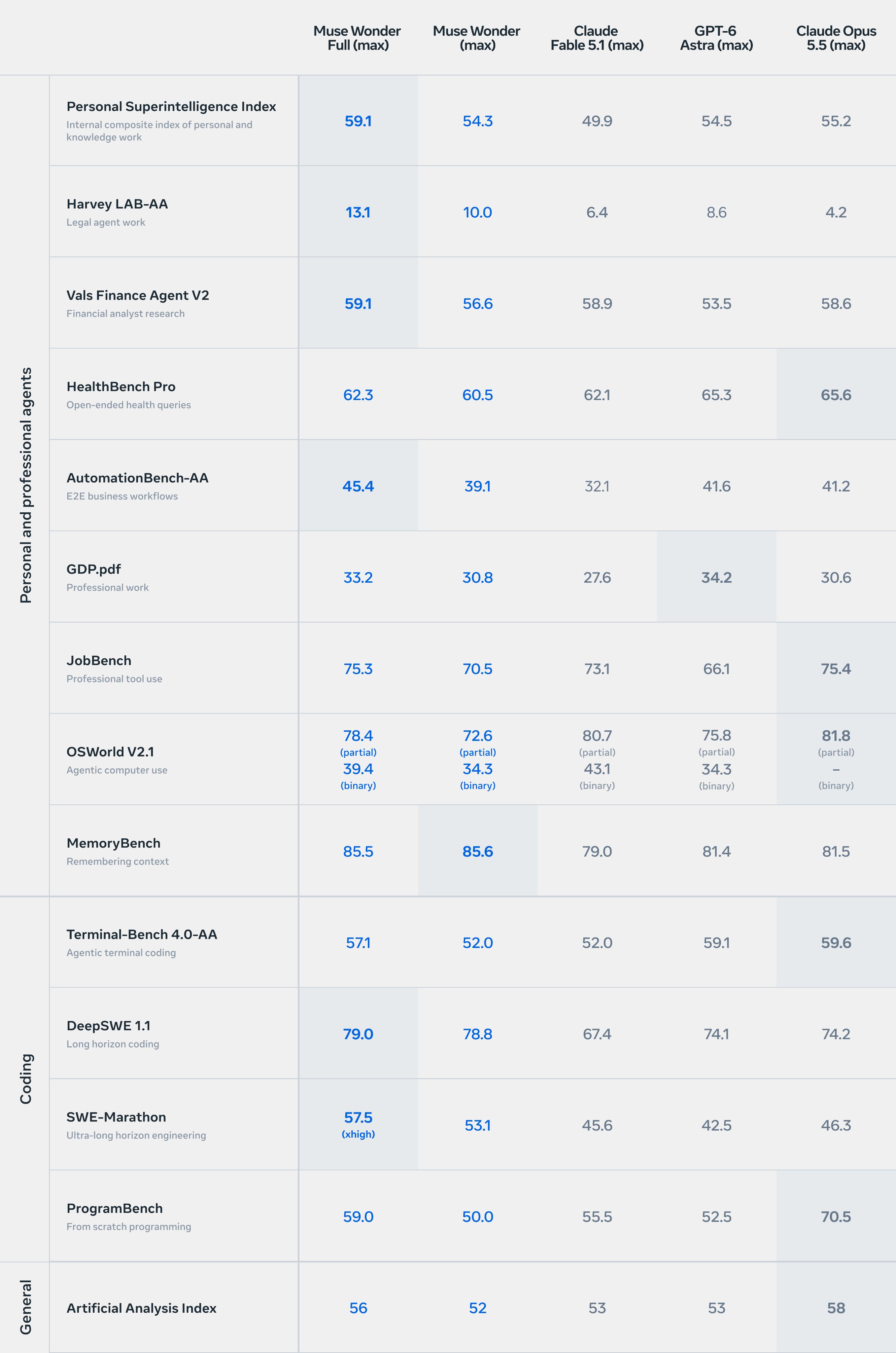
On October 12, 2026, Meta released the Muse Wonder family: Muse Wonder and Muse Wonder Full. According to Meta's published numbers, Full scores 57.5% on SWE-Marathon, 79.0% on DeepSWE 1.1, and 59.1% on the Personal Superintelligence Index, outperforming Claude Opus 5.5 and GPT-6 Astra on several measures.
Mark Zuckerberg told the Financial Times that Meta has caught up with competitors "at the frontier," and hinted that model development speed "will likely accelerate noticeably from here."
The model he caught up with is not the one developers can buy.
The Benchmark Model and the API Model Are Not the Same
Wonder Full is not available through the API. It is offered only through Muse Code subscription tiers at $50 and $200. API customers receive standard Muse Wonder.
Artificial Analysis measured the standard version: 52 on the Intelligence Index, versus 56 for Full. The four-point gap reflects different model tiers, not different usage patterns.
Developer Theo put it directly: "The standard Wonder served through the API is noticeably weaker."
Meta used a subscription-only model to build the "caught up to the frontier" narrative. What enterprises can integrate directly is a lower tier. OrcaRouter's analysis points to the core problem: the model you can't lock down is the one you should be least eager to build on.
Priced Like Opus, Costs More Per Task Than Astra
Muse Wonder's API pricing is $4 per million input tokens and $20 per million output — identical to Claude Opus 5.5.
Artificial Analysis's cost data shows a different picture: Wonder averages $4.52 per task on the Intelligence Index, versus $3.26 for GPT-6 Astra. The gap is not in the unit price but in token consumption — Wonder generates substantially more output tokens than Astra, raising the total cost per task.
For high-frequency agent workloads, that means the same unit price and a different bill. Meta aligned the unit price with Opus without addressing token efficiency. For usage-billed enterprises, that is a calculation to run before deployment.
What Developers Found
Early developer feedback diverges from the official benchmarks.
Developer Claire Vo's testing found strong agent performance, competitive coding, and decent email writing, but weak front-end design and creative writing. Another user said the real-world performance "doesn't match the benchmark scores" and remains clearly behind Opus 5.5. Meta's chief AI officer, Alexandr Wang, acknowledged on launch day that "there are still a number of bugs being worked through," and asked developers to "put Wonder to work on real coding tasks."
Official benchmarks measure a model under controlled conditions, at optimal configuration, on selected tasks. API customers get the model in real workflows, at standard configuration, on everyday tasks. The gap between the two is the discount that any "caught up" claim needs to carry.
P.S. Meta has not said whether Wonder Full will come to the API, or explained the product logic behind the tiered release. On the Artificial Analysis Intelligence Index, standard Wonder scores 52, while GPT-6 Astra and Gemini 4 Argon both score 53. The 56 from Full puts Meta level with frontier competitors — but only subscribers can reach it.
Frequently Asked Questions
Q: What did Meta release?
A: On October 12, Meta released Muse Wonder and Muse Wonder Full. Full is available only through Muse Code subscriptions at $50 and $200 tiers; the API provides standard Wonder.
Q: Why does the distinction matter?
A: Meta's headline benchmarks come from Full. The API version scores 52 on the AA Intelligence Index versus 56 for Full, and developers report the API model is noticeably weaker.
Q: How does pricing compare?
A: Muse Wonder's API pricing matches Claude Opus 5.5 at $4 input and $20 output per million tokens, but its per-task cost averages $4.52 versus $3.26 for GPT-6 Astra, due to higher token consumption.
Q: What do developers say?
A: Early testers report strong agent performance and competitive coding, but weaker front-end design and creative writing, with some saying results don't match the benchmark scores.
Q: What has Meta not said?
A: Whether Wonder Full will be available via API, and the product logic behind the tiered release.