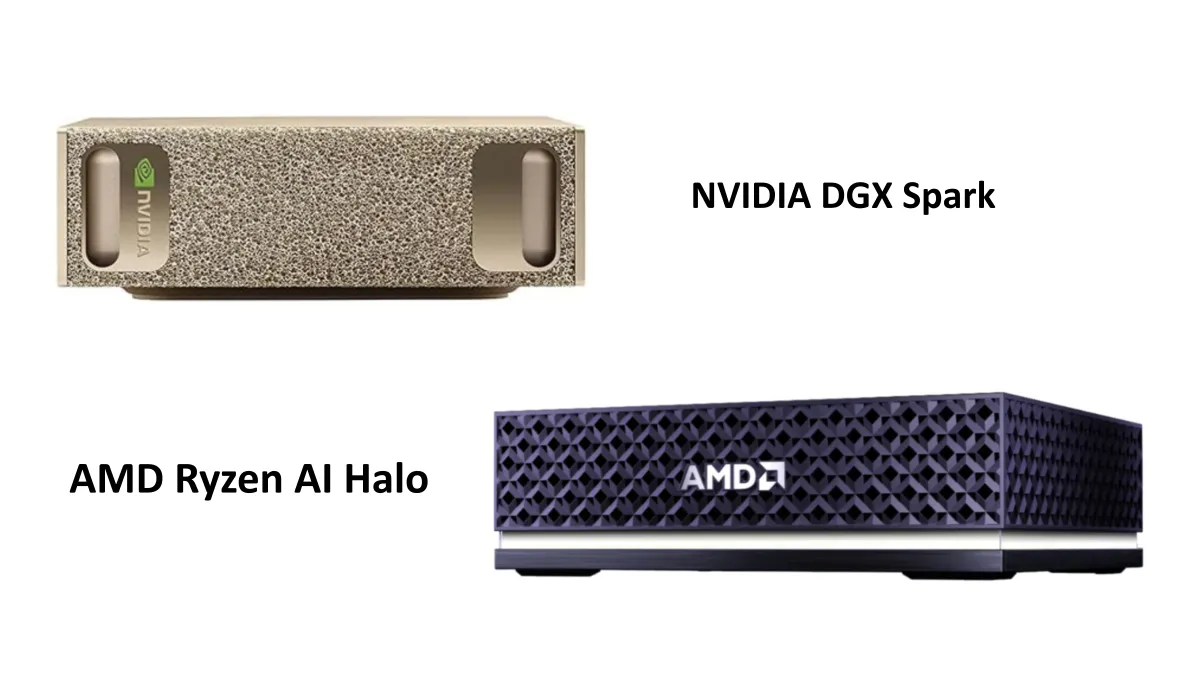
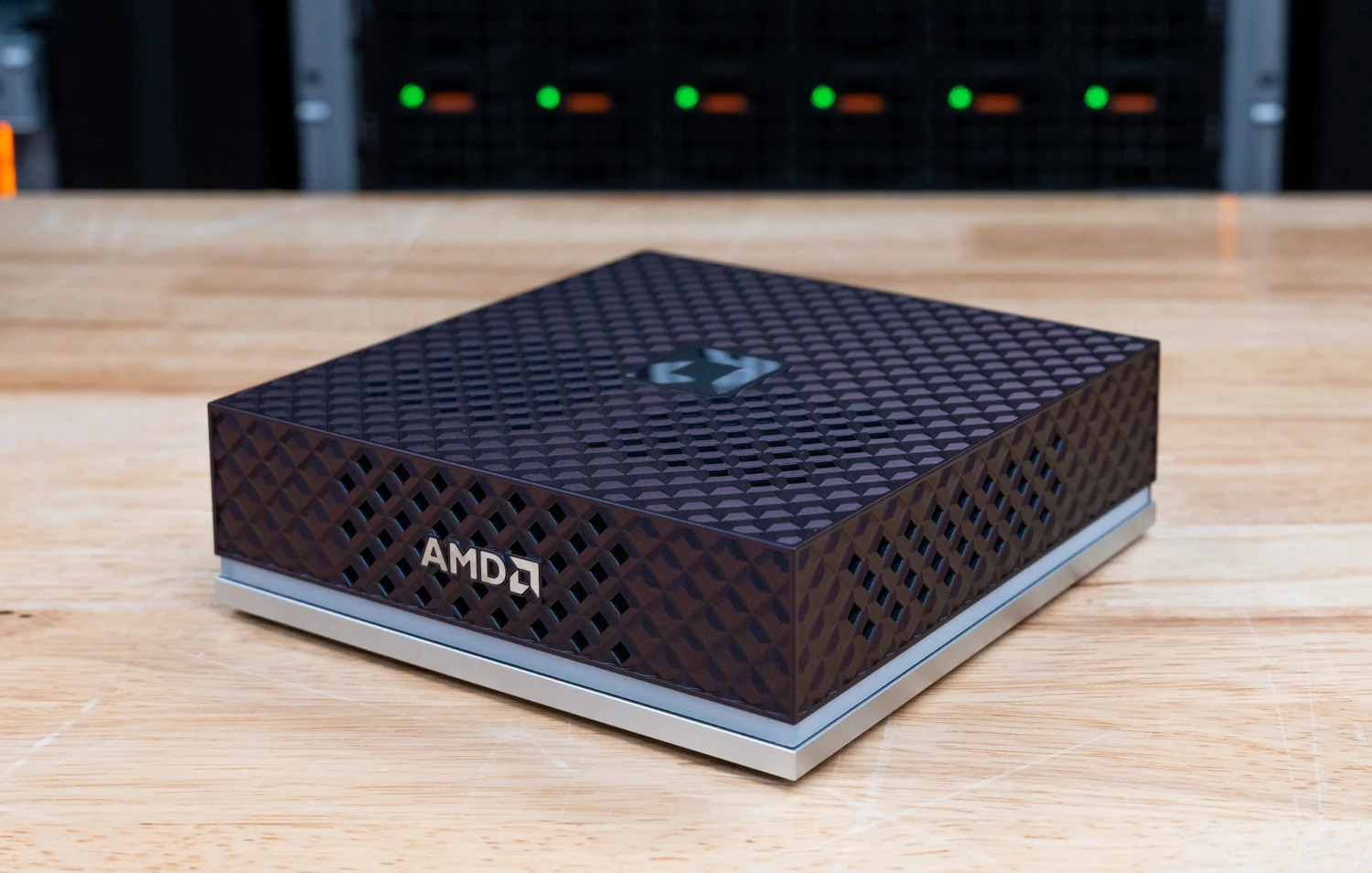
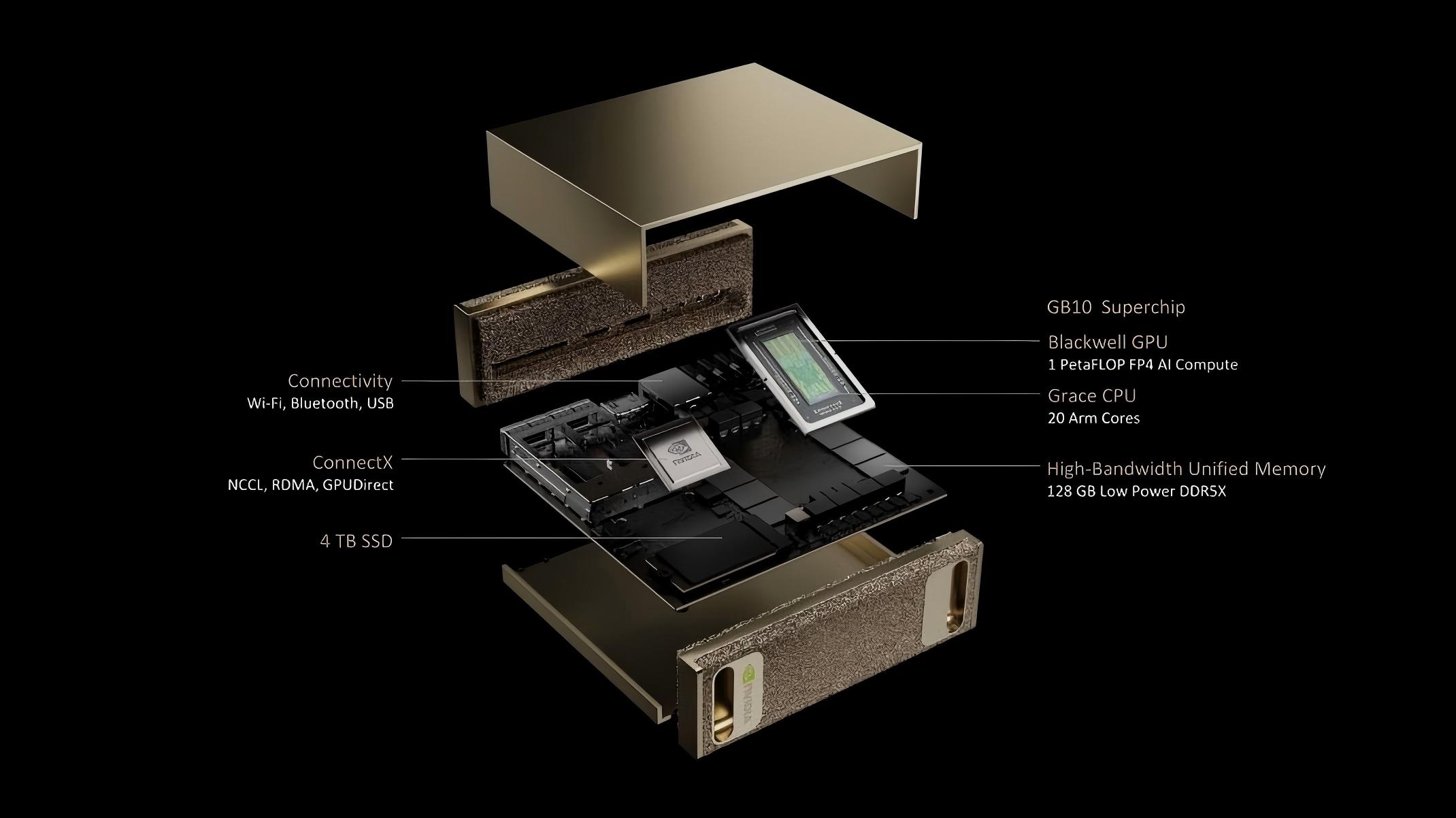
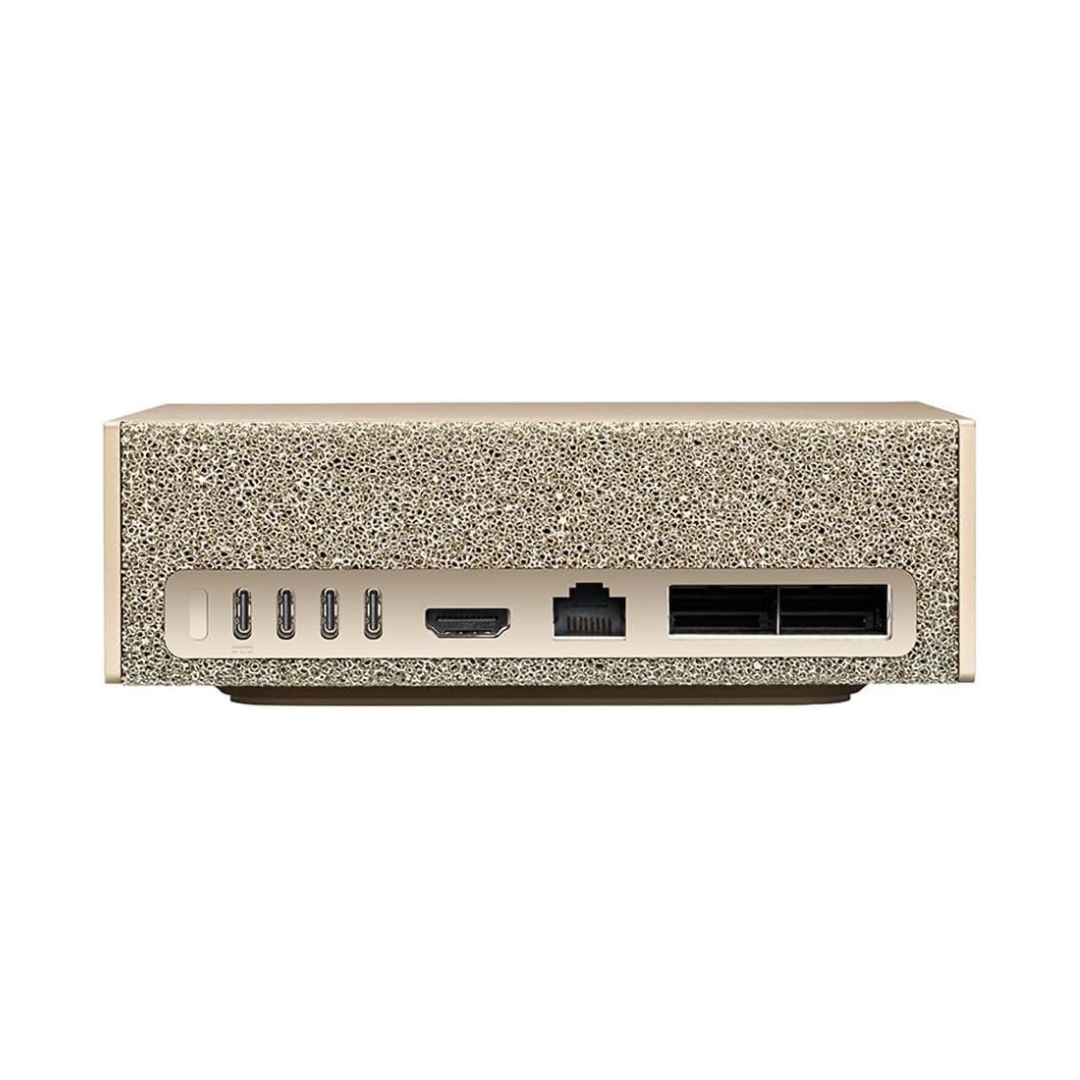
The ASUS Ascent GX10 is NVIDIA’s DGX Spark vision in a 150mm square chassis: 20 Arm CPU cores, a Blackwell GPU, 128GB of LPDDR5x memory shared between them, and two 200Gbps QSFP ports for linking multiple units into a memory pool. The AMD Ryzen AI Halo is built around Strix Halo: 16 Zen 5 CPU cores, Radeon 8060S graphics, 128GB of LPDDR5x, running either Windows or Linux.
Both are compact, power-efficient, and designed for local AI development. But the benchmarks reveal a clear split.
The Numbers That Define Each Machine
CPU-Centric Workloads: AMD Leads
AMD’s Strix Halo platform consistently outperforms NVIDIA’s GB10 in CPU-heavy tasks:
Test | AMD Ryzen AI Halo | NVIDIA DGX Spark | Winner |
|---|---|---|---|
7-Zip Compression | 186,921 MIPS | 169,052 MIPS | AMD (+11%) |
7-Zip Decompression | 146,109 MIPS | 106,084 MIPS | AMD (+38%) |
LLVM Compile Time | 431.8 sec | 504.3 sec | AMD (14% faster) |
Memory Bandwidth: NVIDIA Leads
DGX Spark shows stronger sustained memory bandwidth:
Test | AMD Ryzen AI Halo | NVIDIA DGX Spark | Winner |
|---|---|---|---|
STREAM Scale | 110,611 MB/s | 128,970 MB/s | NVIDIA (+17%) |
STREAM Triad | 107,105 MB/s | 121,433 MB/s | NVIDIA (+13%) |
STREAM Add | 107,022 MB/s | 122,815 MB/s | NVIDIA (+15%) |
Storage Performance: NVIDIA Has a Clear Advantage
In 128K sequential read tests, DGX Spark reached 13,399.6 MB/s—nearly double AMD’s 6,897.5 MB/s—with average latency of 0.597ms versus AMD’s 1.159ms. Spark’s PCIe Gen5 storage connection delivers throughput AMD can’t match.
What This Means for AI Workloads
The differences in hardware translate directly into different strengths. The 128GB unified memory is the headline feature on both systems. But what happens with that memory defines each machine’s personality.
MoE Architecture Advantage
PCMag’s testing on the GX10 found that MoE models like Qwen3-30B-A3B run at speeds comparable to a 20B dense model, because only a fraction of parameters activate per token. The architecture matters as much as the raw capacity. For developers running MoE models, the memory bandwidth advantage may be less critical than the ability to fit the model at all.
Agentic Workflows Favor CPU
In a local enterprise AI agent workflow test, the AMD Ryzen AI Halo completed tasks 15% faster than the DGX Spark (311.6 seconds vs 367.1 seconds). The AMD system showed a 34% advantage in the CPU orchestration stage—the part of agentic workflows where tools are called, data is retrieved, and validation is performed. This is the kind of workload that will dominate AI development as agents become the primary interface.
SSD Difference
Halo’s drive runs at PCIe Gen4 link speeds, limiting its available bandwidth well below the drive’s own capability. Spark’s storage stack is built for higher sustained sequential throughput, a significant advantage for large model loading and checkpoint operations.
The Ecosystem Trade-Off
Software support is where the two machines diverge beyond benchmarks.
DGX Spark: Runs NVIDIA’s DGX OS, an Ubuntu-derived distribution with all drivers and tools preinstalled. The software stack matches data center systems, so models move to DGX Cloud or enterprise infrastructure without code changes. It’s Linux-only; Windows is not an option.
Ryzen AI Halo: Runs Windows 11, Linux, or AMD’s Debian-derived Ryzen AI Developer Platform. HP’s ZBook Ultra G1a (same Strix Halo platform) is ISV-certified, a factor for professional workflows.
The ecosystem question depends on your existing infrastructure. If your team is already Windows-based, AMD is the only option. If you’re building on CUDA and deploying to NVIDIA cloud infrastructure, the DGX Spark keeps everything consistent.
Which One Should You Buy?
Buy the DGX Spark if: you need NVIDIA’s ecosystem, plan to deploy to NVIDIA cloud infrastructure, run memory-bandwidth-intensive models, benefit from PCIe Gen5 SSD speeds, and are comfortable with Linux-only operation.
Buy the Ryzen AI Halo if: you need Windows support, run CPU-heavy agentic workflows, prioritize lower upfront cost, value CPU performance in orchestration-heavy AI tasks, or need ISV-certified professional workflows.
The DGX Spark is not trying to win a speed race across every dimension—it’s trying to win on ecosystem and memory capacity. The Ryzen AI Halo is targeting a different buyer: the developer who needs local AI capability but doesn’t want to leave the x86 ecosystem.
P.S. The quietest signal in the benchmarks is the storage gap. Spark’s PCIe Gen5 SSD delivers nearly twice the sequential read throughput of Halo’s Gen4-limited implementation. For loading large models and checkpointing, that gap becomes a real workflow constraint on the AMD side. If you’re running models that need frequent reloading or large training checkpoints, the extra bandwidth on the NVIDIA side matters more than the benchmark scores suggest.
Frequently Asked Questions
Q: What are the two machines compared in this review?
A: The NVIDIA DGX Spark (ASUS Ascent GX10) and AMD Ryzen AI Halo (Strix Halo platform). Both have 128GB unified memory and are designed for local AI development. Both are priced around $4,000.
Q: Which machine has better memory bandwidth?
A: The NVIDIA DGX Spark leads in sustained memory bandwidth with STREAM scores 13-17% higher than AMD's Ryzen AI Halo (e.g., 121,433 MB/s vs 107,105 MB/s in STREAM Triad).
Q: Which machine is faster for CPU-heavy workloads?
A: The AMD Ryzen AI Halo wins in CPU-heavy tasks: 38% faster in 7-Zip decompression, 14% faster in LLVM compilation, and 34% faster in CPU orchestration for agentic AI workflows.
Q: How do the storage speeds compare?
A: DGX Spark's PCIe Gen5 SSD delivers nearly double the sequential read throughput (13,399 MB/s) compared to AMD's Gen4-limited implementation (6,897 MB/s), with significantly lower latency.
Q: Which machine is better for AI agent workflows?
A: The AMD Ryzen AI Halo completed local enterprise AI agent workflows 15% faster (311.6 seconds vs 367.1 seconds). Its 34% advantage in CPU orchestration is a significant win for multi-step agentic tasks.
Q: What is the software ecosystem difference?
A: DGX Spark runs DGX OS (Ubuntu-based Linux) only. Ryzen AI Halo runs Windows 11, Linux, or AMD's Debian-based Ryzen AI Developer Platform. If your team is Windows-based, AMD is the only option.
Q: What is the 128GB unified memory advantage?
A: Both systems can run models that won't fit in a conventional GPU's VRAM—up to 120-billion-parameter models, including MoE architectures like Qwen3-30B-A3B.
Q: Which machine supports MoE models better?
A: Both support MoE models well. Testing on the GX10 found that MoE models like Qwen3-30B-A3B run at speeds comparable to a 20B dense model, because only a fraction of parameters activate per token.
Q: Which one should I buy?
A: Choose the DGX Spark if you need NVIDIA's ecosystem, plan to deploy to NVIDIA cloud, or prioritize memory bandwidth and storage speed. Choose the Ryzen AI Halo if you need Windows support, CPU-heavy agentic workflows, or ISV-certified professional workflows.
Q: What is the significance of the storage gap?
A: For developers running models that need frequent reloading or large training checkpoints, DGX Spark's Gen5 SSD provides a significant workflow advantage. The storage gap may matter more than benchmark scores for some users.