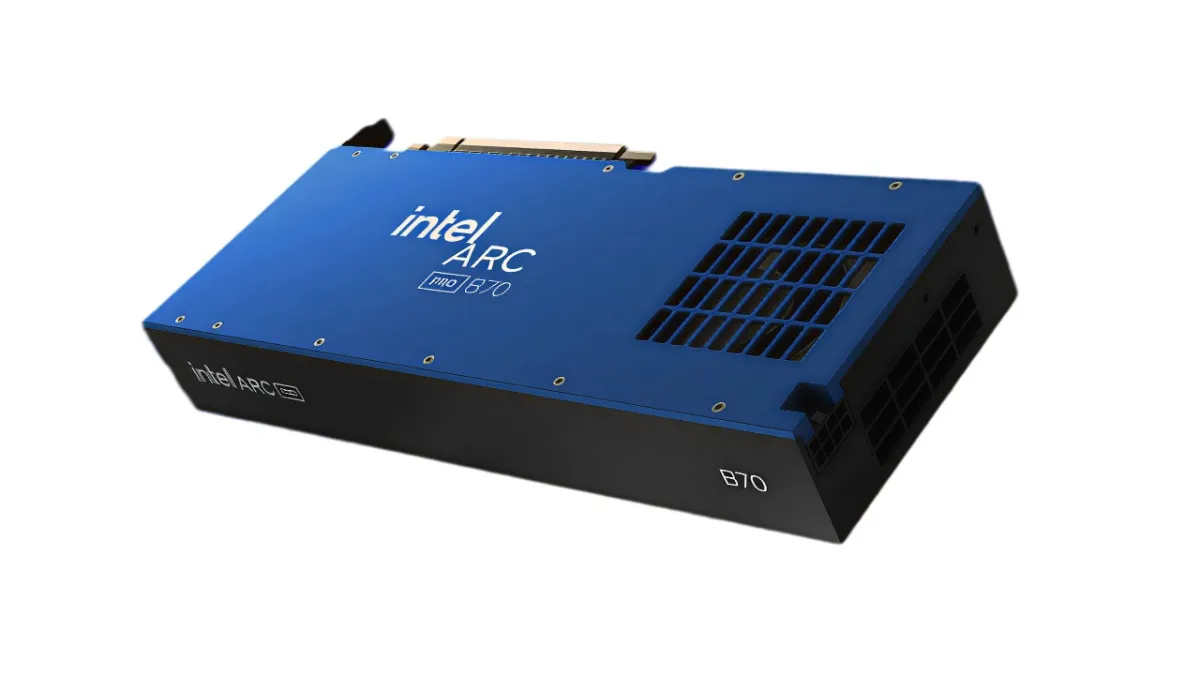
At $949 for 32GB of VRAM, the Arc Pro B70 lands in a unique spot in the market . It's not the fastest card on the market — a single RTX 5090 still delivers 4–5x higher per-GPU inference throughput on small models . But the B70 was never about raw speed on a single GPU. It's about capacity at a price that doesn't require a data center budget.
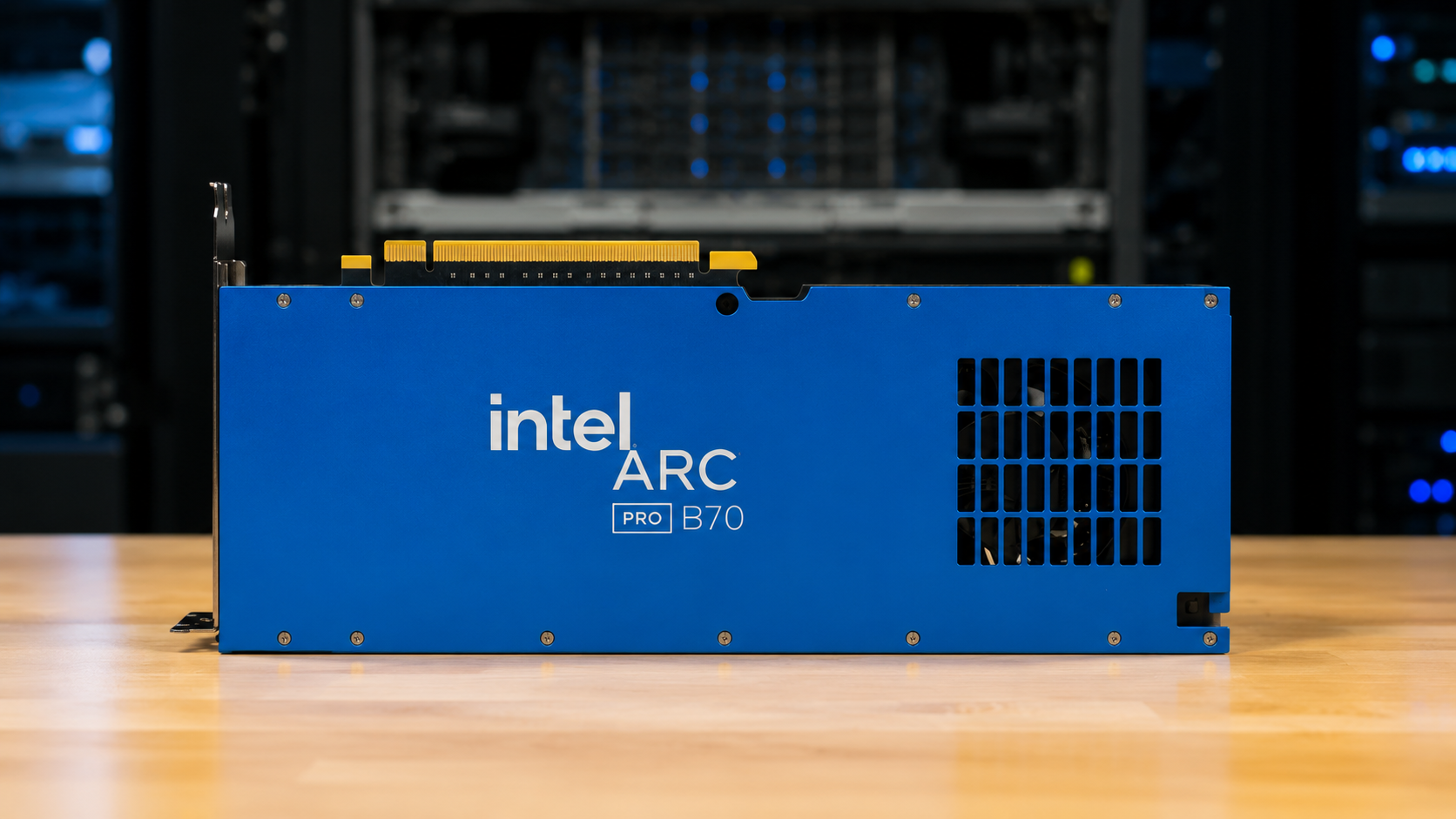
The Hardware Numbers
Spec | Arc Pro B70 |
|---|---|
Architecture | Battlemage (Xe2), BMG-G31 die |
Xe2 Cores | 32 |
XMX Engines | 256 |
INT8 AI Compute | 367 TOPS |
VRAM | 32GB GDDR6, 256-bit, 608 GB/s |
PCIe | 5.0 x16 |
TDP | 230W (configurable 160W-290W) |
Price | $949 MSRP |
Gaming performance | +36% raster vs B580, +45% ray tracing |
The gaming benchmarks offer a useful reference point. The B70 beats the Arc B580 by roughly 36% in rasterization and 45% in ray tracing . It outperforms AMD's RX 9060 XT in every tested game, though it trails Nvidia's RTX 5060 Ti in heavy RT workloads .
But the gaming numbers aren't why you buy this card.
AI Inference: The Capacity Play
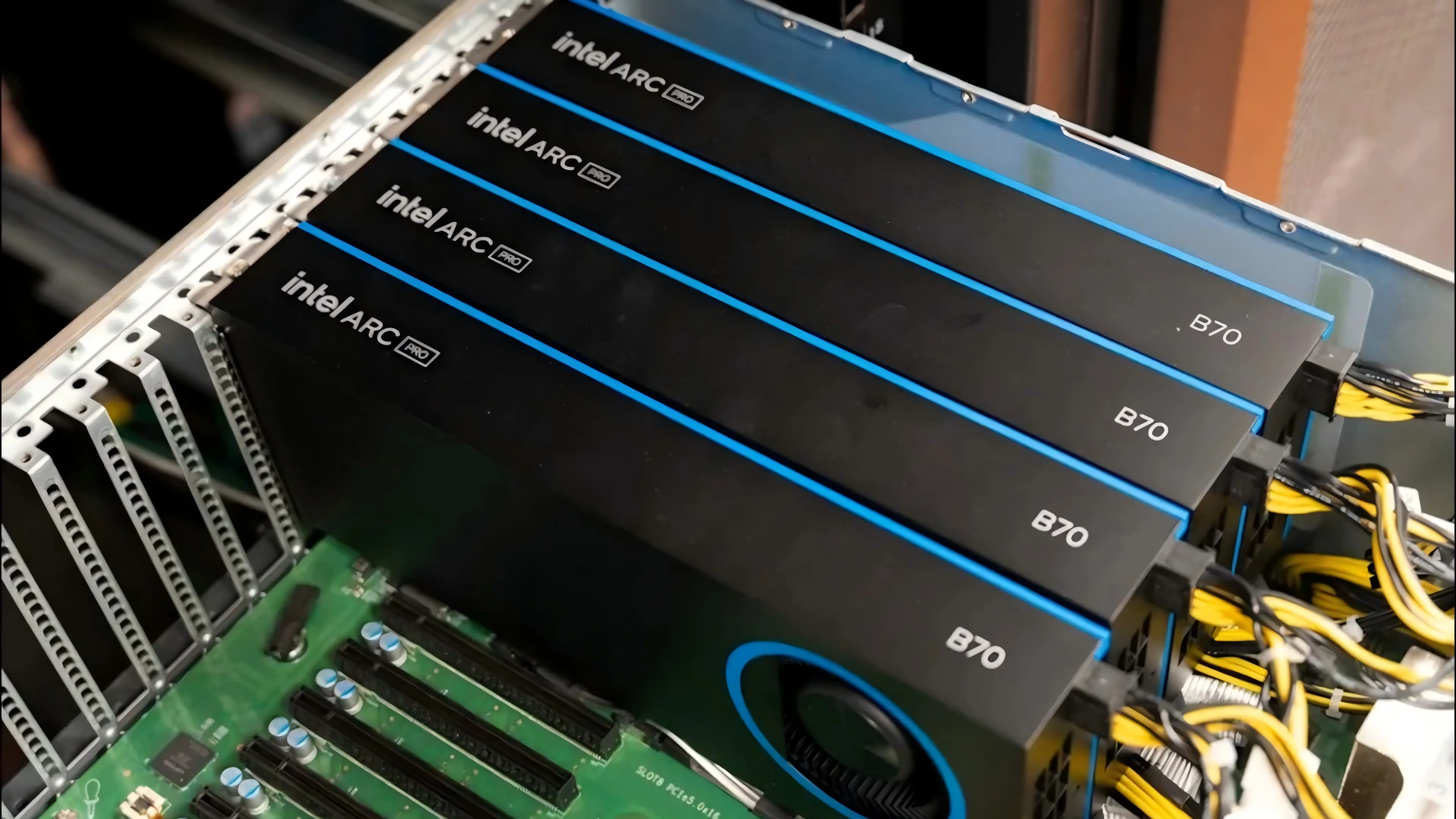
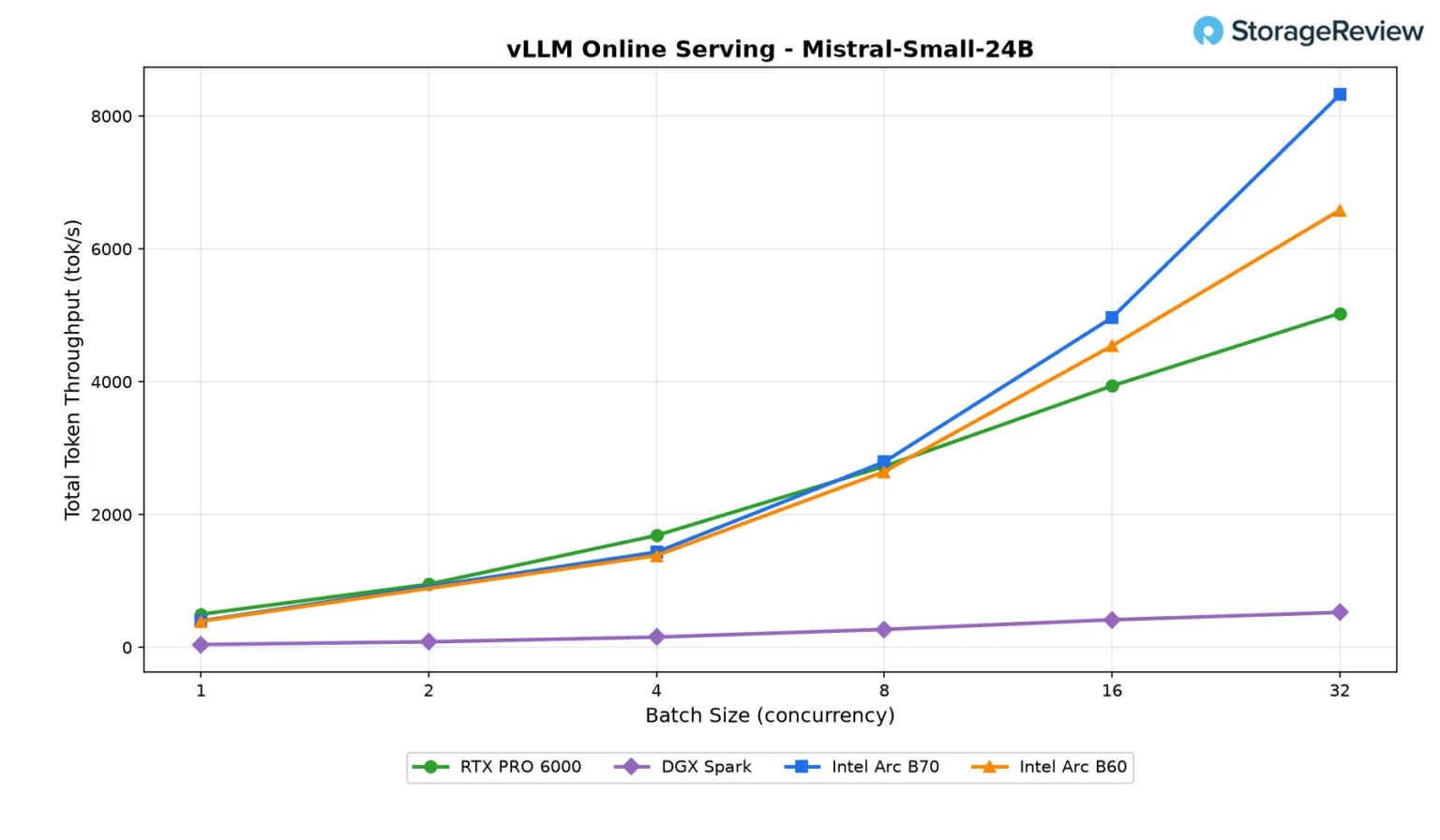
The B70's real value shows up when you move beyond single-GPU benchmarks. In a 4-card configuration, the card can run 27B–35B FP16 models natively — something a single RTX 5090 can't do without 4-bit quantization .
StorageReview's multi-GPU tests tell the story: at batch size 256, four B70s delivered 2,320 tokens per second on DeepSeek R1-Distill Qwen 32B FP16 — outpacing a four-card RTX 5090D setup by 7.5% and RTX 4090D by 48.7% .
The 35B MoE model draws noticeably less power (420W avg) than the 27B dense model (532W avg), reflecting the efficiency of sparse activation — fewer parameters are active per token .
The Software: Where It Gets Complicated
Open-source developer toolkits are proliferating around the B70. A community repository on GitHub provides pre-built containers for llama.cpp and vLLM with four backend options: SYCL (fastest performance), Vulkan (best compatibility), OpenVINO, and Intel's vLLM Scaler for high-throughput serving .
Inference performance can exceed 10,000 tok/s on optimized setups . A community cookbook documents patches that unlocked speculative decoding on the XPU backend — fixing an issue previously thought to be a hard kernel limitation .
But the ecosystem still has rough edges. The OpenVINO backend frequently crashes on MoE models with CL_OUT_OF_RESOURCES errors . The recommended configuration on the GitHub toolkit explicitly excludes OpenVINO from standard benchmarking .
The Cost Argument
Power monitoring data from Puget Systems shows running Qwen3 8B on the B70 costs approximately $0.85 per million output tokens at US average electricity rates. Compare that to cloud pricing: Gemini 3.1 Pro at $12/1M tokens, Claude Opus 4.8 at $25/1M, and GPT-5.5 at $30/1M . The B70 delivers inference at roughly 14-35x lower cost per token than API providers .
For the 35B MoE model, the card draws just 420W average across four GPUs, with total system power around 720W. At $0.18/kWh, the total cost per million output tokens runs about $2-3 — still far below any cloud pricing .
The Verdict
The Arc Pro B70 hardware is ready. The performance numbers are real. The community software support is impressive for a card that launched just months ago.
But Intel's Xe and XPU software stack still lags behind Nvidia's CUDA ecosystem. OpenVINO crashes on MoE models. Documentation requires community patches to fully unlock performance. Enterprises evaluating the B70 need to account for the software maturity gap.
For developers willing to spend time on tooling — and for organizations running high-volume inference on stable model architectures — the B70 offers unmatched capacity per dollar. Four cards can run 120B MoE models for less than the cost of a single high-end workstation GPU.
The hardware is here. The software is catching up. The question is whether Intel can close the gap before the next generation of Nvidia Blackwell cards reshapes the market again.
P.S. The B70 is essentially the "Big Battlemage" consumer card that never arrived. The full-size G31 die was originally intended for an Arc B770 gaming GPU, but soaring VRAM prices kept it confined to the professional segment . The irony: the card that gamers never got might end up being the AI inference workhorse the industry needs.
Frequently Asked Questions
Q: How much VRAM does the Intel Arc Pro B70 have, and what models can it run?
A: 32GB of GDDR6 VRAM on a 256-bit bus with 608 GB/s bandwidth. That's enough to run Qwen3.6-27B at decent quantization levels, or heavily quantized 70B parameter models entirely in GPU memory. It's the same VRAM capacity as an RTX 5090 at less than half the price.
Q: How does B70's inference cost compare to cloud API providers?
A: Puget Systems measured local inference cost at roughly $0.85 per million output tokens on Qwen3 8B at US average electricity rates. Compare to cloud API pricing from June 2026: Gemini 3.1 Pro at $12/1M, Claude Opus 4.8 at $25/1M, and GPT-5.5 at $30/1M. The B70 delivers inference at 14–35x lower cost per token than API providers, depending on model size.
Q: Does the software actually work on Intel Arc GPUs?
A: Yes — but setup is the challenge. Intel's XPU backend has been upstreamed into PyTorch, vLLM supports Intel XPU, and tools like LM Studio can run Arc GPUs via Vulkan. However, getting vLLM running requires specific Python versions, specific Ubuntu versions, careful library path management, and often a wrapper script for multi-GPU setups. As testers put it: "Installing for Intel XPU backend is really hard. I just don't think we are there yet."
Q: What is the multi-GPU scaling like on B70?
A: Multi-GPU scaling works, but it's not linear because cards communicate over PCIe with no direct interconnect. At batch size 256, four B70s delivered 2,320 tokens per second on DeepSeek R1-Distill Qwen 32B FP16. However, many benchmark suites — including Blender — did not properly scale across multiple GPUs. Windows applications generally lack multi-GPU support, while LMStudio on Ubuntu can use multiple cards.
Q: How much power does a B70 system draw?
A: Single card draws about 180.7W under inference load. Four-card setups draw 367.7W for two cards and 720.6W for all four. The 35B MoE model (420W avg across four GPUs) draws less power than the 27B dense model (532W avg), reflecting the efficiency of sparse activation. Total wall power for a four-card system with host hardware runs about 720–832W.
Q: Is the B70 a gaming card or a professional AI card?
A: Professional workstation card. The BMG-G31 die was originally intended for an Arc B770 gaming GPU, but soaring VRAM prices kept it confined to the professional segment. Features include ECC memory support, ISV driver certifications, and SR-IOV virtualization — all workstation-class capabilities not found on consumer gaming GPUs.
Q: How does B70 performance compare to Nvidia RTX Pro 4000?
A: The B70 offers 33% more VRAM (32GB vs 24GB) at roughly half the price ($949 vs $1,800–$2,000). Memory bandwidth is also 33% higher (608 GB/s vs ~450 GB/s). However, per-GPU inference throughput on small models is still 4–5x higher on a single RTX 5090 — B70's advantage is capacity per dollar, not raw speed.
Q: Are there known stability issues on Windows?
A: Yes. Users have reported BSOD (0xD1) crashes in the igdkmdnd64.sys kernel driver during sustained PyTorch/Level Zero compute workloads. The crash occurs during high GPU utilization and has been reproduced on the latest driver versions. Mitigations like cache suppression environment variables reduce the risk but don't fully prevent the crash.
Q: What about Linux support?
A: The fully open-source Linux graphics driver stack works "rather well" according to Phoronix testing. Testing was conducted on Ubuntu 26.04 daily with Linux 7.0 and Mesa 26.0, plus the latest Intel Compute Runtime. However, power consumption reporting via sysfs was not exposed on the Linux 7.0 kernel at the time of testing.