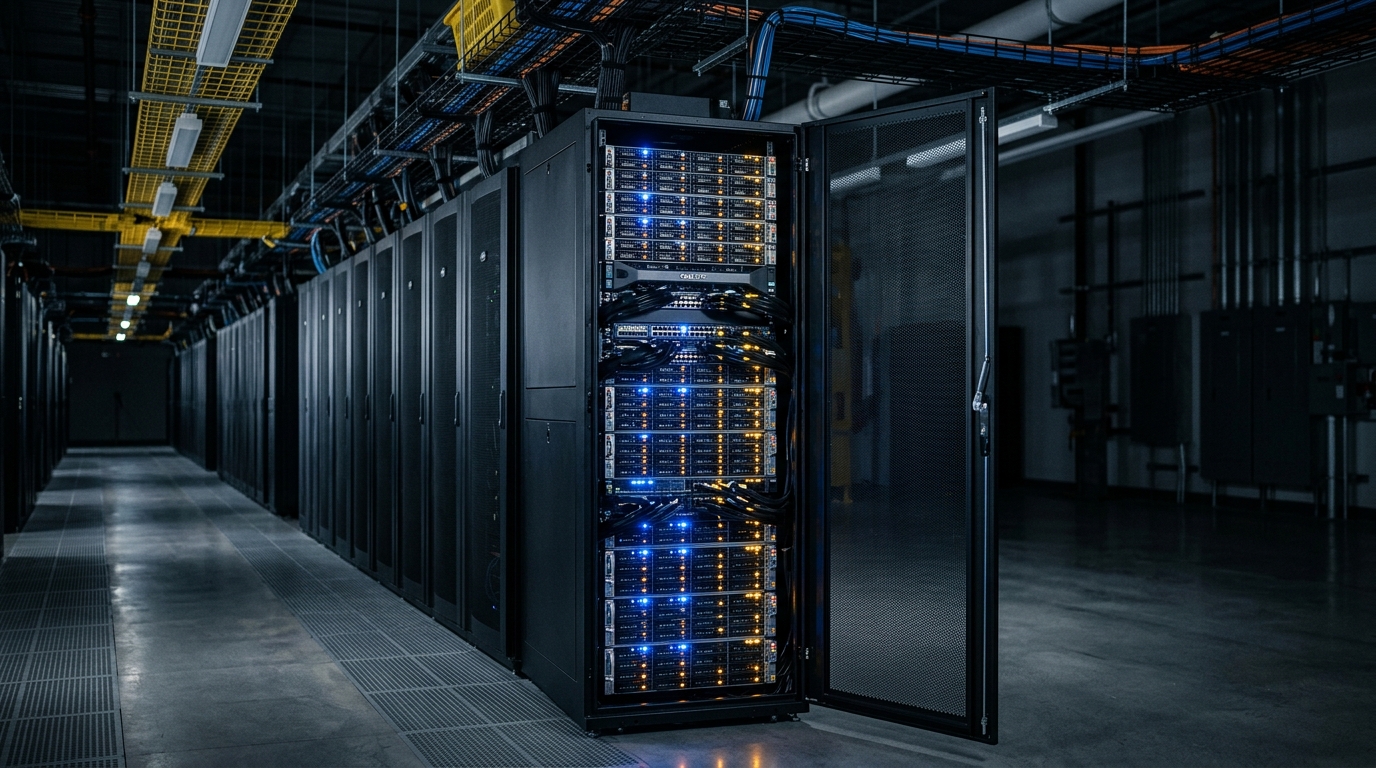

On October 13, 2026, Partha Ranganathan, Google VP and Engineering Fellow, took the stage at the OCP Global Summit in San Jose with a thesis: the era of humans building data centers for AI is ending. The next phase, he said, is AI building data centers for itself. He called it "intelligent infrastructure for the intelligence era."
The proof point Ranganathan offered was AlphaChip, Google's reinforcement learning system for chip floorplanning. It has designed layouts for every generation of Google's TPU since 2020, he noted, and MediaTek has adopted it. But AlphaChip is a chip placer. It decides where transistors go. It does not design data centers, select power architectures, or plan cooling loops. And every other pillar of Ranganathan's vision — LLM-optimized hardware, AI climate models for infrastructure risk, robotic supply chains — remains a plan, not a deployment.
That gap between the vision and the evidence is worth examining closely, because Google's framing has a structural function beyond the keynote.
AlphaChip is real. The rest is a slide.
AlphaChip's track record is genuine. Published in Nature in 2021, open-sourced in 2022, it generates chip layouts in hours instead of weeks and has been used in five generations of TPUs plus Google's Axion Arm-based data center CPUs. MediaTek extended it for its most advanced chips. That's a real contribution to a real problem — chip floorplanning is one of the most labor-intensive stages of semiconductor design.
But AlphaChip solves a bounded optimization problem: given a set of circuit components and constraints, find a good arrangement. It is a search algorithm with a graph neural network. It has no concept of a data center's power delivery, its cooling topology, its network fabric, or its grid interaction. When Ranganathan says "AI will design data centers," he is extrapolating from a placement engine to an infrastructure architect. Those are not the same thing.
The rest of the vision — LLMs improving computer architecture, AI climate models predicting infrastructure cost and outage risk, robotics automating the supply chain — has no public deployment timeline, no measured outcomes, and no named partners. Ranganathan's I·U·S framework (Impressive → Useful → Sustainable) is a stage model, not a roadmap. He did not say which stage Google is in, when it will reach the next one, or how progress will be measured.
Compare that to Microsoft's Maia 300 disclosure the same week: a specific deployment year (2027), a specific performance target (40% higher tokens per megawatt than leading GPU systems), a specific workload focus (long-context inference and multi-step agents). Google's AI-for-infrastructure vision has none of that specificity. It has a metaphor.

Why AI-designed infrastructure needs a defined target
Ranganathan compared AI-designed data centers to the evolution of the automobile: early cars looked like horseless carriages, then developed their own form. "Systems for AI" will follow the same arc, he said, from human-designed data centers to "AI-native" ones.
The analogy has an obvious flaw. Cars evolved because human drivers wanted them to go faster, safer, and cheaper. The optimization target was defined by human needs. If AI designs a data center, who defines the target? Ranganathan didn't say. Is the goal to minimize capital expenditure? Maximize tokens per watt? Reduce grid disruption risk? Improve reliability?
Without a defined objective function, "AI-designed" is not a quality claim. It's a process claim. An AI that optimizes for token throughput might design a data center that creates worse synchronized power spikes — exactly the problem Google's own Mt. Diablo project was built to address. The Ford analogy assumes evolution moves toward "better." It doesn't say better for whom.
Open standards are becoming the training data
Ranganathan emphasized Google's commitment to open ecosystems and industry collaboration. At OCP, that commitment is concrete: Google contributed the +/-400Vdc power architecture and Project Deschutes liquid cooling designs to the Open Compute Project. The "fungible data center" concept — modular, interoperable, standardized interfaces across power, cooling, compute, and networking — is a genuine industry effort.
But the AI-for-infrastructure vision quietly reframes OCP's role. If AI is going to design data centers, it needs to understand the standards those data centers will be built on. Ranganathan has previously noted that OCP's documentation exceeds 10,000 pages and takes 370 hours to read — and proposed using AI to read the entire corpus, find conflicts, and track decisions across versions. That's a sensible use of LLMs. It's also a structural shift: the industry's open standards become training data for Google's proprietary AI systems.
The loop looks like this. The industry writes OCP specs. Google's AI reads those specs and designs data centers compliant with them. Google builds those data centers using its vertically integrated stack. The open standard is the input. The closed AI is the designer. The data center is the output. "Open" becomes the entry point for a closed-loop advantage that only Google, with its full-stack control and AI capabilities, can execute.
What "AI-native" would actually require
If Google is serious about AI designing data centers, the engineering problems are not hard to identify. Data centers are not chip layouts. They are systems of systems: power delivery with millisecond-level grid interactions, cooling loops with thermal inertia, network fabrics with synchronized burst patterns, and physical supply chains measured in years.
Ranganathan's own research frames the opportunity as "Centaurs and Cyborgs" — symbiotic partnerships between human ingenuity and AI, not full automation. The ACM abstract for his ASPLOS talk describes "co-design and collaboration across the hardware-software stack, across disciplines, and across communities" as the key. That language is careful. It describes AI as a tool in a human-directed process, not an autonomous designer.
The keynote language was less careful. "AI will design data centers" is a stronger claim than "AI will assist human designers." The gap between those two claims is the gap between a research agenda and a deployment reality.
P.S. AlphaChip's team has seen departures: both lead researchers left in September 2025 to found Ricursive Intelligence, which raised $300 million at a $4 billion valuation. The AI that was supposed to design Google's future chips now has a competitor staffed by the people who built it.
Frequently Asked Questions
Q: What did Google announce at OCP Global Summit 2026?
A: Partha Ranganathan, a Google VP and Engineering Fellow, presented a vision for "intelligent infrastructure" where AI helps design data centers, optimize hardware, predict infrastructure risks, and automate supply chains. He framed it as a shift from "systems for AI" to "AI-native" infrastructure.
Q: What is AlphaChip?
A: AlphaChip is Google's reinforcement learning system for chip floorplanning, published in Nature in 2021 and open-sourced in 2022. It generates chip layouts and has been used in multiple generations of Google's TPUs. It is a placement optimization tool, not a data center design system.
Q: Why does the article call the vision a "slide" rather than a deployment?
A: Because only AlphaChip has a public track record. The other elements — LLM-driven hardware architecture, AI climate models for infrastructure risk, robotic supply chains — have no deployment timeline, no measured outcomes, and no named partners. Microsoft's Maia 300, by contrast, has a specific 2027 deployment year and a 40% efficiency target.
Q: What is the "closed-loop" concern about OCP standards?
A: If AI systems read OCP's 10,000-plus pages of open standards and use them to design data centers, the standards become training data for proprietary AI. The concern is that open standards become the input for a closed-loop advantage that only a vertically integrated company like Google can execute.
Q: Who defines the optimization target for AI-designed data centers?
A: That is the unanswered question. Ranganathan's keynote did not specify whether the goal is lower capital expenditure, higher tokens per watt, reduced grid disruption, or improved reliability. Without a defined objective, "AI-designed" is a process claim, not a quality claim.
Q: What happened to the AlphaChip team?
A: Both lead researchers left Google in September 2025 to found Ricursive Intelligence, which raised $300 million at a $4 billion valuation. The team that built Google's chip design AI now runs a competing startup.