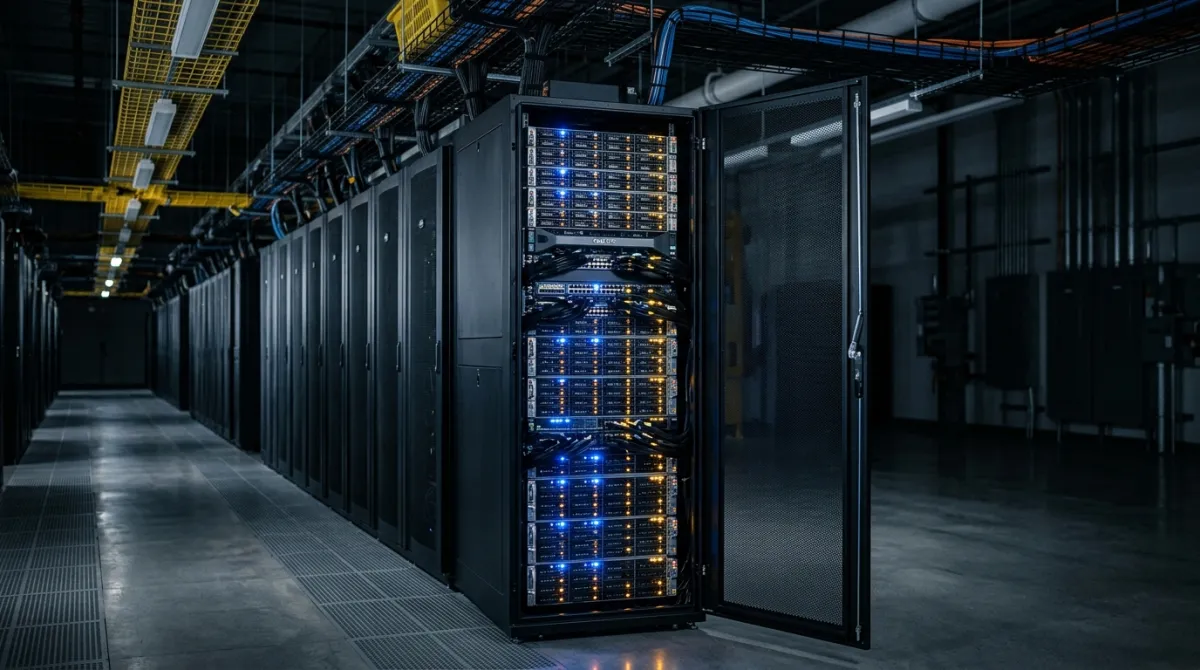
On October 12, 2026, AMD introduced Helion at the OCP Global Summit in San Jose — a rack-scale reference design for agentic AI, capable of housing up to 32,768 Zen 6 cores in a CPU-only configuration. Lisa Su framed it with explosive numbers: agent-generated traffic up 14x this year, monthly token processing up 95x in two years to 4 quadrillion. The pitch is simple. Agents don't just need GPUs for inference. They need CPUs for execution, and AMD is betting the agent era makes server CPUs matter again.
The problem is that AMD's own materials don't name a single customer deploying it.
Inside the rack that scales down to 16 GPUs
Helion is not Helios. Helios is AMD's 72-GPU rack for frontier training and large-scale inference, and it has real customers: OpenAI, Meta, Microsoft, and Oracle have installed Helios systems, with Vultr placing a $1.2 billion order through HPE. Helion is something different. It's a CPU-first rack for running the agents themselves — the code execution, tool calls, API orchestration, and sandboxing that happen between model inferences.
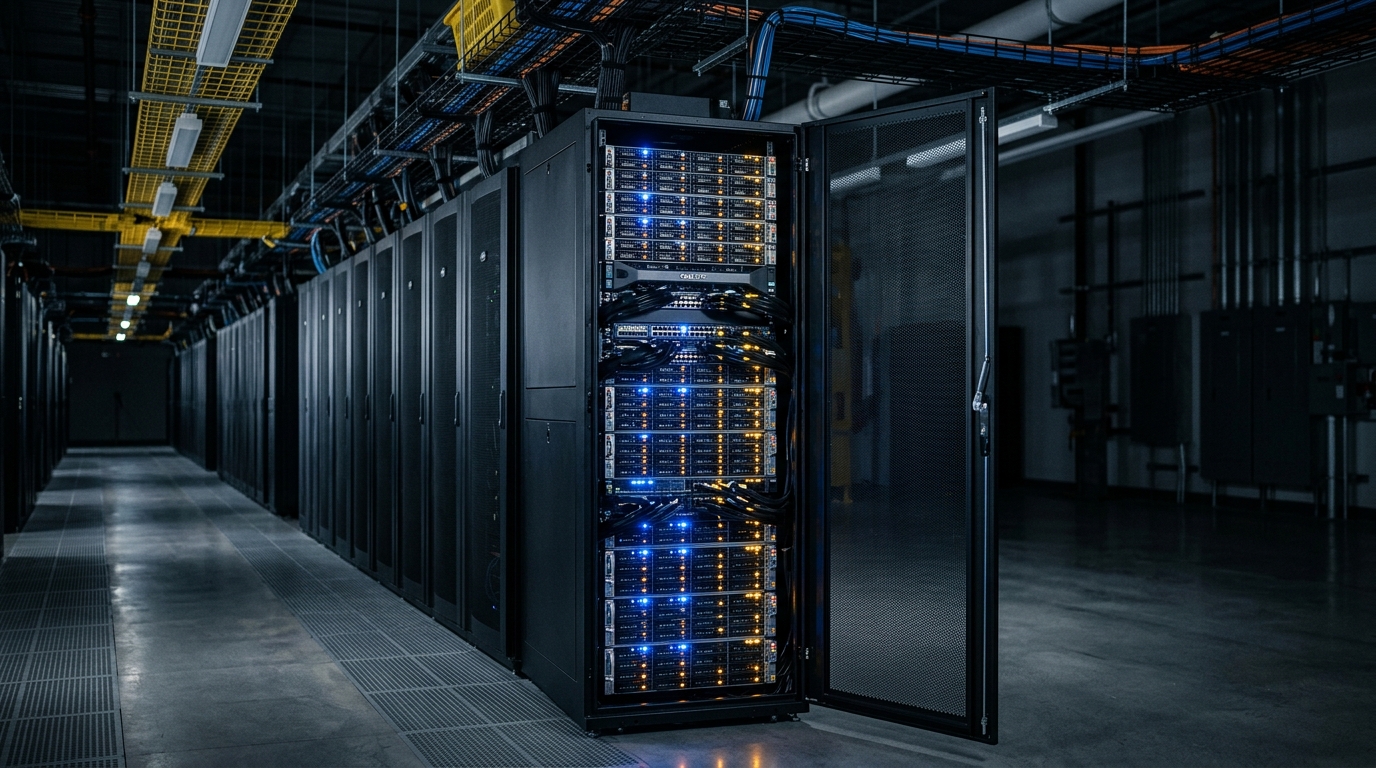
In its hyperscale configuration, Helion is a pure CPU rack. It holds up to 128 sockets of AMD's 256-core EPYC "Venice" processors, with no GPUs at all. Model inference is explicitly offloaded to "separate inference infrastructure" — in AMD's own diagram, a Helios GPU rack sitting beside it. The enterprise configuration adds CPU and GPU in one rack, but the GPU ceiling is deliberately low: 16 MI350P accelerators in two 8-GPU servers that run independently, with no scale-up fabric between them. This is not a training system. It isn't even a high-density inference system. It's a rack optimized for executing the parts of agent workflows that don't generate tokens.
AMD's product page makes the claim explicit: "Not all agents are the same." Personal agents prioritize agents per watt, enterprise agents prioritize number of high-performing agents, and technical agents prioritize performance per agent. The hyperscale rack's three CPU node types map directly to those bins — 256-core at 400W for personal, 256-core at 600W for enterprise, 96-core high-frequency for technical. It's a sensible taxonomy. The question is whether the market agrees with it.
What "14x growth" actually measures
Su's headline figures are striking. But they describe traffic growth, not Helion demand. AMD's own announcements tell a different story about where the money is going: Helios, not Helion. Vultr's $1.2 billion order is for Helios racks. Microsoft's Azure commitment is Helios. Anthropic's up-to-2-gigawatt commitment — with AMD investing up to $5 billion in the lab — is for MI450-series GPUs in Helios racks. There is no comparable customer announcement for Helion.
The partner list is real: Cisco, Dell, HPE, Lenovo, Supermicro, Foxconn, QCT, and Wiwynn are all listed as supporting the design. But "supporting the design" is not the same as deploying it. Cisco's statement is about flexibility. Dell's is about a "validated path" to deployment. HPE's is about "opening the next era." None of them say a customer has ordered one.
AMD has also not published pricing, per-rack power figures, or node counts for the hyperscale version. The product is scheduled for November 2026 availability, but the more interesting date is Verano. AMD's low-power Zen 6 host processor, built on LPDDR5X memory and a new SB1 socket, is listed as an option for Helion's GPU host nodes — and it isn't scheduled until the second half of 2027. Su said during the keynote that Verano would reach volume production in the first half of next year, but multiple sources point to H2 2027. If the enterprise configuration needs Verano to hit its intended efficiency, the complete Helion rack may not exist until well after "November 2026."
Why separating inference from execution gets expensive
The CPU-only hyperscale rack makes a specific bet: that separating agent execution from model inference across racks — or data centers — won't hurt performance. AMD's justification is that hyperscalers "already operate separate accelerated infrastructure." If the GPU racks are already elsewhere, the argument goes, adding CPU racks nearby just matches the existing topology.
But agentic workflows are not batch jobs. They run in loops — plan, call a tool, observe, plan again — and each iteration requires a round trip between the executing CPU and the inferencing GPU. Akamai's analysis of agentic inference puts it precisely: "even adding 100 milliseconds of latency, if you're looping 100 times, that's 10 seconds of latency that you've added." For a chatbot, 10 seconds is tolerable. For an agent managing a supply chain or coordinating physical systems, it's a failure. Akamai's data also shows that up to 90% of agent task execution time goes not to the GPU, but to tool calling, external APIs, and data retrieval. The CPU rack needs to be close to the tools, not just close to the inference.
AMD has not disclosed the network topology between the CPU-only Helion rack and the "separate inference infrastructure" it depends on. The 102 Tbps of programmable networking is impressive in aggregate, but the relevant metric for agents is round-trip latency on the inference-execution loop, not raw bandwidth. If AMD expects enterprises to deploy Helion CPU racks in one rack and Helios GPU racks in another, the network between them becomes part of the critical path. AMD hasn't published latency figures for that path.
There's also the token router. AMD says the enterprise configuration includes an integrated token router that directs agent model calls to frontier models in the cloud or open-source models in the same rack. It's a pragmatic design — it lets enterprises mix expensive frontier calls with cheap local inference. But it adds another decision layer to every agent action, and AMD has not published its latency characteristics. The router exists to route, but routing takes time.
Nvidia isn't the real competition
AMD's framing positions Helion against Nvidia's proprietary rack-scale ecosystem. Su's line — "There is no one company that has every answer to every solution" — is a direct shot at Nvidia's closed approach. The open OCP blueprint, the UALink-over-Ethernet fabric, the contribution of the spec to the Open Compute Project — all of it is designed to attract customers wary of vendor lock-in.
But the real competitive threat may not be Nvidia at all. It may be the absence of a market for CPU-heavy agent infrastructure. Cloud giants are already building agentic architectures — but many are betting on distributing agent execution to the edge, near the tools and data agents need, not centralizing it in a CPU rack. Akamai's analysis argues that "centralization is no longer an optimization; it is an anchor" for agentic workloads, and that inference should move closer to where decisions happen. If that thesis holds, a 32,768-core rack in a hyperscale data center is solving a problem enterprises will route around by deploying smaller CPU nodes closer to the work.
AMD's answer is the enterprise configuration — a single rack that keeps execution and inference together, with the token router choosing when to call out to frontier models. It's a compromise between centralization and distribution. Whether it's the right compromise is an empirical question AMD hasn't answered with data.
P.S. AMD says Helion configurations are "planned to be available" in November 2026, but the only agent infrastructure AMD has actually shipped in volume is Helios — a GPU rack. The CPU rack built for agents is still waiting for its first agent.
Frequently Asked Questions
Q: What is AMD Helion?
A: Helion is a rack-scale reference design AMD announced on October 12, 2026, at the OCP Global Summit. It targets agentic AI workloads, with a CPU-only hyperscale configuration supporting up to 32,768 Zen 6 cores and an enterprise configuration combining CPUs with up to 16 MI350P GPUs.
Q: How is Helion different from Helios?
A: Helios is AMD's 72-GPU rack for frontier training and large-scale inference, with customers including OpenAI, Meta, Microsoft, and Oracle. Helion is a CPU-first rack for running agent execution workloads, not model inference. In its hyperscale form it contains no GPUs at all and relies on separate inference infrastructure.
Q: Does Helion have any customers?
A: AMD has not announced a single customer deployment commitment for Helion. Eight OEM partners — Cisco, Dell, HPE, Lenovo, Supermicro, Foxconn, QCT, and Wiwynn — are listed as supporting the design, but none have confirmed an end-customer order. By contrast, Helios has a $1.2 billion order from Vultr and deployment commitments from Microsoft.
Q: When will Helion be available?
A: AMD says Helion configurations are "planned to be available" in November 2026. However, the Verano low-power Zen 6 host processor, an option for Helion's GPU host nodes, is not scheduled until the second half of 2027, suggesting the full enterprise configuration may not reach its intended form until later.
Q: Why does AMD separate CPU execution from GPU inference?
A: AMD argues that hyperscalers already operate separate accelerated infrastructure, so adding CPU racks near existing GPU racks matches the current topology. The company positions the CPU-only rack as optimized for agent execution tasks like code running, tool calls, and API orchestration, which it says do not generate tokens.
Q: What is the main risk to Helion's adoption?
A: The main risk is that agentic workloads may favor distributed execution near tools and data rather than centralized CPU racks in hyperscale data centers. If enterprises deploy smaller CPU nodes closer to where agents act, the value proposition of a 32,768-core centralized rack weakens. AMD has not published latency data for the inference-execution loop that would address this concern.