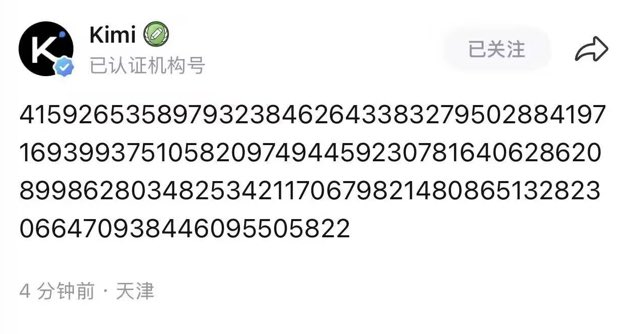
On September 18, Moonshot's official account published a long digit string and deleted it: 415926535897932384626433832795... That is the decimal expansion of π with the leading “3.1” removed. The community read it as a teaser for Kimi K3.1.
The next day, the leaker @chetaslua posted four claims: subscriptions are back, a new round of post-training has started, the focus is computer use and multimodal, and the next model arrives before the end of October.
Three of those four claims are unverifiable. One is already confirmed.
The Only Claim You Can Check
Moonshot paused new consumer subscriptions on July 20, four days after K3 launched, because demand exceeded cluster capacity. It reopened them on September 18 with rebuilt tiers: Go at ¥468/year, Plus at ¥948, Pro at ¥1,908, and Max above that. Code now starts one tier higher than before.
That is the confirmed part. The model card, weights, API id, and price for K3.1 do not exist as of September 20.
The leak's track record is worth noting. On July 26, the first K3.1 leak listed efficiency improvements — faster inference, better token efficiency, steadier agents, open weights — with no date. On August 18, the same leaker said the next Kimi model would arrive within August. August ended with nothing. The October date is the fifth entry in a sequence where the only testable element has failed once.
What K3.1 Actually Needs to Fix
The direction of the leaks has been consistent for two months: efficiency, not capability. That matches what K3's own benchmarks show.
K3 is a 2.8-trillion-parameter sparse MoE model with 1M-token context and native image input. It scores 57 on the Artificial Analysis Intelligence Index, comparable to Opus 4.8 and GPT-5.5. On AA-Briefcase, an agentic knowledge work benchmark, it ranks second only to Claude Fable 5.
The problem is the bill. K3 costs $10.57 per task on AA-Briefcase, driven by an average of 83 turns and 120,000 output tokens per task. That is roughly 10 times the cost of comparable tasks on other models. Its API pricing is $3 input / $15 output per million tokens — 2.8 times Qwen3.7-Max and 16.7 times DeepSeek V4 Pro's output price. Goldman Sachs noted that K3's blended pricing of $2.3 per million tokens set a new high for Chinese models.
K3.1 is not positioned to close the capability gap with Fable 5 or GPT-5.6 Sol. It is positioned to close the cost gap. The leaks consistently describe faster inference, lower latency, better token efficiency on long reasoning, and fewer wasted reasoning steps. Those are the metrics that determine whether an agentic workload is economically viable.
What the Subscription Reopening Says
Moonshot paused subscriptions because K3 demand exceeded capacity. It reopened them two months later, after rebuilding the tiers and adding capacity.
That sequence is the real story of K3.1. A model that is second-best on agentic benchmarks but ten times more expensive per task is a model that strains both the serving infrastructure and the user's budget. The capacity expansion that enabled the subscription reopening is the same capacity expansion K3.1 is designed to exploit. Efficiency improvements reduce the compute needed per query, which lets more users run the same hardware.
The teaser and the leaker are both about timing. The subscription reopening is about capacity. K3.1's job is to make K3's capability affordable to serve at scale.
What to Do With This
If you are planning an integration, the only model with an API id, price, and weights today is K3. K3.1 is a direction with a deadline attached by someone who does not work at Moonshot. The correct amount of planning around it is none.
If you are watching for a signal, the vendor teaser is stronger than the leaker's post. A company that deletes a π string has the model in some form. But the teaser carried no date, and the October deadline came from the leaker, not from Moonshot.
The direction is credible. The date is not.
P.S. Kimi's release cadence through the K2 line was near-monthly — K2, K2.5, K2.6, K2.7 Code — before consolidating into K3. A fast K3.1 refinement would fit that pattern. But K3 launched in July, and the subscription pause lasted two months. The next checkpoint will be whether Moonshot publishes a model card before October ends. If it does, the leaker gets one right. If it doesn't, the pattern holds: direction right, date wrong.
Frequently Asked Questions
Q: What did Moonshot tease?
A: On September 18, Moonshot's official account posted the digits of π with the leading “3.1” removed, then deleted it. The community read it as a teaser for Kimi K3.1.
Q: What's confirmed so far?
A: Kimi consumer subscriptions reopened on September 18 after a two-month pause, with rebuilt tiers. No model card, weights, API id, or price for K3.1 exists as of September 20.
Q: Is the October release date reliable?
A: The leaker @chetaslua predicted an August release that didn't happen. The October date is the fifth entry in a sequence where the only testable element has failed once.
Q: What does K3.1 need to fix?
A: Cost, not capability. K3 scores 57 on the Artificial Analysis Intelligence Index but costs $10.57 per task on AA-Briefcase — roughly 10 times comparable models. Output pricing is $15 per million tokens.
Q: Why does the subscription reopening matter?
A: Moonshot paused subscriptions because K3 demand exceeded cluster capacity. Reopening them two months later indicates capacity expansion — the same capacity K3.1's efficiency gains are designed to exploit.