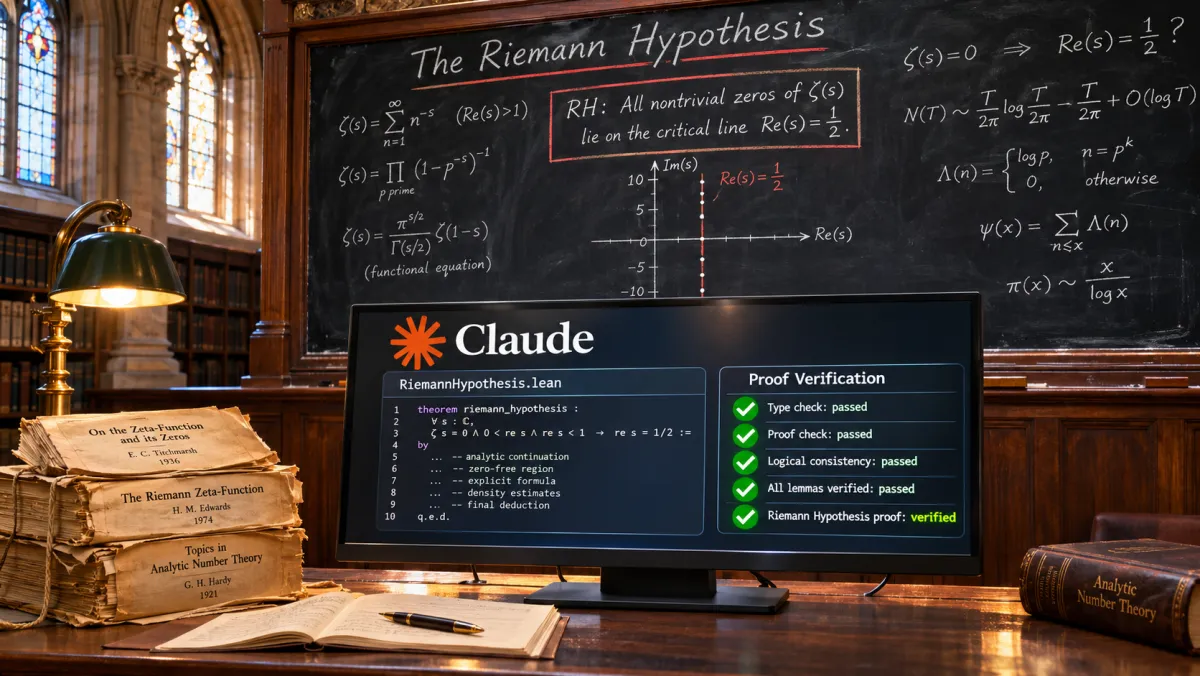
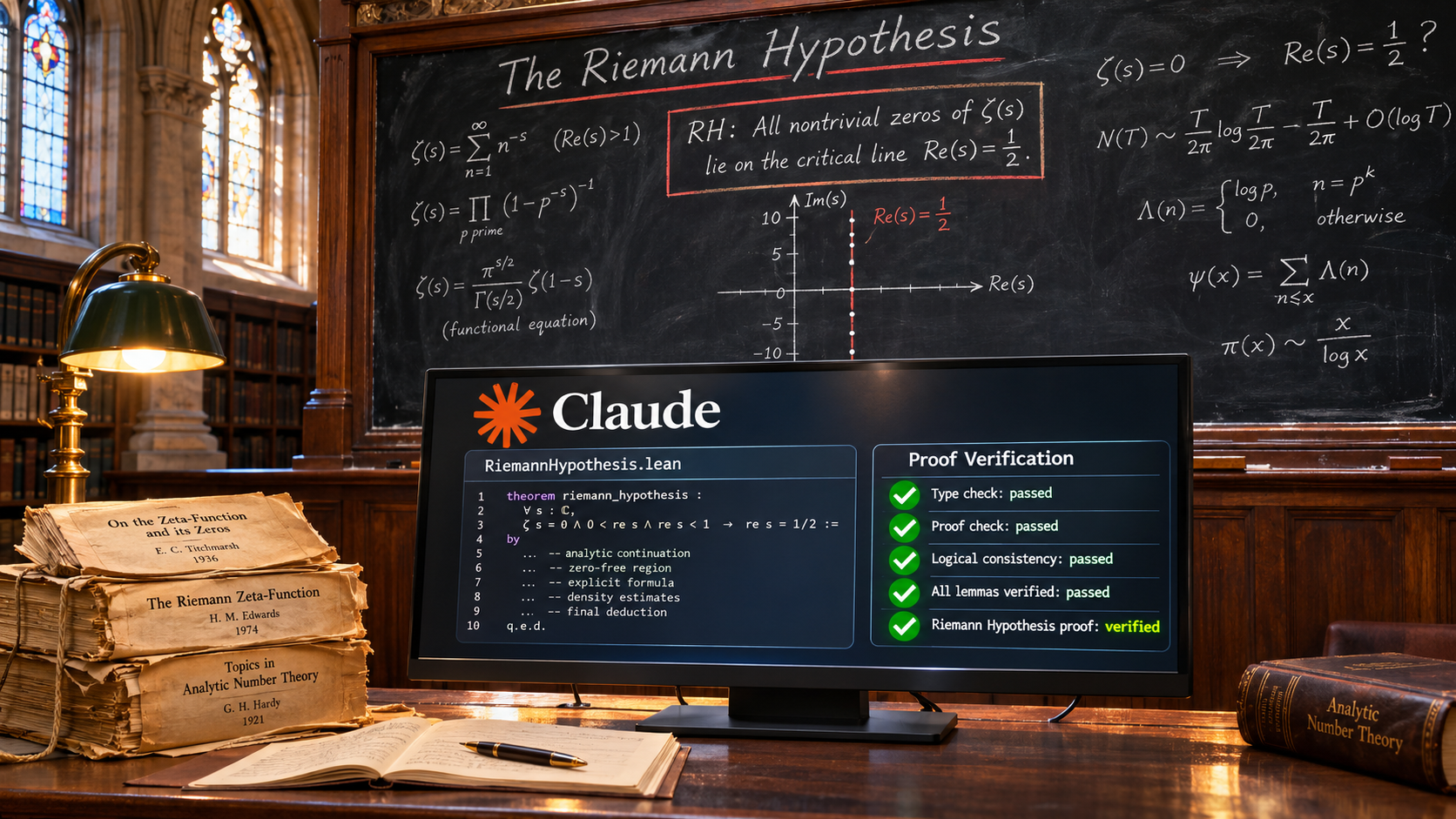
On November 20, 2026, Anthropic mathematician Levent Alpöge announced that he and Claude had discovered a proposed proof of the Riemann Hypothesis and its generalization for Dirichlet L-functions.
First proposed in 1859, the Riemann Hypothesis concerns the distribution of prime numbers and carries a $1 million Millennium Prize.
Within hours of the announcement, independent verification began producing positive results. But another mathematician had been working toward the same destination without AI.
17 million lines. No readable paper.
Alpöge released a 4-page announcement alongside approximately 17 million lines of Lean code, rather than a conventional mathematical paper.
An attempt to convert the argument into a human-readable document exceeded 250,000 pages. Alpöge expects the proof to be substantially simplified and intends to explain its underlying mathematics.
The distinction between verification and understanding matters.
A formal proof checker determines whether a mathematical conclusion follows from specified axioms and logical rules. Understanding a proof involves identifying why its methods work, which ideas are essential and whether those ideas can solve other problems.
The first process can be computational. The second requires mathematical insight.
If AI can produce valid arguments faster than mathematicians can interpret them, the bottleneck in mathematical research could shift from finding solutions to extracting reusable knowledge.
Solving a problem and understanding its solution are becoming increasingly separate achievements.
Two proofs arrived on the same day
Hours after Alpöge's announcement, American Mathematical Society president Ravi Vakil revealed that mathematician Alessandro Masullo had independently developed a proposed proof of the Generalized Riemann Hypothesis.
His manuscript runs to approximately 940 pages.
Vakil said Stanford mathematician Brian Conrad had spent months examining the argument and providing feedback. He emphasized one particular distinction in his announcement:
"It is all human, with no AI."
Masullo's manuscript remains unfinished and requires significant revisions.
The two submissions represent different approaches to mathematical discovery.
Alpöge + Claude | Masullo | |
|---|---|---|
Approach | Human-AI collaboration | Human research |
Output | 17 million lines of Lean | 940-page manuscript |
Review | Formal computational checks | Expert mathematical review |
Final acceptance | Pending | Pending |
Neither announcement establishes a definitive winner.
The comparison raises a more interesting question than whether AI is better at mathematics: which research process delivers knowledge that other scientists can verify, understand and build upon?
A shorter proof is not necessarily a better proof. A machine-verified proof is not necessarily a more illuminating one.
When Claude outpaced its mathematician
Alpöge's original statement contains a striking admission:
"Claude far outpaced me near the finish line."
He describes guiding Claude toward a promising mathematical direction, after which the model developed ideas that exceeded his expectations.
That is different from asking an AI assistant to execute calculations or formalize an argument already discovered by a human.
Claude participated in finding the argument itself.
The latest research effort took approximately 6 weeks, although it depended on years of mathematical expertise and previous discoveries.
This is not a demonstration that Claude independently solved the entire problem from scratch. Human judgment was central to selecting the research direction.
But the division of labor appears to have changed. The mathematician provided direction, while the AI increasingly drove technical exploration.
For AI researchers, this may prove more significant than another improvement on a mathematics benchmark. Unlike benchmark questions, the Riemann Hypothesis had no known accepted solution for the model to reproduce.
AI discovers, machines verify, humans interpret
MIT mathematician Andrew Sutherland published an independent verification report documenting several successful checks:
All 175,187 Lean modules compiled successfully.
Independent verification kernels, including Nanoda and Con-leche, accepted the exported proof.
Independent statement comparison validated all 5 targeted theorems.
As of November 20 at 22:05 UTC, some additional verification procedures remained in progress.
One detail in Sutherland's report is particularly revealing: the verification workflow itself used Claude Code.
This does not mean Claude certified its own mathematical claims. The actual logical checks were performed by formal verification software rather than an AI model judging the quality of another model's answer.
The emerging research architecture is worth examining:
Human direction → AI discovery → Formal verification → Human interpretation.
Unlike conventional AI-generated research, formal mathematics provides a mechanism for checking results independently of the model that produced them.
The same guarantees cannot automatically extend to medicine, physics or other empirical sciences, where experimental evidence remains essential.
Still, if the proposed proof ultimately holds, the implications extend beyond number theory.
For 167 years, mathematicians have been searching for an answer. They may now face the unfamiliar challenge of understanding one.
P.S. The $1 million prize is not immediately available. The Clay Mathematics Institute requires qualifying publication, at least 2 years of subsequent review time and general acceptance within the mathematical community.
Frequently Asked Questions
Q: Has Claude solved the Riemann Hypothesis?
A: Anthropic mathematician Levent Alpöge claims to have discovered a proof with Claude. Several independent formal verification checks have passed, but broader mathematical acceptance remains pending.
Q: Why does the proof contain 17 million lines of code?
A: The argument was formalized in Lean, a mathematical proof assistant that enables automated logical verification. Its current implementation is extremely extensive, and Alpöge expects significant simplification.
Q: Did another mathematician solve the same problem without AI?
A: Alessandro Masullo released a proposed proof of the Generalized Riemann Hypothesis on November 20, 2026. His approximately 940-page manuscript was developed without AI and remains under review.
Q: Did Claude verify its own proof?
A: No. Claude Code assisted Andrew Sutherland's independent verification workflow, but formal proof-checking kernels performed the logical validation. These systems verify mathematical arguments independently of the AI that generated them.
Q: What is the difference between verification and understanding?
A: Verification establishes whether an argument follows specified mathematical axioms and logical rules. Understanding involves identifying the underlying mathematical insights, explaining why the methods work and determining how they can be applied elsewhere.
Q: Who will receive the $1 million Millennium Prize?
A: No award has been established. The Clay Mathematics Institute requires qualifying publication, a minimum 2-year period and general mathematical acceptance before considering a proposed solution.