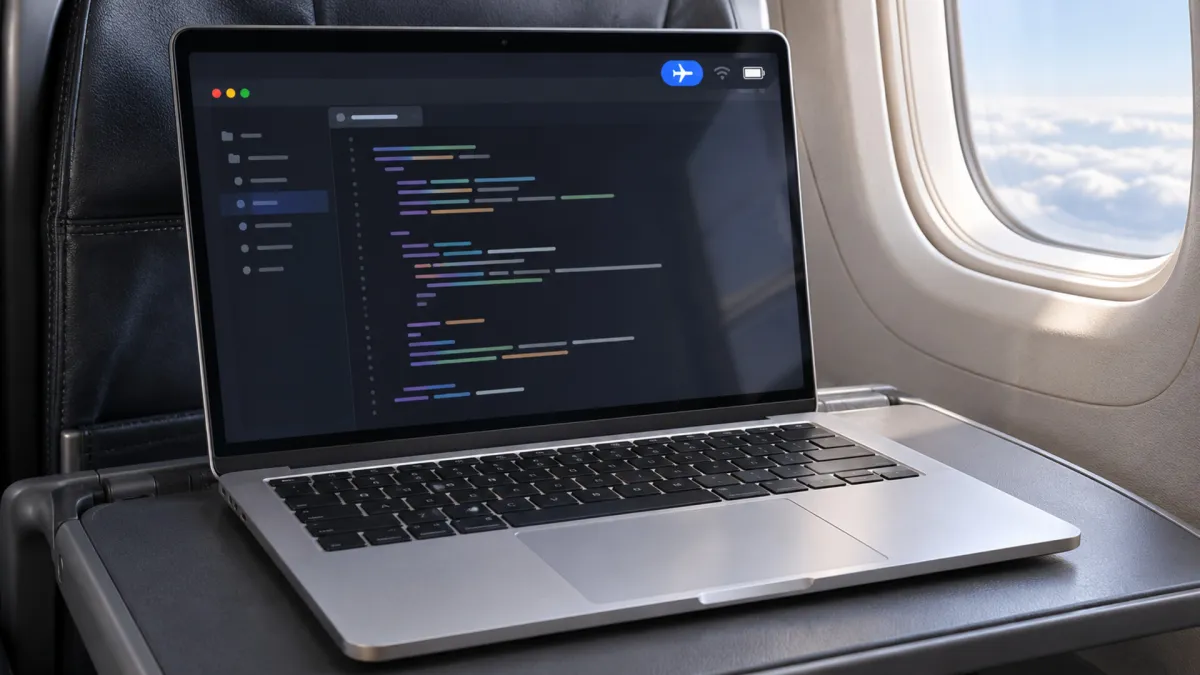
On November 20, 2026, Thinking Machines Lab released Inkling 2 Mini, a multimodal model with downloadable weights under Apache 2.0. Ollama lists its package at 20GB. The model card lists Apple silicon Macs with 32GB of memory or more as supported hardware.
For developers, this puts a coding-oriented model on a machine they may already own. The launch answers whether it can run locally. It leaves open how long it will take to fix a bug on that machine.
A 20GB download is not a memory budget
The 20GB figure describes the model package. A running session also needs memory for the inference runtime and the attention cache that grows with the prompt. On a Mac, the model draws from the same memory pool as the rest of the system.
Thinking Machines demonstrated 20 simulated villagers powered by the same model on an offline M5 Pro MacBook Pro with 48GB of memory. That is a useful proof of offline operation on that setup. It is not a test of 20 concurrent coding agents, and it does not tell us how the same workload would run on 32GB.
Twelve layers do the work three times
Inkling 2 Mini stores 24 layers. The first and last six run once, while the middle 12 run three times, for 48 layer applications per token. This adds computation without storing a separate set of weights for each pass.
Thinking Machines lists 26.4 billion total parameters, 3.4 billion active parameters and 5.4 billion weight activations per token when accounting for repeated passes. Those figures measure different things. Reusing weights keeps the package smaller than storing separate layers; each repeated pass still takes time to run.
Coding scores leave the laptop question open
The lab reports 48.2% on DeepSWE v1.1 and 77.9% on the hard subset of SWE-bench Pro v2. These scores measure success on benchmark tasks, not time to a working patch on the Mac configuration that just meets the support floor. The lab also notes that evaluation setups vary by model.
A test that would settle the practical question: give Mini and your current workflow the same reproducible issue in a repository, with the same acceptance test. Record whether the patch passes, how long it takes and what happens to memory pressure as the session grows. The number that matters is the time to a correct result, including any retries.
P.S. The energy-efficiency result featured in the launch came from a 128GB NVIDIA DGX Spark, not the MacBook. It is not evidence of how long a laptop battery will last.
Frequently Asked Questions
Q: What is Inkling 2 Mini?
A: It is a 26.4B-parameter open-weight model from Thinking Machines Lab that takes text and images and produces text.
Q: What Mac does the release support?
A: The model card lists Apple silicon Macs with at least 32GB of memory.
Q: Does the 20GB package tell me how much memory I need?
A: No. The download does not include the memory used by the runtime, conversation cache or other applications.
Q: What does looping do?
A: The model reuses its middle 12 layers three times per token. It does more computation without storing three copies of those layers.
Q: Did the offline village demo use a 32GB Mac?
A: No. Thinking Machines lists a 48GB M5 Pro MacBook Pro for that demonstration.
Q: Were the coding scores measured on a MacBook?
A: They are published benchmark scores, not MacBook throughput or elapsed-time results.