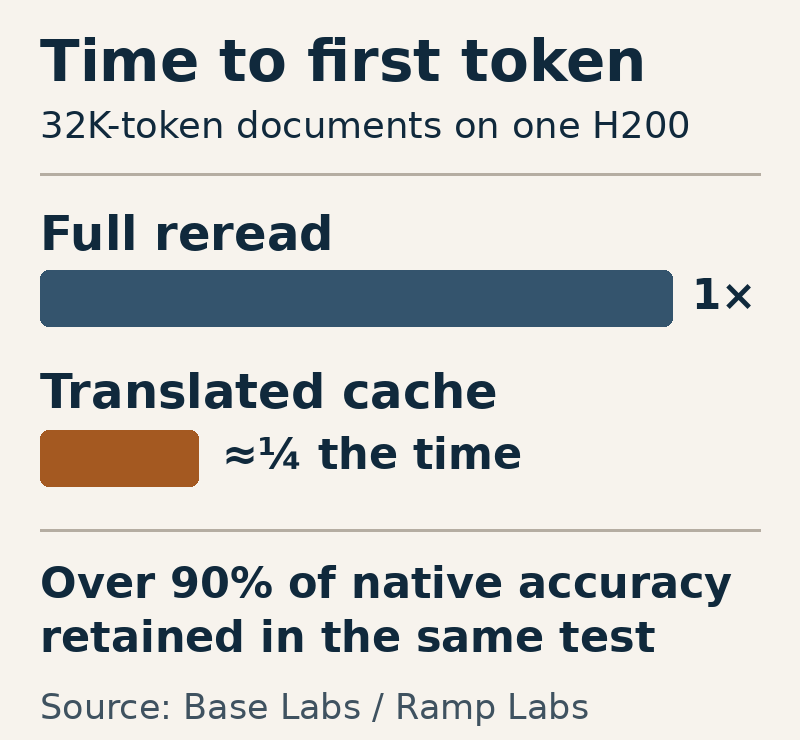
On November 25, 2026, Baseten’s Base Labs and Ramp Labs published a method that lets one AI model use another model’s work after it has read a document. In the authors’ test on 32,000-token documents, the receiving model started answering about four times as fast as it did when it read the raw text itself. It also got some answers wrong that it would have gotten right with its own reading.
The next model usually starts from the text
Imagine a cheap model classifies a long technical report and a stronger one takes over to answer questions about it. The handoff usually sends text. The second model must then process that text before it can produce its first output token, even if the first model already read the same document.
The initial read, called prefill, builds a working representation the model uses when it answers. That representation is not interchangeable across model families. The new method trains one translator to take internal states from the reader and build the receiving model’s working cache. It saves time precisely when a system has done the first read already.
The accuracy numbers are relative, not absolute
The researchers tested seven models from four families in 42 directions. Up to 8,192 tokens, they report that the translated cache kept 96.9 percent of the receiving model’s native accuracy on average across 12 tasks. That is not a 96.9 percent test score. If a model answered 80 of 100 questions correctly on its own, keeping 96.9 percent of that performance would mean about 78 correct answers.
The long-document test used multiple-choice questions and one NVIDIA H200 with vLLM. It started with the source model’s states already computed, and measured the time until the receiving model began its answer. At 32,000 tokens the faster configuration kept over 90 percent of native accuracy. At 128,000 tokens, the full-depth configuration kept 83 percent. This is an accuracy trade-off, not an exact copy of the second model’s own reading.
Try it where your second model does the most rereading
The serving code and translator checkpoint are public. The released translator covers named models such as Llama 3.1 8B, Gemma 4 12B and Qwen3.5 9B, not arbitrary closed APIs. It also needs access to the source model’s internal states.
The most useful test is a handoff you can measure today. Compare first-token latency and answer quality against a full reread on the same questions. Then include the time to move the representation between machines and see how often you would fall back to the text. A router that often escalates long documents to a second local model has more to gain than a workflow where the second model reads a brief summary.
P.S. The benchmark was run by the authors. SUPERCRZY did not independently reproduce the results.
Frequently Asked Questions (FAQ)
Q: What is speculative encoding?
A: It translates internal states from a model that has read a document into the working cache of a second model.
Q: Is that the same as speculative decoding?
A: No. Speculative decoding accelerates generating output; this work targets the time spent processing the document before the second model starts answering.
Q: Does the four-times figure apply to the full workflow?
A: No. The researchers measured time to first token with 32,000-token documents and the first model’s states already available.
Q: Does 96.9 percent mean the answers were 96.9 percent correct?
A: No. It is the share of the receiving model’s native accuracy retained on the reported short-document tasks.
Q: Can it switch between any two models?
A: No. The released checkpoint covers 42 directions among seven listed models. Other pairs are not established by this release.