On November 24, 2026, the vLLM community published the first tagged release of vLLM-GR, a serving engine for models that generate recommendations. The v0.30.0 release contains source code, not prebuilt wheels. The change is for the teams building video feeds or storefronts: one request can return several candidate items, and the engine can limit its search to items in a real catalog.
The model picks an ID, not a paragraph
A recommendation model such as OneRec-1.7B turns interaction history into short sequences that identify items. One sequence might point to a video. To build a feed, the application needs more than one possible pick. Beam search keeps several plausible partial IDs at each step instead of committing to the first answer.
In the project’s technical write-up, the engine keeps track of that search and returns the completed IDs and scores together. Branches can reuse the cached representation of the viewer’s history instead of duplicating it for every candidate. A catalog constraint can also steer the search away from IDs that resolve to nothing. It does not decide whether the items are good recommendations.
The faster engine depends on the request
At beam width 256 and batch size eight on an NVIDIA H20, the project reported 369.4 ms P99 for vLLM-GR, versus 428.1 ms for NVIDIA SID-GR and 1,280.1 ms for SGLang. Switch to a batch of one on an RTX PRO 6000 at the same beam width, and SID-GR leads: 28.25 ms versus 29.21 ms for vLLM-GR. Both comparisons used 1,024 input tokens.
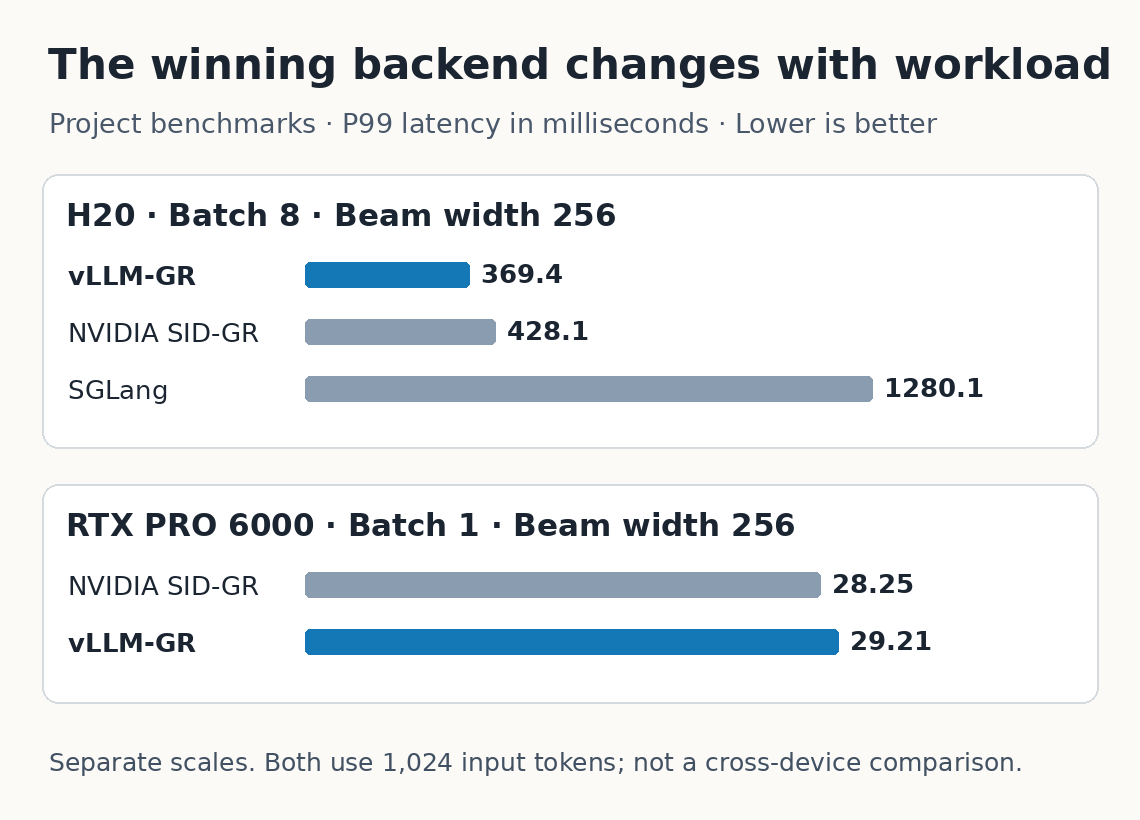
Those are tail-latency snapshots, not a ranking of every setup. The RTX PRO 6000 run used synthetic inputs, generated three tokens and left out HTTP overhead; catalog constraints were disabled. The project says benchmark settings and timing definitions vary across devices. Neither result measures whether people would like the feed more.
The tagged release is a test target
The source repository lists NVIDIA CUDA and Ascend NPU build paths. The release notes report a passing GPU L3 check, but wheel verification did not pass; NPU and L4 validation did not run for that release. Those checks are separate from the benchmark charts, which do include Ascend measurements.
For a serving team, the useful test is a held-out slice of real viewing or shopping history and a current catalog. Compare identical candidate counts and constraints, measure end-to-end P99, and check that the returned items are relevant as well as valid. A faster response is only useful if it gives the next ranking stage something better to work with.
P.S. The cover pairs the project’s wordmark with an editorial illustration of catalog choices. The inline chart redraws two slices of the project’s published measurements; neither is a SUPERCRZY lab test.
Frequently Asked Questions
Q: Is vLLM-GR a new AI model?
A: No. It is a serving engine for generative recommendation models such as OneRec-1.7B.
Q: What does the catalog constraint do?
A: It steers generation toward IDs that map to items in a catalog. It does not guarantee relevance or business outcomes.
Q: Does v0.30.0 come with wheels?
A: No. The tagged GitHub release contains source only and says wheel verification did not pass.
Q: Did vLLM-GR beat every backend?
A: No. NVIDIA SID-GR had lower P99 in the RTX PRO 6000 batch-one comparison highlighted here.
Q: Can I use it on an Ascend NPU?
A: The project documents an Ascend build path, but says NPU validation did not run on this release.