On November 25, 2026, Perplexity released Time Machine for its Search and Context APIs. Developers can give both requests the same timestamp, going back up to 365 days. Search returns results from copies saved by then, and Context reads the earlier copy instead of contacting the live site.
A publication date can’t freeze an article
Suppose an engineering team wants to see how its research agent would have explained a software outage while it was still happening. A page published during the incident might now include the incident review. A date filter can still return that page because its original publication date has not changed. Its current contents would give the agent information it could not have known at the time.
Perplexity’s developer documentation says the search result’s title and snippet come from the earlier copy. The full page needs the cutoff too. Otherwise a test could use an old search snippet, open the present-day article, and get the answer anyway.
A gap in the archive is a result, too
A timestamp is not a promise that every site was captured that day. Search can return fewer results than requested, and Context can return no_content if it cannot supply an eligible copy. A page missing from the archive is not proof it had not been published. A widely cited page may also be better represented than a smaller site that Perplexity crawled less often.
That makes archive coverage part of the evaluation, not a footnote. A team comparing two agents should log missing pages separately from wrong answers, keep the same cutoff for both agents, and audit a sample of what each agent actually retrieved. Otherwise it risks calling one agent more capable when it simply had better evidence.
Count queries with any leak, not only flagged pages
In its own comparison, Perplexity says an automated judge flagged 0.25 percent of pages returned by Time Machine on a random set of 1,000 queries, versus 1.10 percent for Exa Snapshot. On the same set, 18 Time Machine queries and 62 Exa queries returned at least one flagged page. The differences were smaller on the company’s other two query sets.
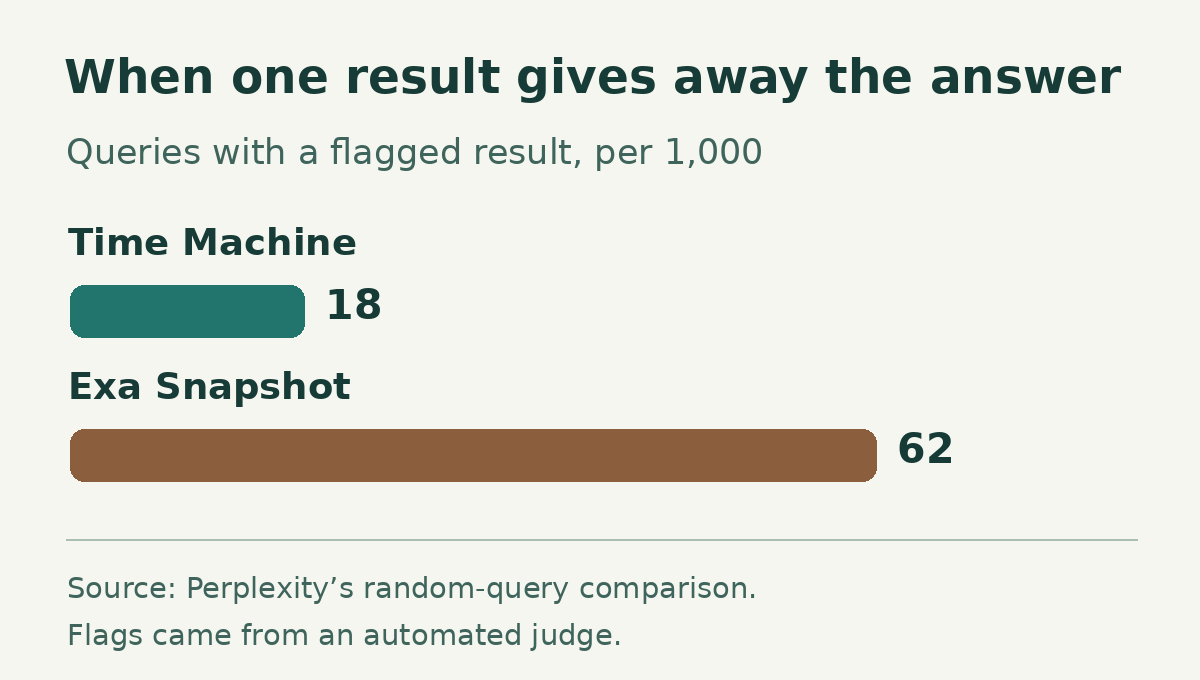
Both counts matter. If a single result supplies the answer, the rest of that query’s results can follow the cutoff and the evaluation can still be spoiled. The product gives developers a useful constraint, but Perplexity’s own test is a reminder not to treat it as proof of zero leakage.
P.S. The comparison is Perplexity’s, not a SUPERCRZY benchmark. An archive cutoff cannot remove information a model already learned in training.
Frequently Asked Questions (FAQ)
Q: Is Time Machine a new consumer search mode?
A: This announcement concerns Perplexity’s developer APIs, not a new mode in the consumer app.
Q: How far back can I set the cutoff?
A: The API accepts a time with a timezone up to 365 days in the past.
Q: Is it the same as filtering articles by date?
A: No. Its purpose is to use the saved content from the cutoff, not merely the publication date on a current page.
Q: What if no suitable copy exists?
A: Search can omit the item and Context can return no_content, rather than substituting the live page.
Q: Does it guarantee a leakage-free test?
A: No. Verify returned sources and consider what the model may already know independently of retrieval.