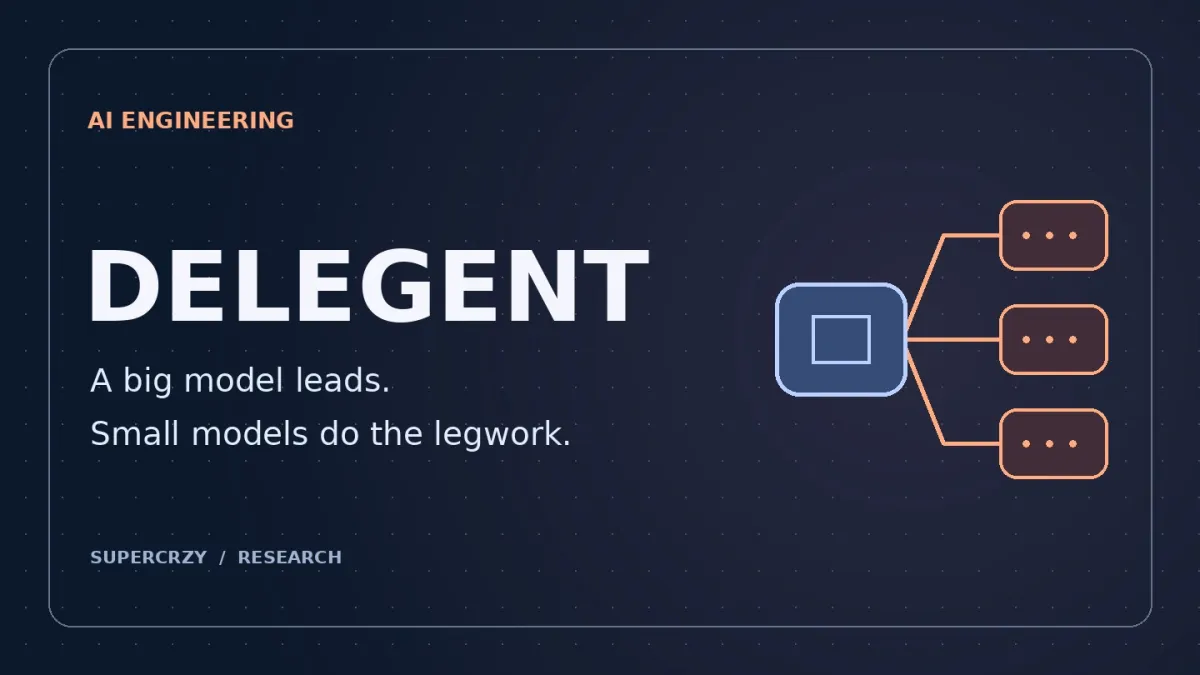
On November 24, 2026, University of Waterloo researchers Lingwei Gu and Jimmy Lin submitted Delegent to arXiv, a preprint and companion implementation that treat the coding model as a lead rather than the worker for every step. On a 50-task DeepSWE sample, GPT-6.1 Sol solved 29 tasks both alone and with Qwen3.8-27B-FP8 subagents. Its metered model cost averaged $2.11 alone and $0.70 with those workers.
The lead model still writes the patch
Delegent is built around Claude Code, but Claude was not the lead model in that main comparison. Sol chose what to delegate, reviewed the reports and wrote the final patch. The smaller model investigated code, ran tests or sifted evidence. The lead received the worker's report rather than every piece of intermediate output. There was no trained router choosing a single model for the whole job.
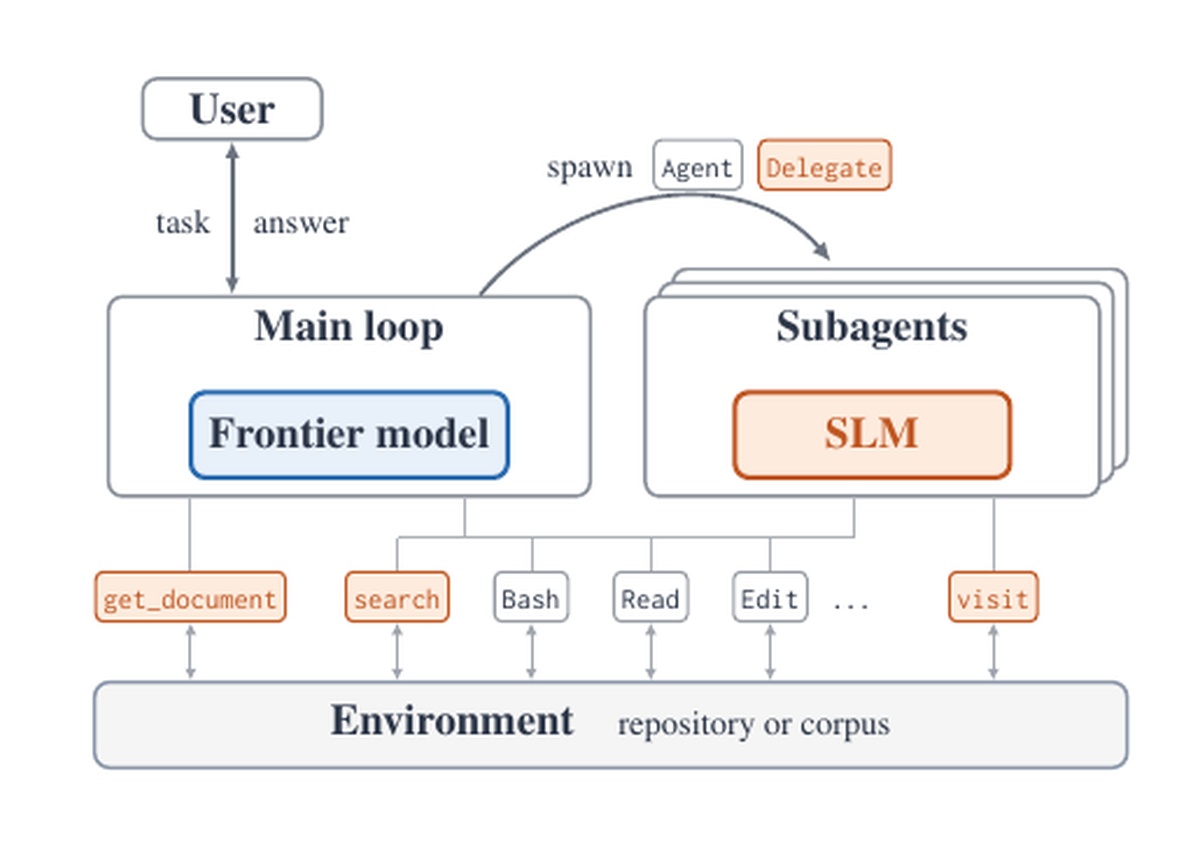
That division is the experiment. A small model need not solve the issue by itself to find the relevant file or report a failing test. The authors also tried MiniCPM5-2B as a worker. It resolved 30 of 50 DeepSWE tasks in the team configuration at about $0.71 in frontier-model charges. One extra solved task in this sample does not establish that it is a better worker.
A smaller bill is not a faster job
With the 27B worker, the median DeepSWE job went from 25 to 38 minutes. On the shorter SWE-bench Verified tasks the median took about twice as long. The authors used shared GPUs, so the delay could change with the hardware and how busy it is. The right comparison for a team is cost per successful task at a latency that meets its needs, not just the API total.
The 67 percent saving is a reduction in the large model's metered bill. It does not make local hardware, power or the time spent waiting free. When the authors priced the 27B model at a third-party API rate, the estimated combined cost was about $0.81 per DeepSWE task. Both baselines had prompt caching. Their research code is public; these are the authors' results, not our replication.
Repeated legwork is the strongest case
On the authors' 694-question search evaluation, both configurations answered 663 correctly, and delegation reduced the frontier charges from 9.1 to 3.7 cents per question. The authors did not calculate full small-model API cost for search. And the largest savings came from tasks where the lead would otherwise read a lot: a reason to start with long background jobs rather than replacing the fast path for every interactive request.
P.S. Lead with a representative batch and track passed tests, latency and combined spend together. Equal solved counts in an experiment do not promise equal quality on your own repository.
Frequently Asked Questions
Q: Is Delegent an Anthropic release?
A: No. It is a research implementation built on Claude Code. GPT-6.1 Sol was the lead model in the main results discussed here.
Q: What did the 67 percent saving include?
A: Frontier-model API charges in the sampled DeepSWE comparison. The separate combined-cost estimate adds a price for the 27B worker.
Q: Did the smaller model write the final patch?
A: The lead model stayed in charge and wrote the final patch. The worker handled scoped tasks such as investigation and tests.
Q: Did delegation speed up the hard coding tasks?
A: No. Median wall-clock time rose from 25 to 38 minutes with the 27B worker in the authors' setup.
Q: Are the results guaranteed on any repository?
A: No. These are sampled research benchmarks. Results will depend on the workload, models and worker hardware.