On November 15, 2026, NVIDIA announced the Vera CPU rack-scale platform. The press release is titled around accelerating scientific discovery, and it opens with climate modeling, molecular dynamics and DKRZ's HLRE-5 supercomputer. Chinese wire coverage compressed it into one line: Vera doubles x86 energy efficiency.
NVIDIA published a different post on November 4, titled around delivering the highest agent throughput and the fastest agents. The numbers there are different: 1.6x more agents per watt than the fastest x86 CPU, and 2x agent speed versus the most efficient x86 CPU.
Two official documents, one chip, two markets.
The 2.4x and the 1.6x come from different tests
The "doubles efficiency" line is a compressed number. NVIDIA's press release states that on OpenFOAM's motorBike Large airflow simulation, Vera delivers 1.9x the performance of x86 and 2.4x the performance per watt. On the weather research and forecast model, performance rises 1.6x and efficiency 2x, and NVIDIA labels that weather figure as projected.
"Doubles" is not 1.9, not 2.4, and not 1.6. It is closest to the weather projection, which NVIDIA itself marks as an estimate rather than a measurement.
The test conditions matter more than the multiplier. These are vendor-run benchmarks on memory-bandwidth-sensitive, highly parallel scientific workloads. The comparison systems' exact models, core counts, memory configurations and power caps were not disclosed. Phoronix independently confirmed Vera's lead on OpenFOAM, but that is an HPC workload, not an agent workload.
Agent sandboxes are the real product
NVIDIA's November 4 post gives a separate set of numbers: in a 100-megawatt data center comparison, a single Vera CPU supports 1.6x more agents per watt than the fastest x86 CPU, and runs agents 2x faster than the most efficient x86 CPU.
These have customer validation. Perplexity runs agentic coding 1.5x faster on Vera and plans production deployment. Daytona started 1,000 agent sandboxes in 10.8 seconds on Vera, against 88.4 seconds on x86. Modal reports 2x sandbox throughput versus x86. DeepInfra reports agent orchestration up to 2.2x faster than the best x86 processor.
Daytona added a more practical figure: to sustain 1,000 tasks per second, Vera needs about 15% fewer machines than EPYC 9755 and 38% fewer than EPYC 9575F.
HPC is the 2028 anchor, agents are the 2026 pilot
DKRZ's HLRE-5 supercomputer did choose Vera, but it is expected in early 2028. It is a 40 million euro system whose main compute comes from GB200 Grace Blackwell, with Vera handling the CPU partition.
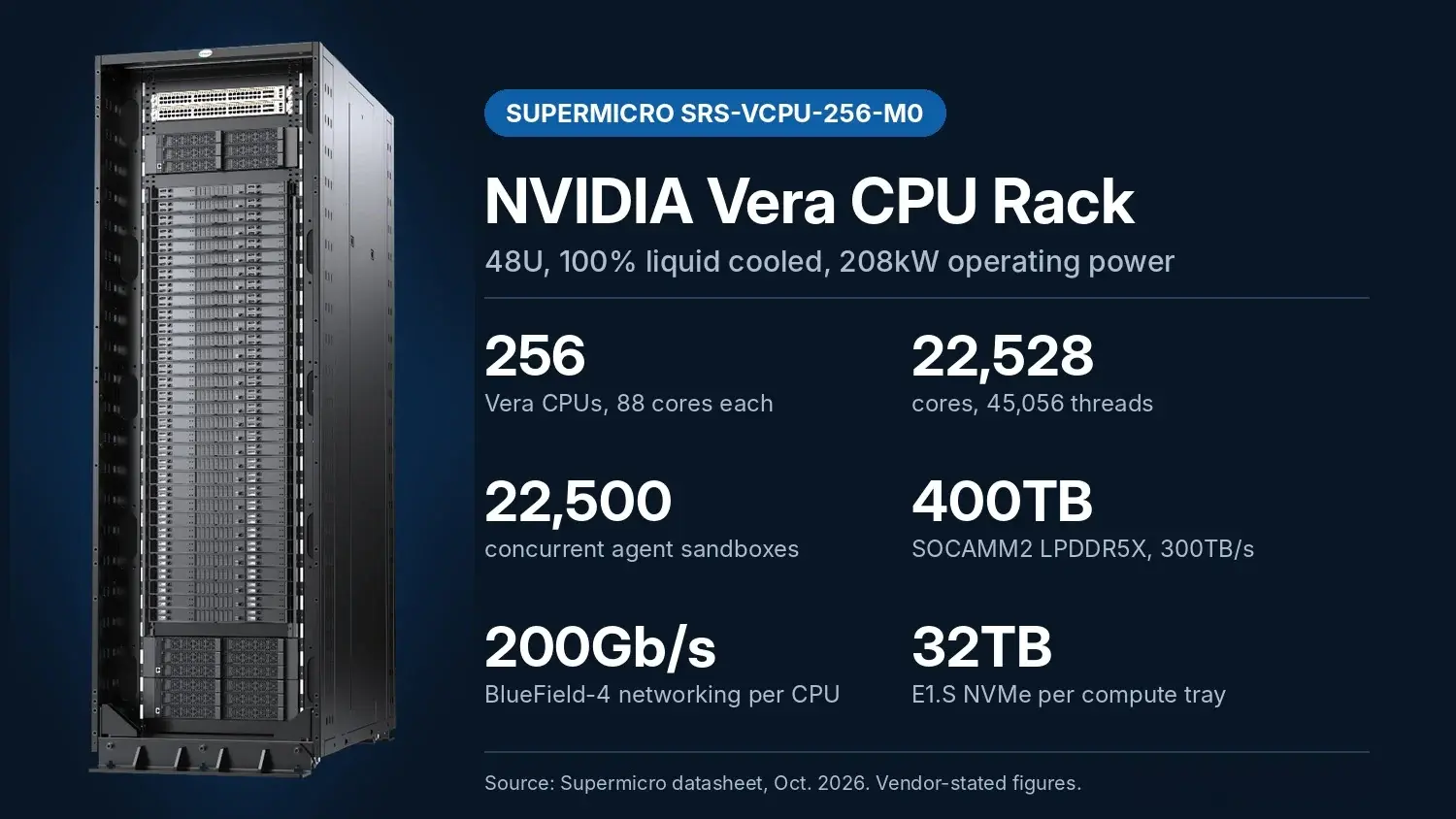
Perplexity, Daytona and Modal are already running on Vera in production or near-production. The rack-scale platform's specifications, 192 CPUs, roughly 300TB of memory, 1PB of storage and support for 22,500 concurrent sandboxes, are designed around sandbox density. Climate simulation does not need a 22,500-concurrent-sandbox metric.
NVIDIA is telling two stories at once. Only the agent side has customer data. The HPC side is a long-term anchor, the agent side is a short-term validation.
Vera admits GPU is not the whole agent
In an agent workload, the GPU generates tokens and code, and the CPU executes the code, calls tools, evaluates results and manages sandboxes. NVIDIA's own data says the CPU compresses context, queries the database, compiles generated code, runs Python toolchains and parses output inside the agent loop.
Vera's existence concedes that an agent factory needs GPUs to generate intelligence and CPUs to execute the actions that intelligence produces. NVIDIA is not selling Vera as an x86 replacement. It is selling it as a way to avoid buying a rack of x86 servers just to run agent sandboxes.
That is a capacity decision, not a performance decision. The customer's question is whether the existing x86 cluster is good enough. Vera's answer is 10.8 seconds against 88.4 seconds, and a 15% to 38% machine count reduction. Whether that persuades anyone depends on how much weight sandbox density carries in the customer's cost model.
P.S. The 2.4x OpenFOAM figure and the 1.6x agent figure are different tests, and the Chinese wire version mixed them into one. Vera's real product logic is not in DKRZ's 2028 supercomputer but in Daytona's 10.8-second sandbox startup.
Frequently Asked Questions
Q: What did NVIDIA actually announce?
A: The Vera CPU rack-scale platform for high-performance computing, with 192 Vera CPUs interconnected by Quantum-X800 InfiniBand, targeting climate modeling, molecular dynamics and other unaccelerated scientific workloads.
Q: Is the 2x energy efficiency claim accurate?
A: It depends on the test. On OpenFOAM, Vera delivers 2.4x performance per watt versus x86. On the weather model, NVIDIA projects 2x energy efficiency. The Chinese wire version compressed these into 2x, which is neither the OpenFOAM figure nor an independently verified number.
Q: Why does agent performance matter more than HPC?
A: Because the agent numbers have customer validation now. Daytona started 1,000 sandboxes in 10.8 seconds on Vera versus 88.4 on x86. DKRZ's HLRE-5 supercomputer, by contrast, is expected in early 2028.
Q: What are the agent performance figures?
A: NVIDIA reports 1.6x more agents per watt than the fastest x86 CPU and 2x agent speed versus the most efficient x86 CPU. Perplexity saw 1.5x faster agentic coding, and DeepInfra saw up to 2.2x faster orchestration.
Q: What is the rack configuration?
A: 192 Vera CPUs, roughly 300TB of memory, 1PB of storage, fully liquid-cooled in an MGX design. Each 1U tray holds eight Vera CPUs. The platform reuses NVL72 chassis, power and cooling components.
Q: When is it available?
A: Rack-scale platforms from Dell, HPE, Lenovo and Supermicro are expected in early 2027. DKRZ's HLRE-5 system, built by Bull, is expected in early 2028.