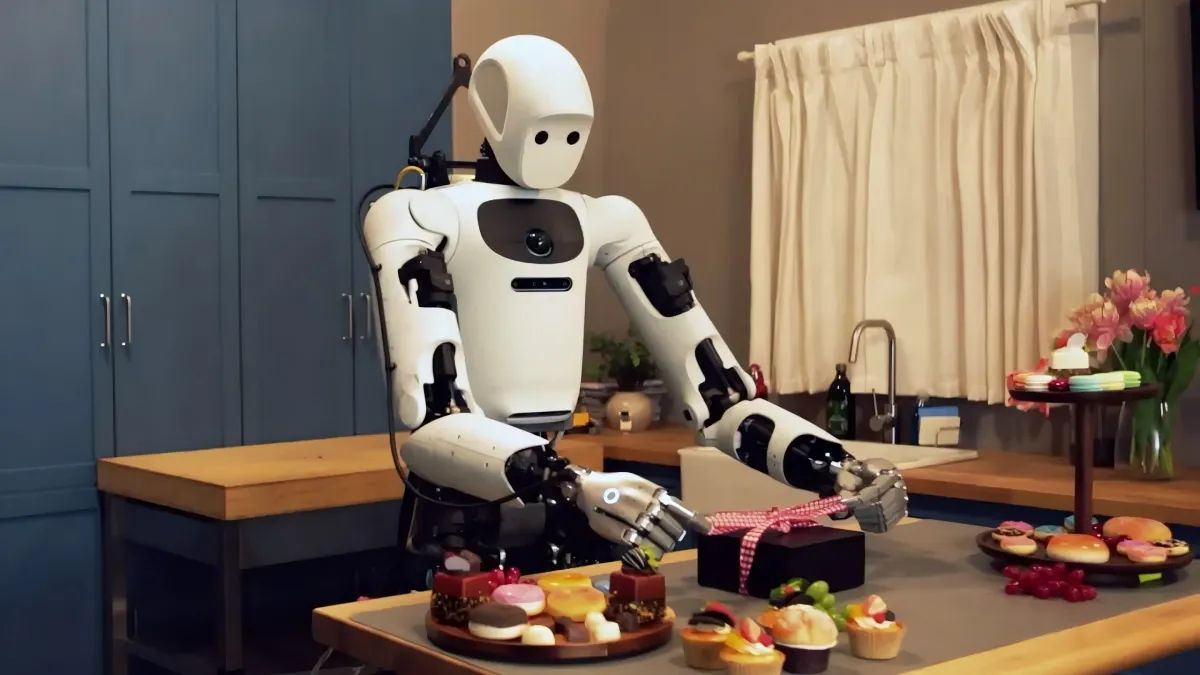
On November 10, 2026, Google DeepMind released Gemini Robotics 2.5, calling it its strongest vision-language-action model to date. On Mercedes-Benz production lines in Kecskemét, Hungary and Sindelfingen, Germany, Apptronik's Apollo 2 humanoid, running the model, performed a kitting task: lifting metal brackets from bulk bins and placing them into sequencing trays in the exact order each vehicle requires. DeepMind reported a pilot success rate of 96%.
DeepMind's robotics director Kanishka Rao also said that closing the gap from 96% to near-human reliability is a steep road.
96% has no denominator
TechOrange noted the most important gap in the number: DeepMind did not publish how many trials produced the 96%, how success was defined, how long the pilot ran, or how many robots operated on the line at once.
That is not a detail that can be waved away. 96% could come from 96 out of 100 attempts, or 24 out of 25. A3 added the failure breakdown: the 4% included manipulation errors and semantic errors, mostly placing a part in the wrong tray. But placing one bracket incorrectly and letting a wrong bracket reach the assembly station are failures of different magnitude, and DeepMind did not separate them.
On a real production line, a percentage means whatever its denominator and failure modes say it means. Without those, 96% is a public-relations number, not an engineering metric.
This was an investor-ecosystem pilot
TechOrange reported a structural fact that most Chinese coverage softened: Google and Mercedes-Benz are both existing investors in Apptronik, and Apptronik has a strategic partnership with Google DeepMind.
The investor's model, in the investor's factory, run by the investor's robot company. No third-party verification has been reported.
This does not make the test fake. It defines its evidence level. When DeepMind says proof of concept, it means it worked at a partner site, not that it will work at any factory. For a manufacturer evaluating humanoids, that distinction decides whether to follow or to wait.
Cloud inference and 2x playback sit behind the 96%
Ars Technica reported two technical details most Chinese coverage omitted.
First, Gemini Robotics 2.5 runs on cloud servers, not embedded. Every grasp requires a server round trip. Ars Technica noted the demonstration video plays at 2x speed because the robot moves slower than a human.
Second, Gemini 4 Argon was used as a simulation engine, generating thousands of practice-scene variants from real camera footage to help 2.5 generalize. Argon also analyzed failures and suggested improvements. But Ars Technica stressed this does not happen in real time: frontier models take time to process tokens, and robots cannot pause for long.
Together, these point to an unstated cost behind the 96%: a cloud inference bill, and an action speed that only looks human at double speed.
The last 4% is the steep road
DeepMind's own executives gave the most honest assessment. Rao called the path from 96% to near-human reliability steep. Carolina Parada, who leads DeepMind Robotics, framed the trade-off directly: a system can be very good at one specific application at the cost of generalization, or it can push on the generalization axis and may not reach 99.9% on every application.
That explains where 96% comes from. Gemini Robotics 2.5 is not a model trained specifically to sort metal brackets. It is a general VLA model tested across more than 200 tasks, including tying bows, pipetting liquids and picking up food with tongs. 96% is its performance on the Mercedes line, not its performance everywhere. A system tuned to 99.9% on one task may fail broadly on others.
P.S. The 96% measures what one Google-ecosystem pilot could do in one carefully chosen scenario. It does not measure whether a different factory, a different part, or a manufacturer without Google investment could reach the same number.
Frequently Asked Questions
Q: What is Gemini Robotics 2.5?
A: Google DeepMind's latest vision-language-action model, released November 10, 2026. It converts visual input and instructions into robot movements, and is being rolled out to robotics partners including Apptronik and Franka.
Q: What does the 96% mean?
A: It is the success rate in a proof of concept where Apptronik's Apollo 2 humanoid sorted automotive parts on Mercedes-Benz production lines in Hungary and Germany. DeepMind has not published the number of trials, how success was defined, or how long the pilot ran.
Q: Why does the missing denominator matter?
A: Because a success rate without a trial count and a failure definition is not a comparable engineering metric. The 4% failures included manipulation errors and semantic mistakes like placing a part in the wrong bin, but DeepMind did not break down how often each occurred.
Q: Is this an independent test?
A: No. Google and Mercedes-Benz are both investors in Apptronik, and Apptronik has a strategic partnership with Google DeepMind. The pilot used the investor's model, in the investor's factory, with the investor's robot company. No third-party verification has been reported.
Q: What are the technical limitations?
A: Gemini Robotics 2.5 runs on cloud servers, not embedded, so each action requires a server round trip. The demonstration video is played at 2x speed because the robot is slower than a human. Gemini 4 Argon was used as a simulation engine for training data and failure analysis, not for real-time control.
Q: What did DeepMind say about the remaining gap?
A: Robotics director Kanishka Rao called closing the last 4% to near-human reliability a steep road. Robotics head Carolina Parada said the model trades some application-specific precision for generalization across many tasks.