
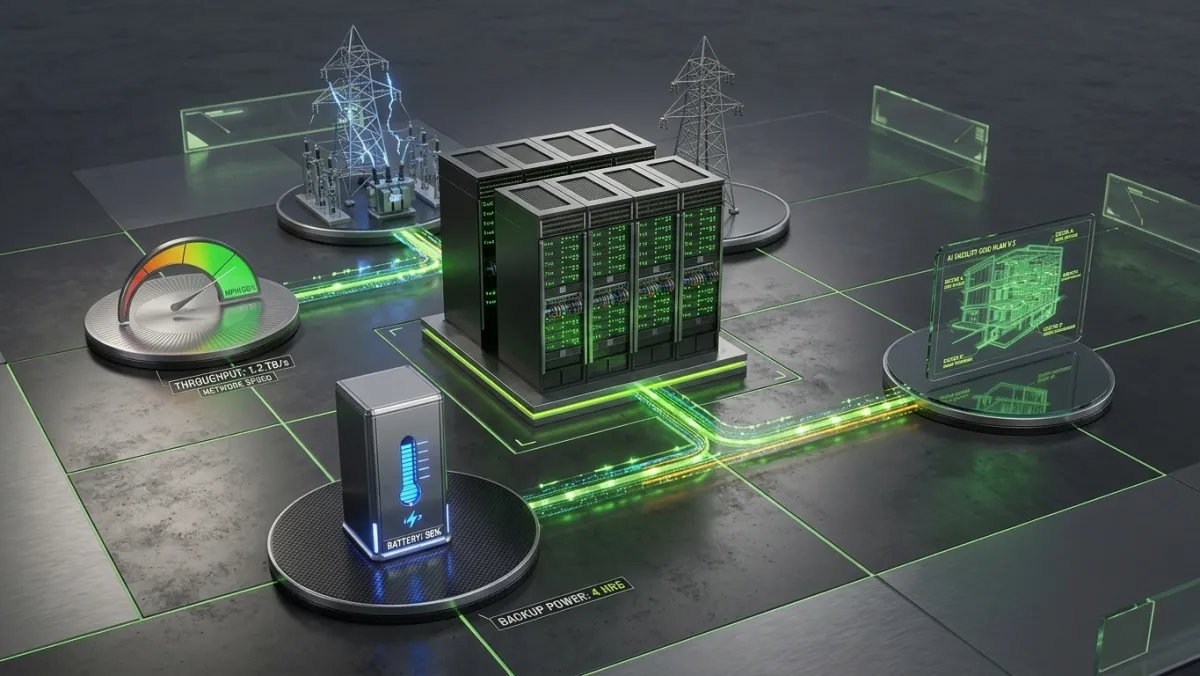
On October 21, 2026, Nvidia unveiled the DSX Pod at GTC Berlin, a containerized AI factory reference design built on Vera Rubin NVL72. Seven liquid-cooled racks, roughly 17 kilometers of Spectrum-X cabling, 800V DC power and dry cooling are integrated, wired and functionally tested at the factory. Once delivered, the unit needs only a prepared site with power, cooling and network connections. Nvidia says on-site deployment drops from six months to as fast as 14 days.
Nvidia will not build or sell it. Dell, HPE, Lenovo, Schneider Electric and Vertiv are among 17 partners manufacturing and delivering units, with global shipments starting in early 2027.
14 days comes with a "prepared site" qualifier
Every headline says six months to 14 days. Nvidia's own release and product page add a condition: the site must already have power, cooling and network access. Blockchain News puts it plainly — 14 days is deployment time for a prepared site, not an independently validated benchmark for total data center construction.
Land permits, substation construction, grid interconnection and fiber laying are not on the 14-day clock. Nvidia pulled the wiring work forward into the factory. It did not answer who brings the power to the container door. Times Now notes that power demand for high-performance AI chips remains the obstacle, and that building generation plants often takes longer than building the data center itself.
So the real value is not "builds fast." It is keeping already-delivered compute running while the grid catches up. Jensen Huang's "three months of delay costs $10 billion in revenue" arithmetic counts delay after compute arrives, not before. DSX Pod cuts idle GPU waiting from six months to 14 days, but the total project timeline still bends to the grid.
Nvidia turns the data center into a shippable unit
Huang called it "a complete transformation of the world's supply chain." Most coverage treated that as rhetoric. It describes a structural shift: data centers are moving from engineering projects to manufactured products.
Pre-integrated, pre-tested, pre-burned-in at the factory, running on arrival. Containers move by truck, not heavy rail. Dell, HPE and Lenovo manufacture the shell. Nvidia defines the rack layout, cabling spec, liquid cooling interface and power architecture. Partners build the box; Nvidia controls the most valuable part inside it.
HPCwire notes the design draws partly on Nvidia's work with European vendor Bull, which used Nvidia GPUs in its modular Jupiter supercomputers. DSX Pod pushes the logic further: not modular servers, but transportable, standardized AI factory units. When infrastructure becomes a standardized unit, competition shifts from who can build a data center to who can manufacture these units cheaper and faster — and Nvidia holds the definition.
Dry cooling and 800V DC are built for European rules
Berlin was not an accident. WIRED's headline was direct: Huang's European vision runs on plug-in data centers. European data centers face strict water and efficiency rules, and evaporative cooling is restricted in some markets.
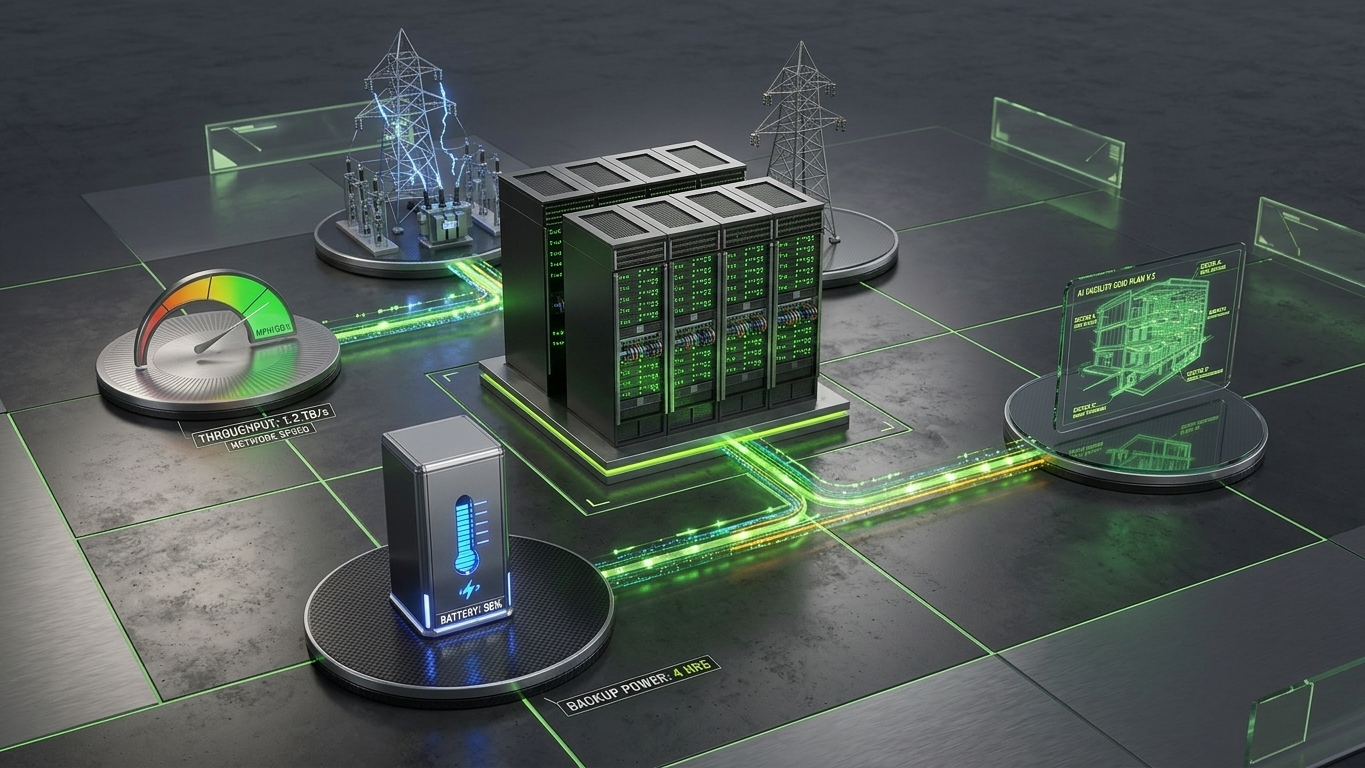
The design combination is closed-loop liquid cooling, dry cooling and 800V DC power. Nvidia claims savings of about 54 million liters of water per day at 2 GW scale, equivalent to daily use for 180,000 households. DSX MaxLPS claims 30% lower energy consumption at the same AI output.
The point is deployability in water-constrained regions. The Middle East, southern Europe and parts of the U.S. share cheap land, abundant sun and tight water. Dry cooling removes water from the constraint list. The 54 million liter figure is a vendor estimate and has not been independently verified.
P.S. Nvidia's own FAQ asks whether DSX Pod means customers can skip site preparation. The answer is no — the site must already have power, facility water, cooling and network connections. The 14-day promise carries that premise from the first word.
Frequently Asked Questions
Q: What is Nvidia's DSX Pod?
A: A containerized AI factory reference design built on Vera Rubin NVL72. Seven liquid-cooled racks, Spectrum-X cabling, 800V DC power and dry cooling are integrated and tested at the factory, then shipped as a unit. Nvidia designs it; partners like Dell, HPE and Lenovo build and sell it.
Q: Is the 14-day deployment claim accurate?
A: Only for a prepared site. Nvidia's own materials state the site must already have power, facility water, cooling and network connections. Permits, substations and grid interconnection are outside the 14-day clock.
Q: Why does the grid matter more than the rack?
A: Because generation and interconnection timelines often exceed data center construction. DSX Pod cuts idle GPU waiting from six months to 14 days, but the total project still waits on power. It reduces waste, not the critical path.
Q: What changes when a data center becomes a shippable unit?
A: Competition shifts from construction to manufacturing. Nvidia defines rack layout, cabling, cooling interfaces and power architecture; partners build the enclosure. Standardized units make Nvidia the spec-setter for the category.
Q: Why dry cooling and 800V DC?
A: Both target water- and efficiency-constrained markets, especially Europe. Dry cooling removes evaporative water use, and 800V DC reduces conversion losses. Nvidia's water and energy savings figures are vendor estimates, not independently verified.
Q: When will DSX Pod ship?
A: Nvidia says global shipments begin in early 2027 through its partners. There is no announced pricing, and Nvidia is not selling units directly.