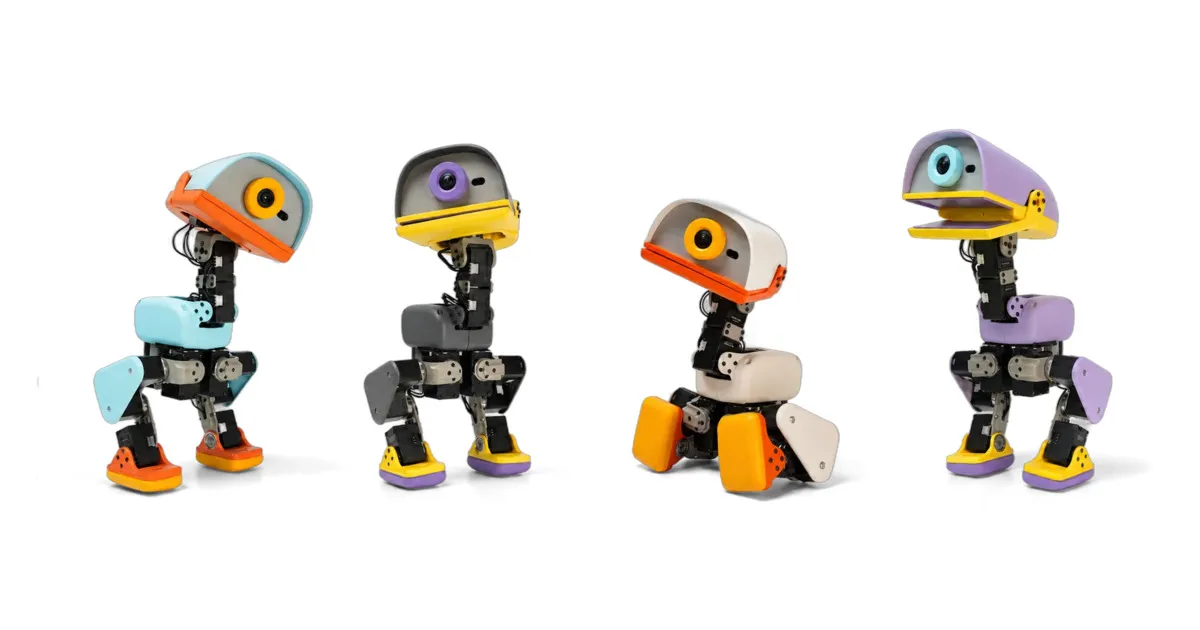
On November 24, 2026, NVIDIA published an Isaac Lab workflow that teaches Pollen Robotics’ Microduck to steer around obstacles without replacing the model that keeps it upright. The new controller sits between a gamepad and the existing walking policy. A person still chooses where to go; the robot can adjust how it gets there.
One model walks, another steers
The original walking policy translates velocity commands into joint movements. NVIDIA freezes those weights and trains a separate navigation policy to change the requested forward, sideways and turning motion. The two models handle different jobs: one deals with what is in the way, and the other keeps the robot on its feet.
Microduck’s head-mounted time-of-flight sensor measures distance on an 8×8 grid at 15 Hz. In training, NVIDIA varied obstacle layouts and simulated imperfect depth readings, including noise, delays and missing measurements. The model does not need a full map to react to objects immediately in front of it. That is also a limitation: a local sensor is not a substitute for planning a route through a building.
NVIDIA shows a physical run, not an autonomy score
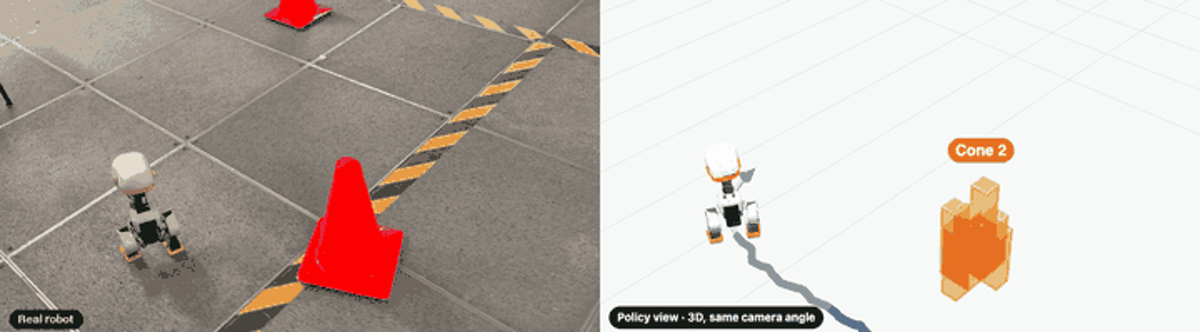
NVIDIA shows a real Microduck going around cones, alongside a 3D reconstruction from the same run. The company distinguishes steering corrections made by the policy from moments when the operator intervened. It does not report a fleet-wide success rate or show that the robot can navigate an unfamiliar room without supervision.
The deployment tools run navigation inference on a laptop, which sends adjusted commands to the robot’s walking policy. The default forward cap is 0.15 metres per second. Releasing the gamepad stick stops the supervised run; the tools also offer a dry run that sends no movement commands. This is a reference workflow for developers, not a claim that every retail unit just gained an update.
What robotics teams can reuse
NVIDIA reports that one training run on DGX Spark took roughly six hours, using 4,096 parallel environments and 3,000 training updates. That is one reported configuration, not a minimum hardware requirement or a measure of how often the robot avoids an obstacle. The October walkthrough already taught developers to train and export a walking policy. The new part is adding navigation on top without reopening that training job.
The useful question for another robot team is whether the same split makes failures easier to isolate. Compare the same walking model with steering off and on, then record collisions, falls and operator interventions separately. A clean cone-course clip is a starting point; those comparisons tell you which layer actually helped.
P.S. Cover: Pollen Robotics product imagery. The inline image is cropped from NVIDIA’s demo; its left panel shows the physical robot, and the right panel is a reconstruction. SUPERCRZY did not run the robot.
Frequently Asked Questions
Q: Did NVIDIA retrain Microduck to walk?
A: No. The new workflow trains a navigation policy and reuses the existing walking policy with its weights fixed.
Q: Can Microduck run the cone course without a person?
A: The demonstrated setup is supervised. A person requests movement with a gamepad, and the model adjusts it around obstacles.
Q: Does navigation run on the robot itself?
A: In the documented setup, navigation inference runs on a laptop and sends commands to the walking model on the robot.
Q: What sensor does the navigation policy use?
A: The setup uses a head-mounted time-of-flight sensor that measures distance in an 8×8 grid at 15 Hz, alongside the robot’s available state.
Q: Is this a software update for every Microduck?
A: No. NVIDIA published a reference workflow for testing and deployment with configured hardware.