Tencent’s new Apple Silicon packages put image search, visual Q&A and typed decisions in one local model family. The larger package has 9.13 GB of tensor files.
On November 25, 2026, Tencent added Apple Silicon support to WePocketModel 1.0. Its new 2B and 4B packages run with a dedicated MLX runner for M-series Macs. This is not a new model generation. The original Transformers and GGUF releases were announced two days earlier.
The same model can do three different jobs
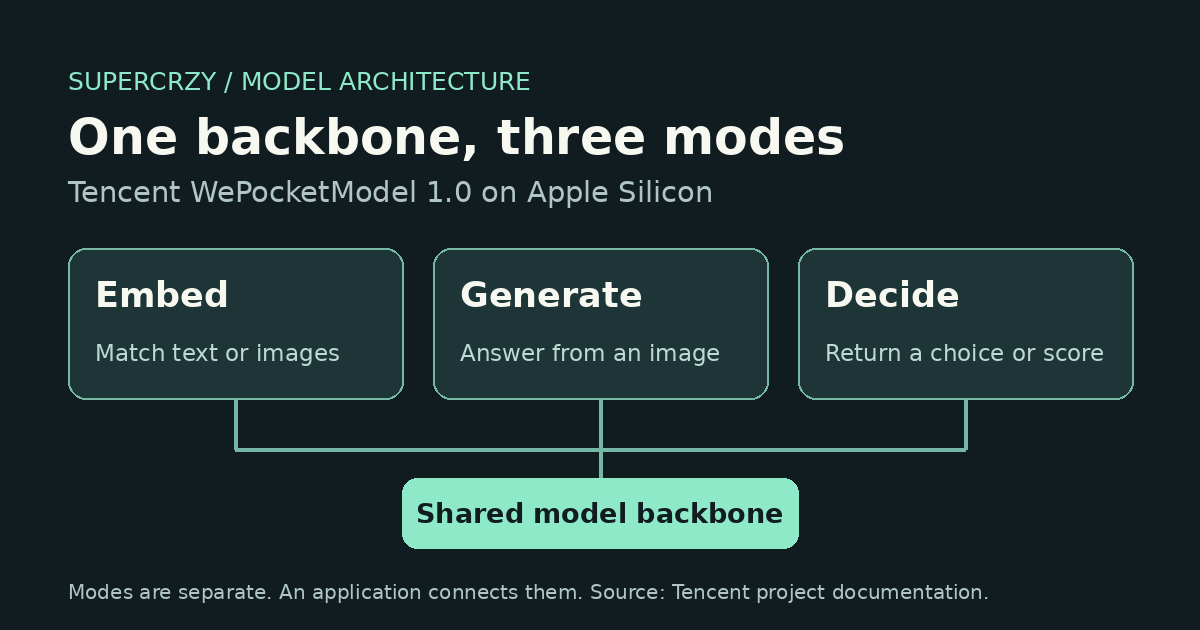
A photo assistant might have to find a product image, explain what is visible in it and decide whether an editor should review it. The first step calls for an embedding, a numerical representation an app can compare with other images or text. The second calls for a generated answer. The third can use a structured choice or score.
Tencent's MLX runner exposes those three operations through separate modes. It can accept an image when generating a response or calculating an embedding. The structured mode offers choices and scores instead of relying on an app to extract a verdict from prose. Those modes share a model backbone, but Tencent's examples invoke them separately. Developers still need to build the search index, connect the steps and decide what to do with the result.
The smaller download is not a memory benchmark
We added up the tensor file sizes in Tencent's public 2B package and 4B package, including the separate task modules. They total about 4.47 GB and 9.13 GB respectively, using decimal units, before code and other small files. That count tells you roughly how much data you are downloading, not how much unified memory the runner uses.
The weight and memory figures Tencent lists for other backends do not answer that Mac question either. Image preprocessing, context, working buffers and other apps can affect how much memory is available. We have not measured peak allocation or latency on a Mac.
The useful test starts with a look-alike
A practical trial would give each package two similar catalog photos, ask it to retrieve the one that matches a short description and then have it choose whether the item passes a visible-attribute check. It should also be able to decline a decision when the image cannot settle the question. A textile blend is not something the model should infer from the color of a shirt.
The point of a shared local model is not that those three commands exist. It is whether an app can keep one model resident, complete the whole sequence and leave enough memory for the rest of the work. That is what to measure.
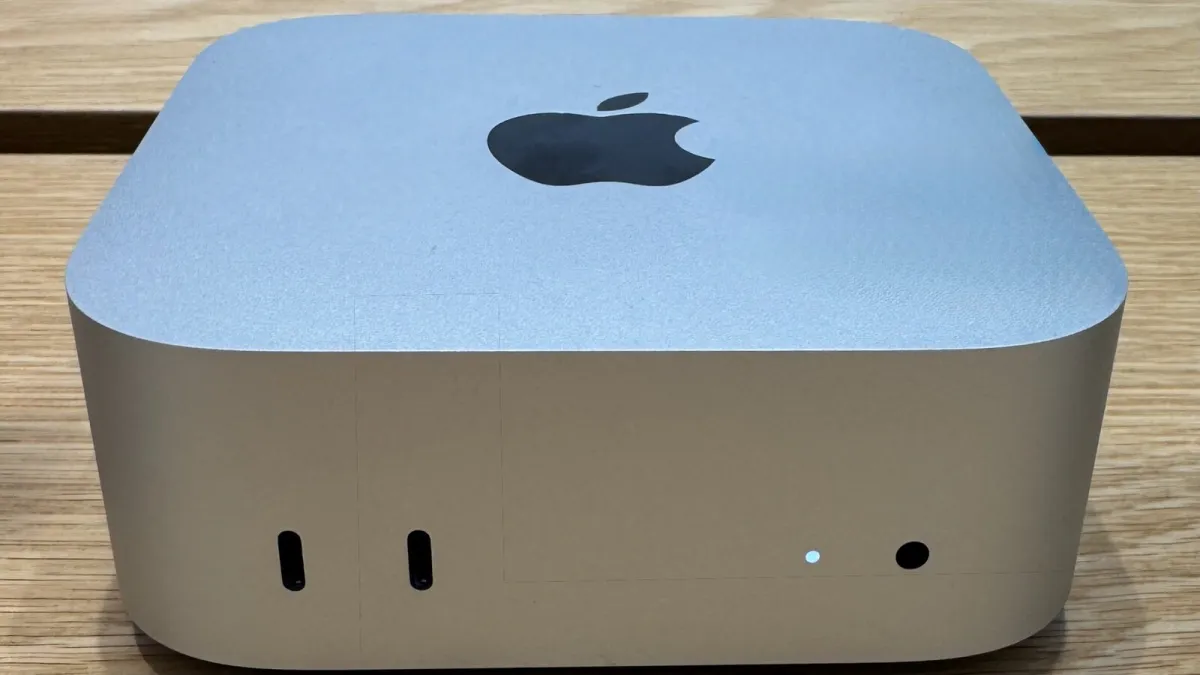
Cover: Mac mini M4 archive photo by Seasider53, cropped from the original (CC BY 4.0).
P.S. The checkpoint sizes are from Tencent’s file metadata, not a SUPERCRZY device benchmark.
Frequently Asked Questions (FAQ)
Q: What did Tencent release on November 25?
A: Separate 2B and 4B WePocketModel 1.0 checkpoint packages with a dedicated MLX runner for Apple Silicon.
Q: Is WePocketModel 1.0 a new model?
A: No. The model appeared on November 23; the change is an additional Mac runtime and matching packages.
Q: Can it process images?
A: Tencent documents image input for both generation and embeddings.
Q: Does 9.13 GB mean the 4B package needs 9.13 GB of RAM?
A: No. The figure is the sum of the published tensor files; it is not peak memory during a run.
Q: Does it come with a desktop assistant?
A: The release supplies weights and a runner, not a finished assistant that searches your library or takes actions for you.