On November 25, 2026, Sakana AI announced Namazu Small, a reasoning model built from NVIDIA’s Nemotron 3 Nano base. At 30 billion total parameters, it is a quarter the size of Nemotron 3 Super. In Sakana’s tests it led the larger model on 13 of 25 benchmarks. The more useful finding is where those wins came from: tasks that gave the model something to check.
Where the smaller model wins
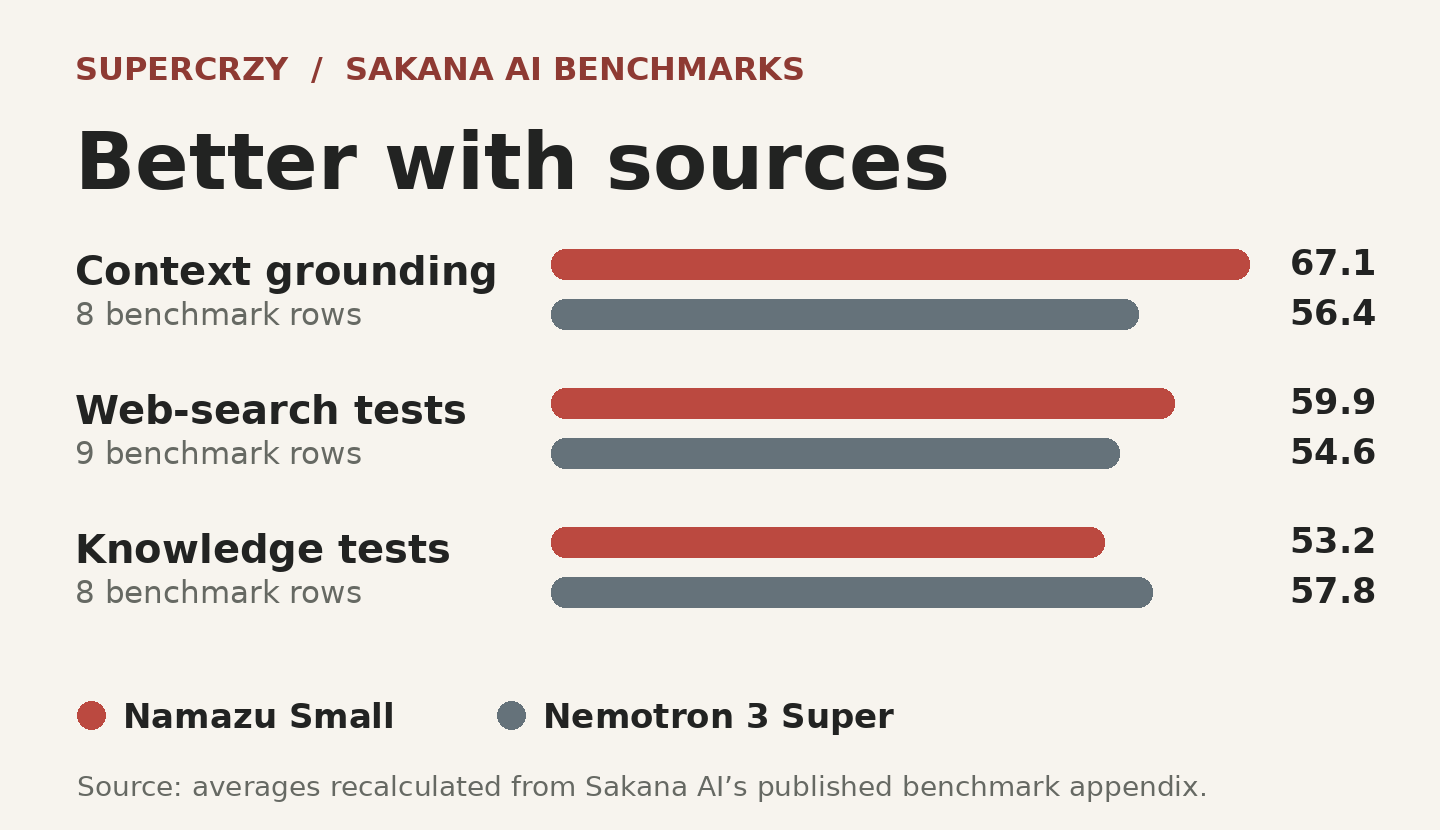
Namazu Small averaged 67.1 on eight tests of context grounding and instruction following, against 56.4 for Nemotron 3 Super. It won seven of the eight rows. The spread was particularly wide on LLM-jp LongBench, where it scored 86.0 to Super’s 60.0. It did not win every long-document test: Super scored 53.1 on LongBench v2 against Small’s 45.7.
Sakana also reports a 59.9 average across nine web tests, against 54.6 for Super. That average includes BrowseComp, where Namazu Small led 73.5 to 36.1. On FRAMES it trailed 85.0 to 86.0. A team relying on search should test its own queries and sources rather than assume the largest jump will transfer.
What the headline average hides
Across all 25 rows, Namazu Small averaged 60.1, ahead of Super’s 56.2. But Small lost seven of the eight knowledge tests. On Japanese SimpleQA, which tests factual questions rather than reading a supplied document, it posted 8.0 to Super’s 24.9. On that category as a whole, Super led 57.8 to 53.2.
This split matters more than the aggregate. An internal-document assistant should be able to point to a source and say when the document does not support an answer. A general assistant without a reliable source has a different job. The same model could be a good candidate for the first and a poor default for the second.
The deployment question is still open
Sakana continued pretraining and then post-trained the Nemotron 3 Nano base. Its tests compare the result against NVIDIA’s post-trained Nano and Nemotron 3 Super, not against untouched base models. Sakana says it intends to offer Namazu Small on premises and will share details in early-to-mid December. The announcement does not link downloadable Namazu Small weights or a public API for this variant.
That leaves a useful buying test for when access arrives: check whether the model can cite the right passage when two documents conflict, and decline when neither one answers the question. Then measure latency and memory on the hardware you plan to use. Parameter count is not a memory or speed figure.
P.S. The cover is Sakana AI’s launch artwork. The group averages and 13-of-25 tally are our arithmetic on Sakana’s appendix, not independent runs.
Frequently Asked Questions
Q: What is Namazu Small based on?
A: Sakana says it continued pretraining and post-trained NVIDIA’s Nemotron 3 Nano base. The resulting model has 30 billion total parameters.
Q: Did it beat Nemotron 3 Super on every test?
A: No. It led on 13 of 25 rows in Sakana’s appendix and trailed on 12.
Q: Which tasks favored Namazu Small?
A: It scored higher on the average of the web-search and grounding groups. Super averaged higher on the knowledge group.
Q: Does the small size mean it runs on any laptop?
A: No. Memory and speed depend on the deployment format, runtime, context length and hardware. Sakana did not give a universal requirement.
Q: Can developers download it now?
A: The announcement does not link public weights or a public API for this variant. Sakana says on-premises details are planned for early-to-mid December.