On November 24, 2026, Cognition released SWE-2.1, an updated coding model trained on Moonshot AI’s Kimi K3. The standard model is available in Devin Desktop, Cloud and CLI. Cognition also announced an Ultrafast version serving the same model through Cerebras. That gives developers two changes to test, not one: what the new model can solve, and how much of a job gets done before time runs out.
The model improved before it got faster
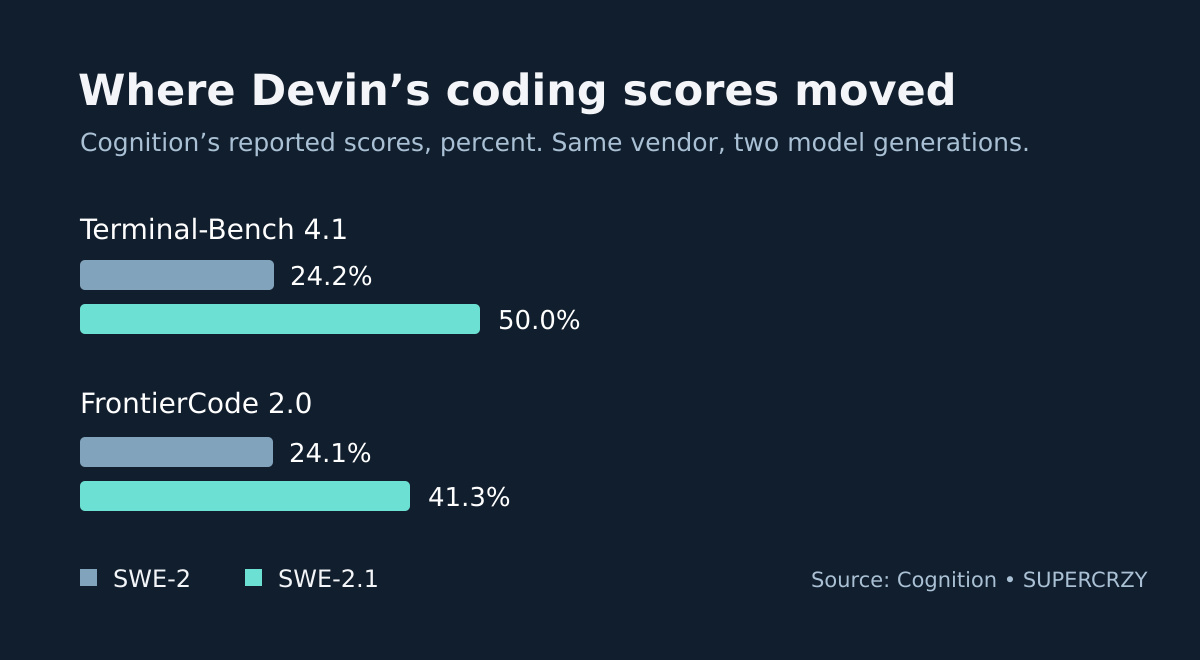
In Cognition’s release table, SWE-2.1 scored 50.0% on Terminal-Bench 4.1, up from 24.2% for SWE-2. On FrontierCode 2.0 it rose from 24.1% to 41.3%. Those are gains of 25.8 and 17.2 percentage points, respectively, across two measures of developer work.
Those figures show progress against Cognition’s own previous model, not a lead over all alternatives. In the same table, Claude Opus 5.5 scored 65.8% and 47.3%, respectively. Cognition also says the reported models do not all run in the same harness. That makes a within-product upgrade a cleaner conclusion than a ranking of every tool on the table.
The speed number stops at token generation
Cognition’s demo shows the standard model at 60 output tokens per second and its Cerebras-served variant at 600. Faster output can shorten the parts of a run spent generating text or code. It doesn’t speed up a repository checkout, CI queue or test suite. And Cognition says it normalized time budgets for its reported benchmark scores rather than simply giving the faster version more time to solve each task.
If generation takes half the time in a workflow and everything else stays fixed, making generation ten times faster cuts the overall time by 45%, not 90%. That’s an illustration, not a Devin measurement. It’s why the useful number for a team is elapsed time to a reviewable patch with passing checks.
The useful trial starts with an old ticket
Try both variants on a resolved issue in a disposable checkout, using the same starting commit, instructions and test budget. Track time to the first reviewable diff, how many checks pass and whether either run needs a human to intervene. If both variants produce an equally good patch, the faster one earns its place only if you can see the saving in the actual workflow.
Cognition advertises standard SWE-2.1 free through December 8 on Desktop and CLI and lists introductory pricing for the faster mode. The temporary terms make a side-by-side trial easier, but neither a demo nor a launch discount tells you whether the faster mode is worth keeping.
P.S. The performance numbers are Cognition’s, not a SUPERCRZY test. The distinction to watch is time to a working change, not the rate at which text appears.
Frequently Asked Questions
Q: What is SWE-2.1?
A: It is Cognition’s updated coding model for Devin, trained on Moonshot AI’s Kimi K3.
Q: Where is the new model available?
A: Cognition lists Devin Desktop, Cloud and CLI for SWE-2.1.
Q: What makes the Ultrafast variant different?
A: Cognition says it is the same model served faster through a partnership with Cerebras.
Q: Is a complete job ten times faster?
A: Not necessarily. The speed figure concerns generated tokens, while tools, tests and review take separate time.
Q: Are the benchmark numbers independent?
A: No. The scores cited here come from Cognition’s release and use the company’s stated methodology.