On November 24, 2026, Google DeepMind opened Humanity’s First Exam on Kaggle. Its 544 text and image prompts ask models to do ordinary things like count objects or read colors in a sign. The twist is that getting a question right once won’t necessarily help you here. The strict score rewards a model only when it gets all the related questions right, every time.
One wrong answer is enough
The technical report groups the 544 prompts into 136 families of four. The researchers sample four answers per prompt. A model has 16 chances to get something wrong in each family; any miss costs the whole family on the strict measure. That is different from asking whether the model can produce a correct answer if you try enough times.
Take the neon sign used in the launch post. The task is not to recognize the sentence. It is to name the colors of particular letters in the right order. A model can read the sign fluently and still misread the colors. That distinction matters if you need the answer to be usable without opening the image yourself.
The chart changes when misses count
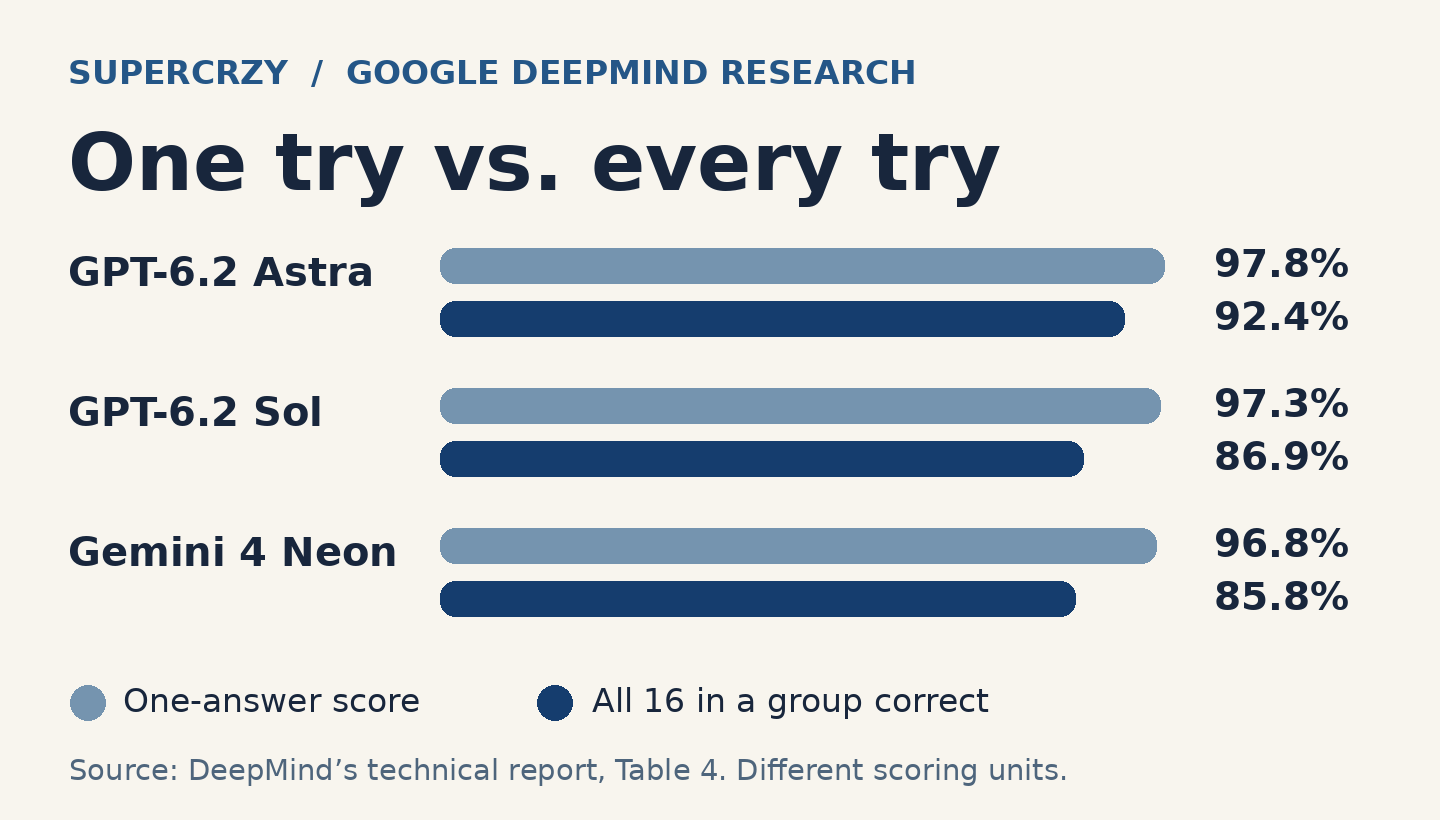
In the report’s evaluation of 18 models, GPT-6.2 Astra scored 97.8% on the single-answer measure and 92.4% on the strict family measure. GPT-6.2 Sol went from 97.3% to 86.9%, and Gemini 4 Neon went from 96.8% to 85.8%. These are two different units of scoring, not a record of models getting worse over time. The comparison is useful precisely because the two measures ask different things of the same model.
The result is not an endorsement of a model for everything. The report puts Neon above the higher-tier Gemini 4 Carbon on this measure, for example. And the test isolates answers rather than multi-step work: it cannot tell you whether an assistant will pick the right tool, ask a user before acting or recover from a failed command.
Test the variants your team actually sees
For a real evaluation, start with one routine job and the variations that make it harder. A document assistant might read the same field in a clean PDF, a scan with a cropped margin and a version where the field moved. Track the failures separately instead of letting several easy wins hide the version that sends people back to manual review.
DeepMind’s live Kaggle board is a place to look at the benchmark, not a substitute for that test. DeepMind is asking for new questions through December 15. The useful submission is not the most obscure puzzle; it is an ordinary task that is easy for a person and still exposes a reproducible failure.
P.S. The cover is the example image published by Google DeepMind. The chart uses Table 4 of the technical report, not the live Kaggle scores or an independent SUPERCRZY test.
Frequently Asked Questions
Q: What does Humanity’s First Exam test?
A: Whether language models can answer straightforward text and image questions consistently, including when the question changes slightly.
Q: How does the strict score work?
A: A family counts as correct only if all four samples for each of its four prompts are correct.
Q: Is 92.4% the model’s single-answer accuracy?
A: No. It is GPT-6.2 Astra’s strict family score in the technical report. Its single-answer score there was 97.8%.
Q: Is this an agent benchmark?
A: It tests model answers, not the ability to complete a tool-using workflow safely.
Q: Can readers submit questions?
A: Yes. Google says the Kaggle competition accepts everyday example questions through December 15.