On November 24, 2026, PrismML released Ternary Bonsai 2.5 27B, a compressed model based on Qwen3.8 27B. Its downloadable weights are licensed under Apache 2.0. The change from Bonsai 2 is not a smaller headline footprint: PrismML still advertises 5.9 GB. The change is how much of a multi-step job the model can finish at that size.
The improvement starts after the first tool call
In PrismML’s own tests, AppWorld rose from 51.2 to 90.5. The full-precision Qwen model scored 93.2 in the same table. AppWorld tests tasks in simulated apps, so this is a more relevant comparison for someone building a local assistant than a simple code-generation score. It does not tell you how well the model will handle your particular apps or files.
The gains are uneven. SWE-bench Verified rose from 60.8 to 75.6, still below the base model’s 80.6. On LiveCodeBench v6, the new Bonsai slipped from 83.8 to 83.0. The results favor a narrower reading of the release: PrismML shows larger gains where a model has to keep taking steps and reacting to tool feedback, not a universal improvement in coding.
The download is not the memory budget
PrismML’s public Hugging Face file listing gives a more useful starting point than the headline number. The smallest standard PTQ1_0 GGUF file is roughly 6.0 GB on disk. Its counterpart with multi-token prediction (MTP) is roughly 6.2 GB, and the listed GGUF variants reach roughly 7.9 GB. So even before opening the model, the format and decoding option change the cost of the download.
Once a model is running, the context cache, runtime buffers and any tool processes need memory too. A short prompt and a long repo session may fit very differently on the same machine. Runtime and device support matter as well: PrismML advertises llama.cpp on NVIDIA and Intel GPUs and MLX on Apple devices. Its reported 204 output tokens per second on an RTX 4090 used MTP; that number is not a forecast for an ordinary laptop or for the pace of a complete agent task.
What a local pilot should measure
Try one job you would actually delegate, such as updating a small private repository and running its checks. Record the model variant, context length, peak memory, elapsed time and whether the outcome passed the checks you already use. If the model fits only by shrinking the context until it can no longer see the relevant files or tool output, it fits on disk but not in your workflow.
Running inference locally can avoid sending prompts to a hosted model. It does not automatically make the whole workflow offline: that depends on what tools and services you connect. The useful result from this release is that developers can now test a stronger local model against those boundaries rather than buying into a new memory headline.
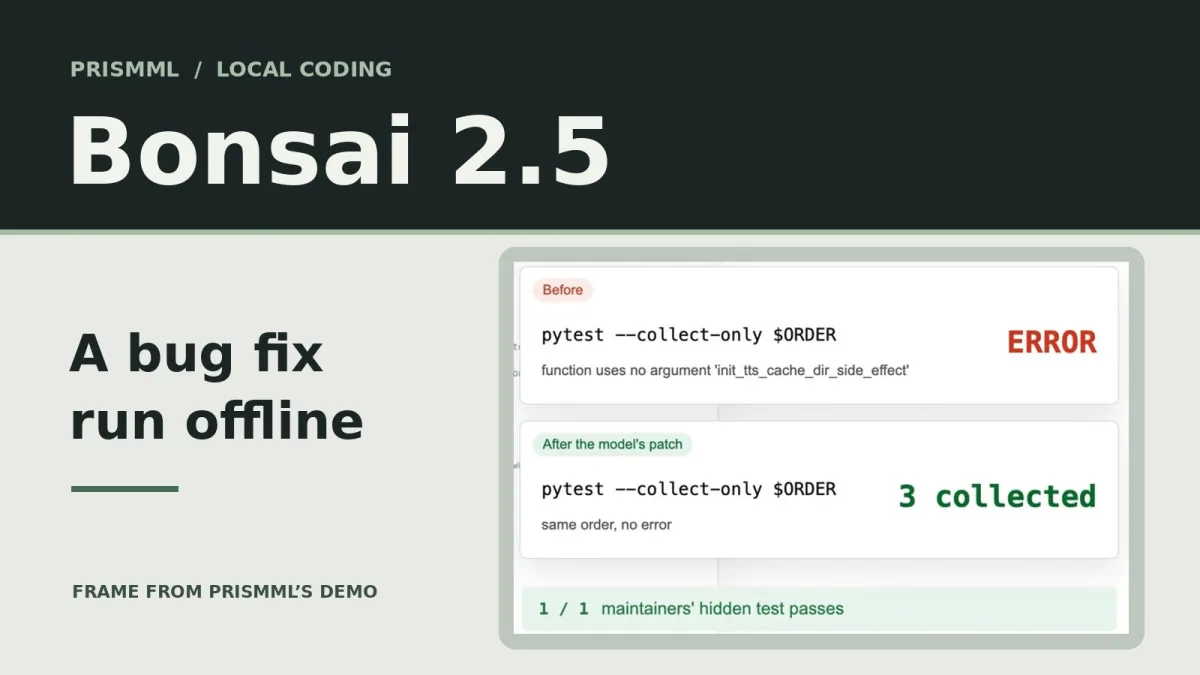
P.S. The performance figures are PrismML’s, not an independent SUPERCRZY test. The downloadable GGUF file sizes can be checked separately from those results. Cover: still from PrismML’s official offline coding demo.
Frequently Asked Questions
Q: What did PrismML release?
A: Ternary Bonsai 2.5 27B, a compressed model based on Qwen3.8 27B, with public weights under Apache 2.0.
Q: Does a 5.9 GB footprint mean it will run in 6 GB of RAM?
A: No. File variant, runtime buffers, context cache and any other active tools all affect peak system memory.
Q: What improved in the new version?
A: PrismML reported large gains on AppWorld and SWE-bench Verified relative to Bonsai 2. The new version did not improve on every test.
Q: Which platforms does PrismML list?
A: It lists llama.cpp for NVIDIA and Intel GPUs and MLX for supported Apple devices. Hardware and runtimes differ in compatibility and performance.
Q: Does local inference make the entire workflow offline?
A: No. Inference can run on-device, but a connected tool or service can still use the network.