On November 27, Sber published the weights for two GigaAM speech recognition models that can produce text while someone is still speaking. GigaAM-v4 focuses on Russian and English, while GigaAM Multilingual v2 covers 21 languages. Both use the MIT license and support a local deployment path. These are speech-to-text models, not the recently released GigaChat Omni model that interprets video together with audio.
What makes the release useful is not the language count alone. The 776-million-parameter multilingual model puts languages including Kazakh, Uzbek, Georgian and Armenian in the same streaming package as English and several other European languages. A team building captions for those audiences can evaluate one engine across several languages, then decide which still need a separate model or human review.
The biggest gains are not in English
In Sber's own multilingual benchmark, the average word error rate was 3.96% when the model could read the full recording, and 5.58% in streaming mode with a 640-millisecond future-context setting. Word error rate counts substitutions, missing words and extra words against a reference transcript. Lower is better. The comparison shows the cost of committing to text with less future audio, under the particular conditions Sber chose.
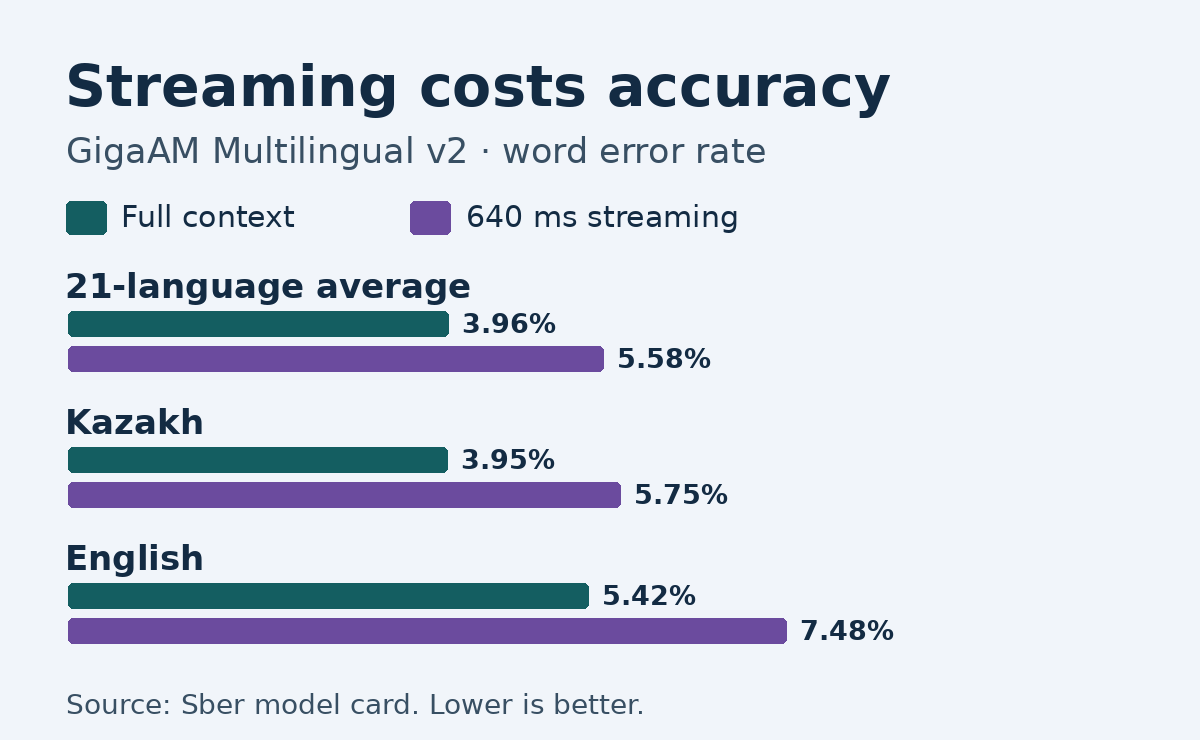
Kazakh shows why the model deserves attention. The same table puts it at 3.95% with full audio and 5.75% when streaming, versus 14.20% for the Omnilingual baseline in that table. In English, the picture changes: GigaAM records 5.42% with full audio, versus 4.55% for the Qwen baseline. Those are different comparison rows, not evidence that GigaAM is the best choice for every language or that all the competing systems were tested in matching live settings.
The smaller 238-million-parameter v4 RNN-T model also shows a regional split. In its own model card, Sber reports a Russian average of 5.99%, down from 9.51% for its previous RNN-T model across a mix of public and in-house tests. On a separate public English subset, v4 gets 7.28%, compared with 6.67% for the Qwen entry. These are different benchmarks from the multilingual table, so the English scores should not be used to rank the two new GigaAM models against each other.
The context setting is not a stopwatch
Sber documents 160, 320 and 640 milliseconds of future context for both models. These are settings for how much later audio the decoder can consider, not promises about how quickly a viewer sees a caption. How long the app buffers incoming audio, how fast the hardware runs inference, and when the interface chooses to revise or finalize words all affect what the viewer experiences.
For a live demo, measure time to first visible text and time to a stable caption separately. A system can feel responsive while changing names, numbers or sentence endings more often than people can comfortably read. For an archive, the full-context option trades that immediate feedback for access to the entire utterance. The published figures support trying separate settings for live captions and for a final edited transcript instead of treating both as one job.
Local weights are a starting point, not a finished workflow
The model cards describe Transformers and ONNX export paths, and the streaming interface retains state across incoming audio chunks. Both models can return unformatted text or formatted output. That can be helpful for separating a downstream search index from the transcript people read. The multilingual edition offers automatic language selection or a specified language; the table does not establish how well either setting handles rapid switching within a sentence.
A sensible first check is a small, consented sample of the audio the product actually handles: quiet and noisy calls, different microphones, names, and the language pairs typical of the audience. Measure end-to-end latency and corrections on the target machine before promising real-time service. Local inference lets teams keep audio on infrastructure they control, but the application still decides what it stores, logs or sends elsewhere.
Use the same recordings and transcript rules for each engine, and report the results by language rather than pooling them. A name that's spelled two ways can look like a recognition error if normalization differs, while a fluent caption with the wrong price or appointment time can look better than it is on the average. Keep a separate tally for names and numbers. Also log the device and runtime version: a model that looks fast on one GPU may not be a practical choice for a CPU-only machine serving several sessions at once. The model card is a useful shortlist, not a capacity test.
P.S. The best reason to try GigaAM Multilingual v2 is a language your existing engine handles poorly. Start there, not with an average across 21 languages.
Frequently Asked Questions
Q: What did Sber release?
A: It published two speech-to-text models: GigaAM-v4 for Russian and English, and GigaAM Multilingual v2 for 21 languages.
Q: Can developers run them on their own infrastructure?
A: Yes. Both models use the MIT license, and the cards document local execution and ONNX export. Teams still need to validate performance on their target hardware.
Q: Does 640 milliseconds mean captions will appear in 640 milliseconds?
A: No. That is the model’s future-context setting, not measured end-to-end caption latency.
Q: Is GigaAM Multilingual v2 better at English than all alternatives?
A: No. The model card itself shows a lower English word error rate for the Qwen entry in its table.
Q: Is GigaAM the same as GigaChat Omni?
A: No. GigaAM is for transcribing speech. GigaChat Omni is a separate model for interpreting inputs including video and audio.