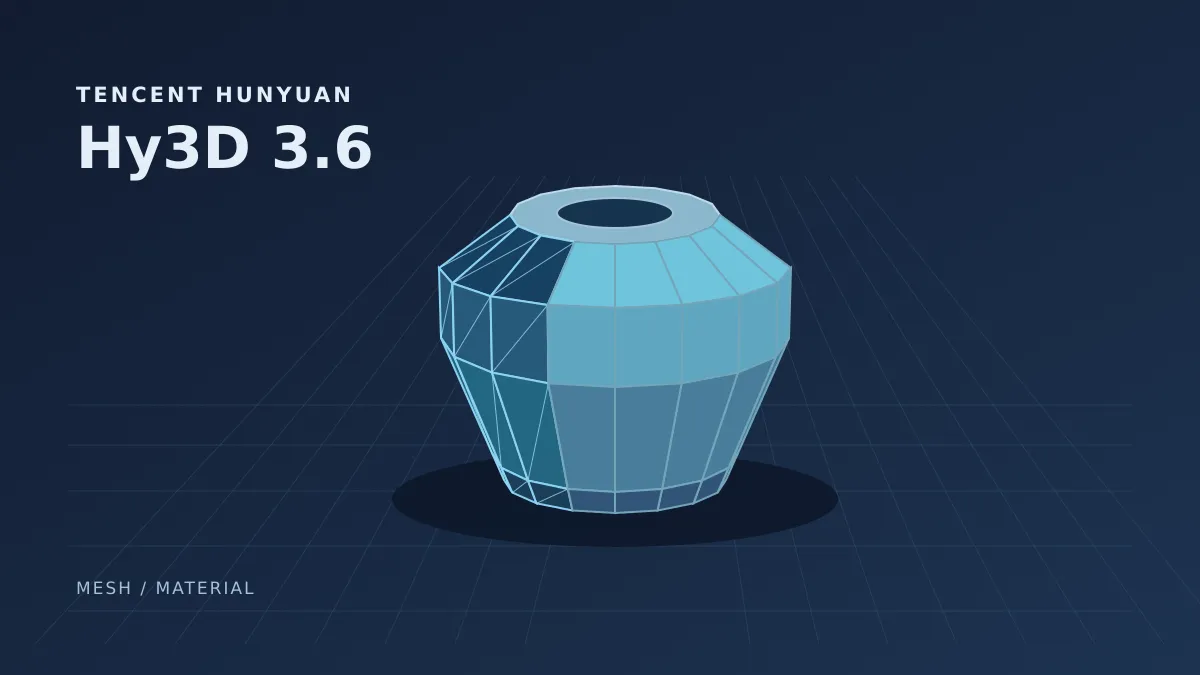
On November 27, 2026, Tencent Hunyuan announced Hy3D 3.6, an update to its hosted 3D asset generator with an emphasis on detailed meshes and materials. The company lists the model on Tencent Cloud TokenHub. The useful distinction for a 3D artist is what the generator hands over and what still has to happen before that file can go into a project.
On Tencent Cloud’s China site, the list price works out to CNY 3–9 per generation (25–75 points at CNY 0.12 each). Tencent also lists a 100-point trial for eligible accounts. Those are China TokenHub terms, not a statement about pricing elsewhere or the cost of later cleanup.
The texture settings matter more than the render
The 3.6 API guide lists two million faces as the default target, not a guaranteed count unless strict mode is used. Textured jobs default to 4K maps, with 2K and 8K options. Physically based rendering (PBR) textures are optional and off by default. A geometry-only job ignores the texture settings altogether.
The guide also exposes a trade-off between fewer visible seams and preserving fine details. That matters if an artist needs to relight the object or inspect it from the back, rather than judge a render from the reference angle. Tencent documents default OBJ and GLB outputs for the textured mode and lists other formats as alternatives.
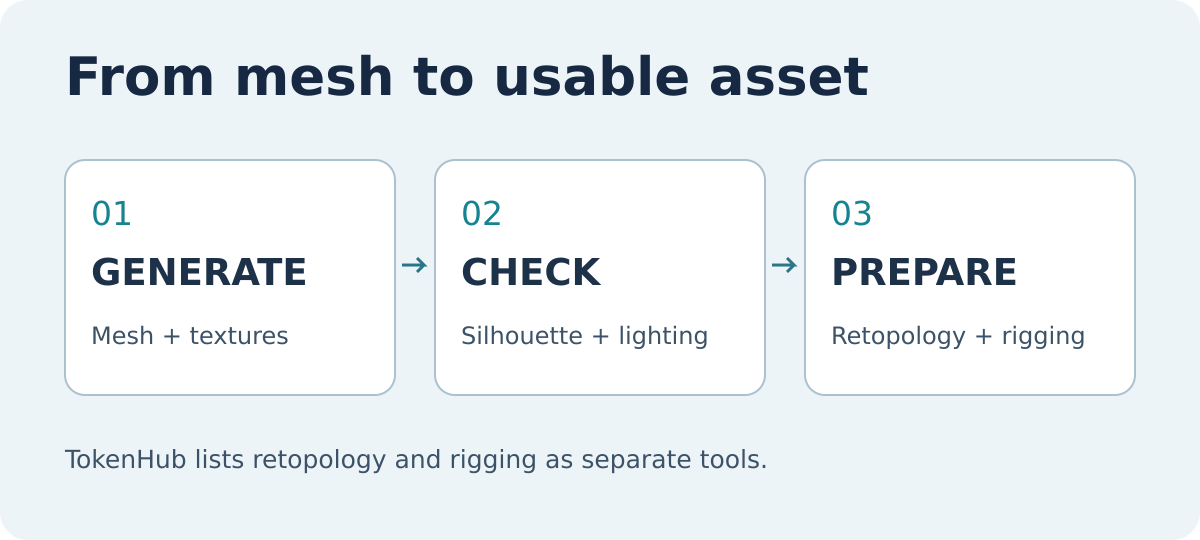
Getting a mesh out is only the first handoff
Tencent’s announcement treats a high-detail output as material for an artist to keep working on. A game team could use it as the source for baking details onto a lighter mesh. An animation team would still need to check whether the geometry deforms at joints. TokenHub lists retopology, UV layout and rigging as separate tools, not steps every 3.6 generation job completes by default.
The model catalog lists text-to-3D, but the current 3.6 invocation guide documents image and multiview requests. The guide is the more useful reference when implementing that endpoint. Providing more views can give the model evidence about surfaces hidden from the front. It is not proof that a generated prop will match every view or meet a studio’s technical requirements.
The benchmark to ask for is cleanup time
Tencent says it organized a blind evaluation with professional 3D artists and modelers and reported better geometry and texture quality for 3.6. The public launch write-up does not establish how long a team spent getting those assets into a game or film pipeline. Testing the same prop under new lighting, checking the mesh and timing the fixes would measure something a good-looking comparison cannot.
P.S. An 8K map is an export option. The useful result is the version a team can move, light and revise without rebuilding it.
Frequently Asked Questions
Q: Where is Hy3D 3.6 available?
A: Tencent lists it in TokenHub as a hosted model. Its launch announcement also names several integrated creation products.
Q: Are PBR textures enabled by default?
A: No. The API guide says they are optional in textured mode and disabled by default.
Q: What texture sizes does the API document?
A: It lists 2K, 4K and 8K, with 4K the default for textured jobs.
Q: Does every job produce two million faces?
A: No. Two million is the default target; the model can adjust the result unless strict face-count mode is selected.
Q: Does a generated model come rigged?
A: A basic generation job is not a promise of a rigged asset. Tencent lists rigging as a separate tool.