On November 27, Sber released the GigaChat 3.5 Omni checkpoint, a multimodal version of its 432-billion-parameter GigaChat 3.5 Ultra. It accepts text, images, audio and video with sound in a single request, then answers in text. The public FP8 weights are MIT-licensed.
That distinction matters when you need to find when a speaker mentions an object on screen. A transcript can tell you what was said; a frame can tell you what was visible. Sber’s model is designed to line up both.
The Soundtrack Is Part of the Input
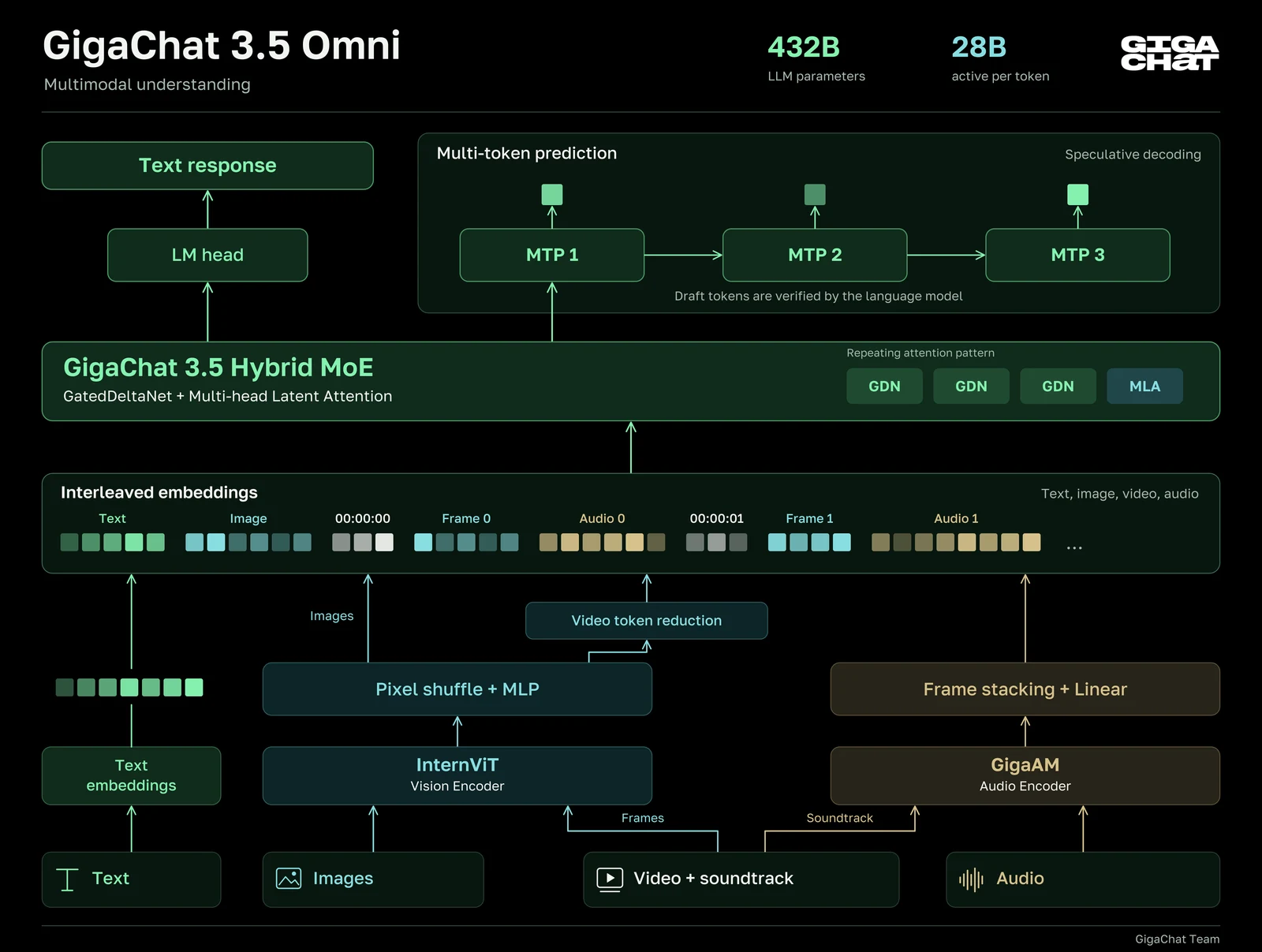
The model samples video at one frame per second, up to 512 frames. It attaches timestamps and interleaves frames with slices of audio to preserve the order of events.
In Sber’s Daily-Omni test, frames plus audio scored 81.04. The same model scored 63.74 with audio alone and 63.16 with frames alone. That shows why both inputs mattered on this test, not how reliably it will handle every recording.
The Benchmark Lead Is Not Across the Board
Across four video-with-sound tests, Sber reports an average of 61.17. Qwen3-Omni-30B-A3B scored 55.26 and MiMo-V2.6-Pro scored 55.10, while Tencent’s WeMM-Video FP8 edged ahead at 61.24. The models did not receive video at identical frame rates or frame caps. These results came from Sber and have not been independently reproduced here.
The Open Download Is Not a Desktop Deployment
The model activates 28 billion parameters per token, but the full checkpoint has 432 billion. The release keeps the vision and audio encoders in BF16. The model card documents a server with eight 80GB H100 GPUs and points to a specific SGLang pull request for serving support.
Sber recorded 152.61 output tokens per second with multi-token prediction for a single request, compared with 73.35 without it. That test used random prompts. It does not tell you how long it takes to upload and analyze a long video.
P.S. Try a task where the answer is clear only when speech and frames are aligned. Then try a quick gesture or a fast cut: one frame per second may miss it entirely.
Frequently Asked Questions
Q: What can GigaChat 3.5 Omni accept?
A: Text, images, audio and video with sound, including combinations of those inputs.
Q: Can it generate audio or video?
A: The published model card describes text responses, not audio or video generation.
Q: Are the weights open for commercial use?
A: Sber lists the published checkpoint under the MIT license.
Q: Does 28B active mean a 28B-sized download?
A: No. It describes the number of active parameters per token, not the size of all the weights.
Q: Did Sber beat every model in its video comparison?
A: No. Its four-test average was 61.17, just below Tencent WeMM-Video FP8’s 61.24.