On November 26, 2026, BharatGen released Patram 1.5, a vision-language model for extracting information from scans, forms, charts and pages that mix languages. Its Hugging Face model card lists 7.8 billion parameters and an Apache 2.0 license. The files are gated: BharatGen says access is granted immediately after users sign in and submit the requested information. The web playground also has a sign-in screen.
The release is worth watching for a reason that has little to do with how much text it can read. Patram can flag an individual value when the page does not support an answer. That gives the person reviewing a scanned document a more specific job than rereading every field.
The first thing to check is what comes back blank
A conventional OCR system can return every character on a page. Patram takes the image directly and accepts instructions about which part to read and how to return it. A team could ask for the dates and totals in a billing table, for example, without asking the model to transcribe the rest of the page.
BharatGen describes four kinds of uncertainty: the answer may be missing, illegible, ambiguous or contradicted by another part of the document. Those cases call for different responses. A blurred number calls for a better scan. Two conflicting totals call for someone to check what each total represents. Treating both as an ordinary prediction hides that difference.
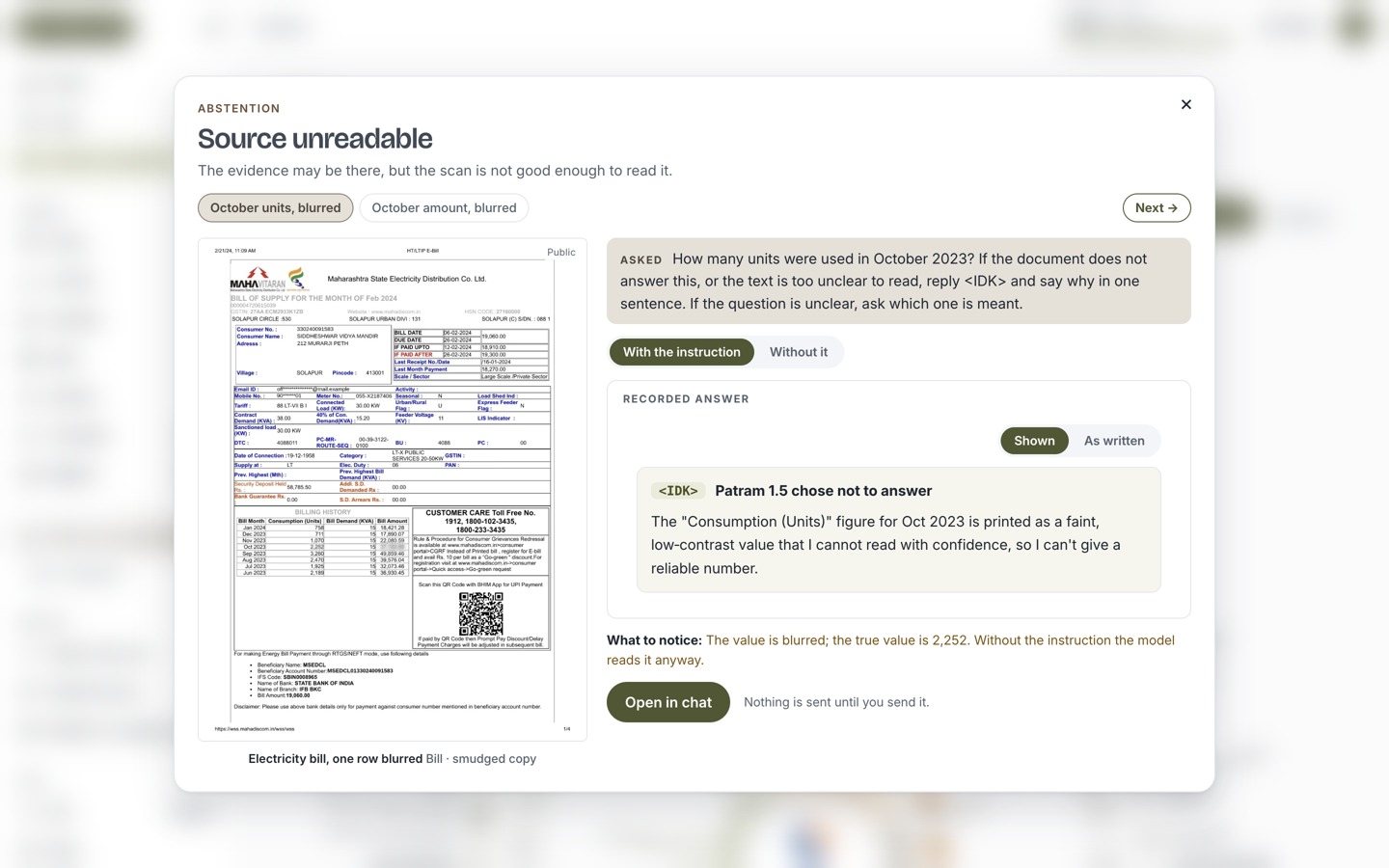
In a recorded demonstration from BharatGen, Patram declines to supply a blurred figure from an electricity bill. It is a useful example of the interface, not an independent test of how often Patram abstains when it should.
The 83 score combines two different tests
BharatGen combined its own 15-task PatramBench with results from 34 public benchmarks, weighting the two groups equally. Patram scored 85 on the first group and 81 on the second, for a combined 83. DeepSeek-V4.1-Flash and Qwen3.5-397B tied it on the combined score in BharatGen’s runs. Two larger models scored a point higher on the public tests alone.
That distinction matters for the documents this release is meant to handle. BharatGen says the public benchmark examples were in English. Teams working with mixed scripts, handwritten annotations or poor scans should bring their own examples instead of treating an average score as a prediction for an entire archive.
On the developer’s abstention test, Patram scored 87 and placed first out of 21 vision-language models. That does not mean it will send exactly the right cases to a human. A team should separately count two kinds of misses: wrong values the model returns confidently, and readable values the model unnecessarily leaves for a reviewer.
The useful trial is one form, not the whole archive
Start with a few dozen versions of a form you already process. Include clear pages, missing fields and bad scans. Give the model the same field names your team uses and keep an independent record of the correct answers. The result you want is a short list of items to review, with enough context to find each on the original page.
BharatGen’s deployment instructions put the vLLM download at about 16 GB, including its patch and examples. That is a package size, not a memory, latency or throughput measurement. The license permits local deployment, which gives teams an option that does not require sending internal documents to the playground. Measure runtime requirements and verify settings before bringing real records into either workflow.
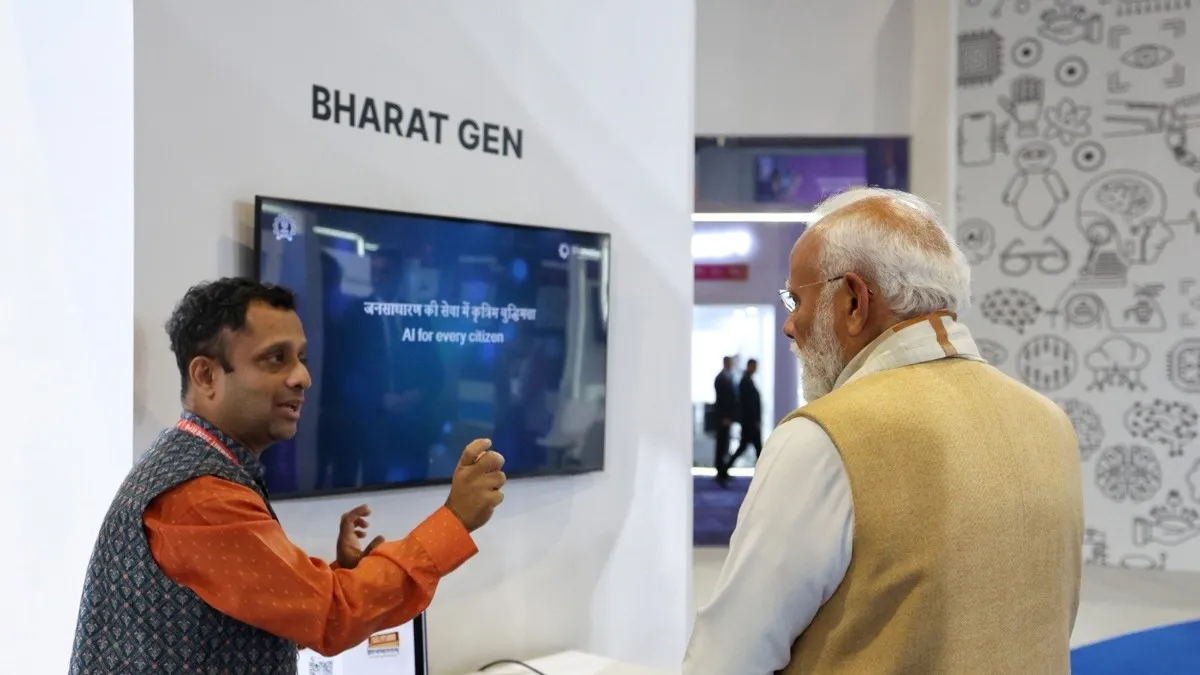
Cover photo: BharatGen founding director Ganesh Ramakrishnan speaks with Indian Prime Minister Narendra Modi at the India AI Impact Summit in February 2026. Courtesy of BharatGen.
P.S. Make a flagged value visible to the reviewer. If your import script silently replaces it with a zero, you’ve just turned uncertainty into a new error.
Frequently Asked Questions
Q: What is Patram 1.5?
A: It is BharatGen’s 7.8-billion-parameter model for reading and answering questions about document images, including scans, forms and charts.
Q: What changed in version 1.5?
A: BharatGen added more control over what the model transcribes and the ability to flag cases where the page does not support an answer.
Q: Can I download the weights?
A: Yes, after signing in on Hugging Face and submitting the requested access information. The model card lists the Apache 2.0 license and says access is granted immediately.
Q: Did Patram beat larger models across the board?
A: No. It tied two larger models on BharatGen’s combined score. Two larger models scored slightly higher on the public English benchmarks alone.
Q: Is the electricity-bill example an independent test?
A: No. It is a recorded example supplied by BharatGen. It shows how Patram can flag an unreadable field, but does not establish that it will always do so.