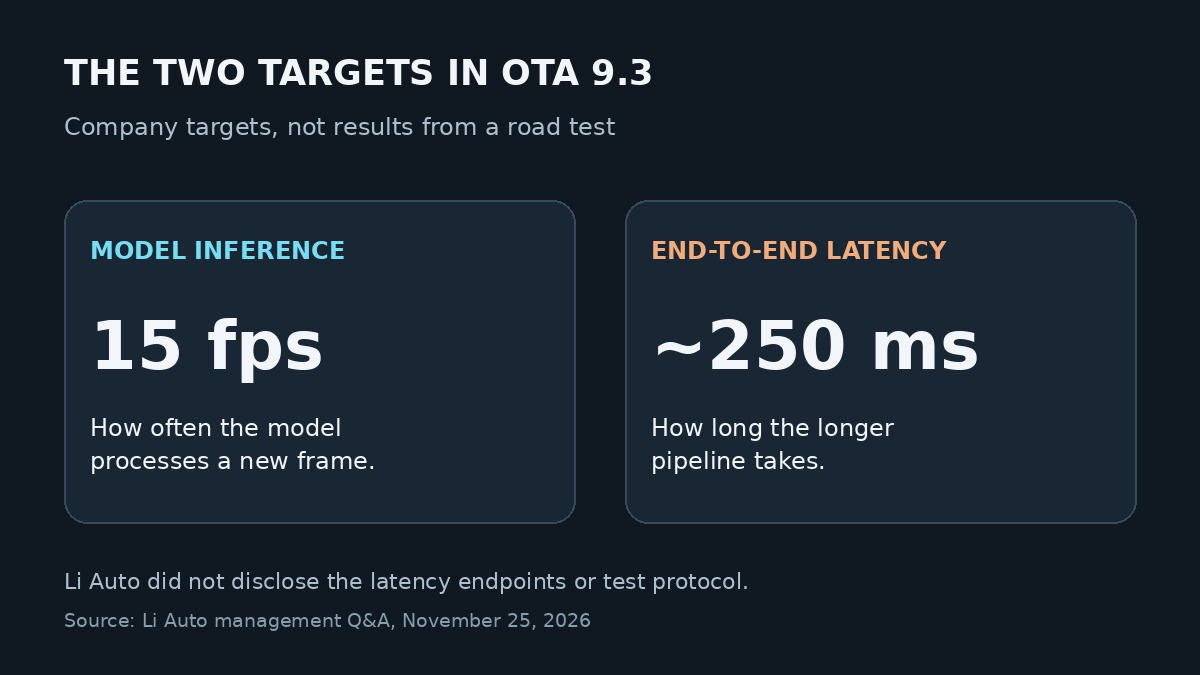
On November 25, 2026, Li Auto Chief Technology Officer Yan Xie detailed two targets for OTA 9.3 on the company's quarterly call: 15 frames per second of model inference and around 250 milliseconds of end-to-end latency. Xie said Li Auto plans to release the driver-assistance update by year-end. The company did not announce an exact release date or an eligibility list in that exchange.
The two numbers measure different things
At 15 frames per second, a model can process a new frame roughly every 67 milliseconds. That is a cadence, not a response time. A system can start processing new observations before it finishes responding to earlier ones. The 250-millisecond target concerns the time across a longer pipeline, whose start and end points Li Auto did not define in its public Q&A.
That distinction matters less on a spec sheet than it does in traffic. A car can process more frames without consistently reacting earlier to an obstructed view or an unexpected maneuver. To tell whether drivers get a more predictable system, we would need comparable runs on the same software and hardware, with a clear account of where the clock starts, where it stops, and how often the delay is worse than the headline number.
The vision model is changing, too
Xie said the company retrained its 3D vision encoder using about 30 percent more data. The encoder helps the model reason about the spatial relationship between roads and objects. More data is a change to the training process; it is not a measured gain in accuracy. The call did not break down which scenarios accounted for the extra data or publish a side-by-side test against the existing build.
The relevant starting point is OTA 9.2. Li Auto had previously announced that the November update would bring MACH VLA 2.5 and revised cockpit features. Version 9.3 is a separate release, so the older update's scope should not be treated as eligibility for the new one.
The release notes matter more than the headline
Li Auto's year-end plan gives owners a window, not a date. The useful next disclosure would pair the figures with a model-by-model rollout list and tests that show whether the targets hold beyond a favorable run. Until then, there is no basis to read 250 milliseconds as braking time, a guarantee across vehicles, or a change in the driver's responsibilities.
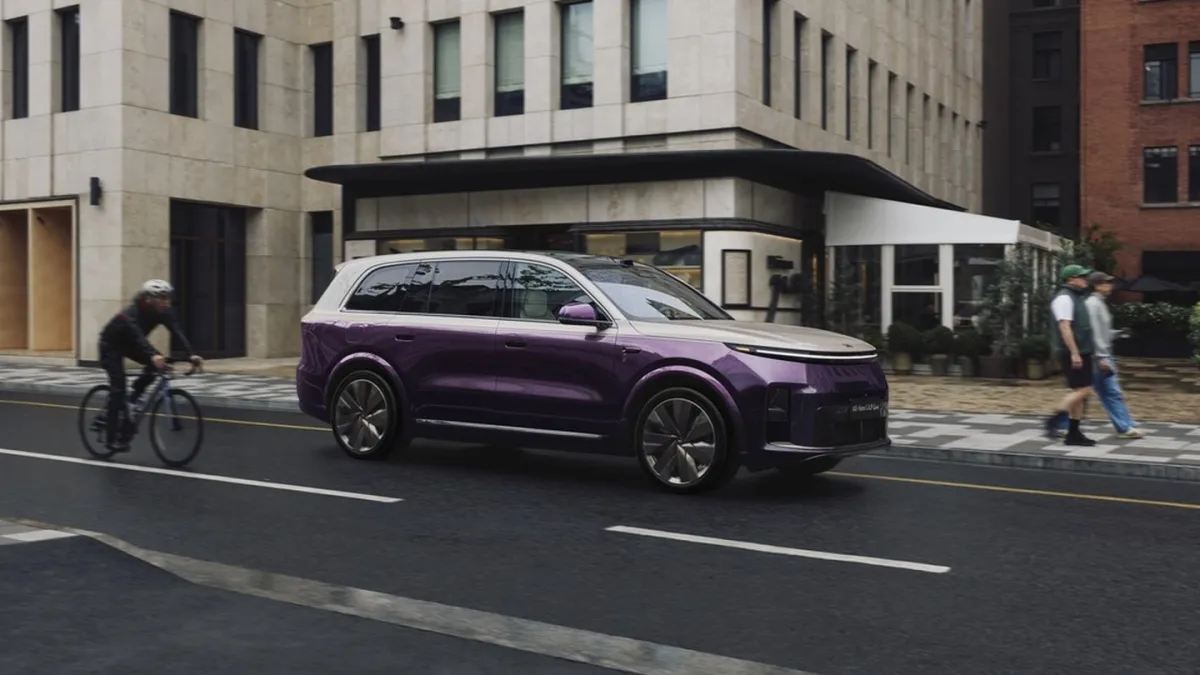
P.S. The November 25 figures are company targets, not measurements from a shipping OTA 9.3 build. A meaningful follow-up starts with release notes and a reproducible test protocol. Cover: Li Auto’s L9 launch imagery, not an OTA 9.3 road test.
Frequently Asked Questions
Q: Has Li Auto released OTA 9.3?
A: No rollout was announced on the call. Li Auto said it plans to release the update by year-end.
Q: What does the 250 ms figure measure?
A: Li Auto calls it an end-to-end latency target. The company did not specify the measurement endpoints or test protocol in the Q&A.
Q: Does 15 fps mean the car reacts every 67 ms?
A: No. The figure describes the model's target inference cadence, not the entire assisted-driving system's response time.
Q: What changed in the vision model?
A: Li Auto says the 3D vision encoder was retrained on about 30 percent more data. It did not disclose a corresponding accuracy gain on the call.
Q: Which vehicles will get the update?
A: Li Auto did not give a model-by-model eligibility list or an exact release date in its OTA 9.3 discussion.