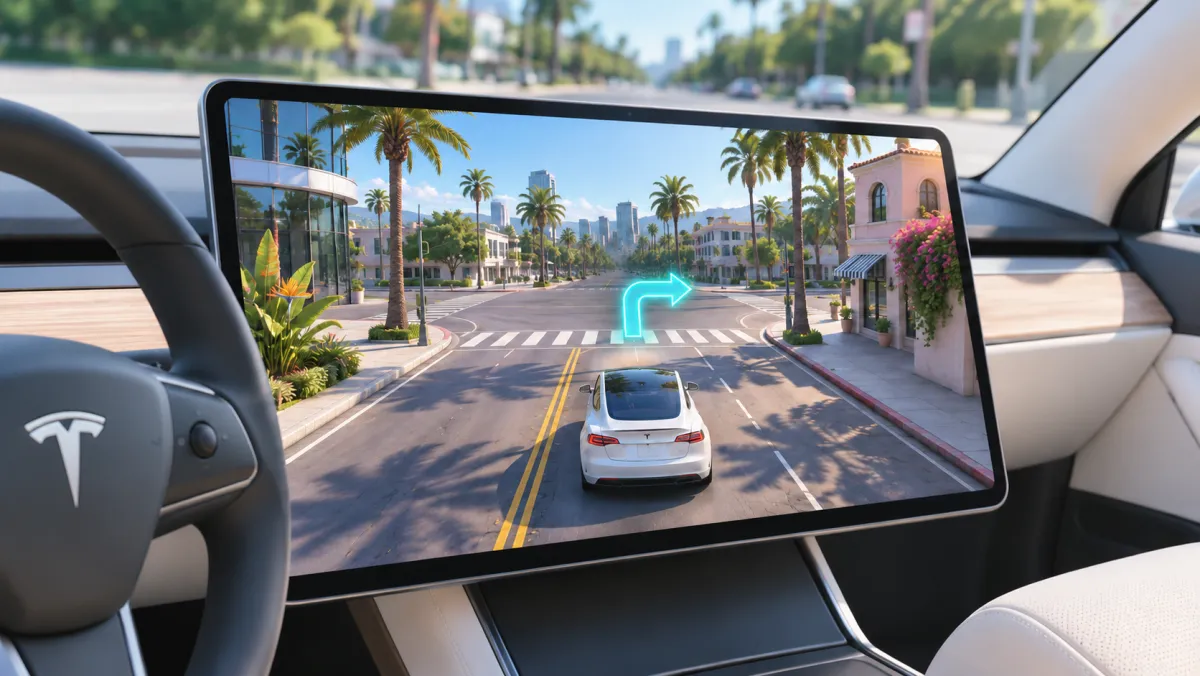
On November 21, 2026, Tesla began rolling out FSD v15 to its first wave of customers. The update changes the end-to-end driving network and adds Reality View, a generated view of the vehicle's surroundings from a virtual camera above it. Arrows show upcoming turns, and pins indicate where the system intends to park.
The New Display Reuses What the Car Already Processes
Earlier FSD displays drew simplified objects and lane lines from separate signals. With Reality View, the system generates a continuous scene from visual features the driving network already computes. Tesla AI lead Ashok Elluswamy describes the display as another output of the end-to-end system.
That reuse is the engineering story. Instead of building a display by drawing every object from a separate signal, Tesla can use the features it already extracted to drive the car. Elon Musk described a separate generation model that takes those shared features and produces the view. The driving system and the display share inputs without doing the same job.
The Compute Claim Has a Narrow Scope
In a side-by-side comparison with an early FSD visualization, Elluswamy said the new view uses less compute. Musk said the rendering uses about half of one accelerator on Tesla's AI4 computer. Neither statement establishes that the entire v15 system uses less compute. Tesla did not provide comparable figures for install size or working memory in those disclosures.
The distinction matters for any device that has to run AI locally. A more detailed image can be cheaper if the system can reuse work it has already done. That tells us something about Tesla's implementation, not that generated graphics are generally cheaper than conventional rendering.
The Driver Needs the Next Move Before It Happens
Reality View has a useful job: show where the car is about to turn or which parking spot it has selected. The test is whether the driver can read that plan soon enough, including when the car changes its mind.
Musk acknowledged that the generated view has noticeable latency and described a possible change that could cut it by roughly 35%. That was a target, not a measured improvement in the first release. A useful comparison would measure the delay from a change in the driving plan to the corresponding change on screen, and report what happens when the display is uncertain or behind.
Tesla has made the driving system's intent more visible. The rollout still needs to show how faithfully the display conveys it under pressure. FSD remains supervised; a more convincing picture is not evidence of safer driving.
P.S. For a follow-up, I would watch the turn arrow when a planned turn changes. A clear change at the right moment would tell us more about the interface than a beautifully rendered street.
Frequently Asked Questions
Q: What is Reality View?
A: A live, generated visualization of the surroundings and planned maneuvers in Tesla's FSD v15. It shows the scene from a virtual camera and overlays cues such as turning arrows or parking pins.
Q: Is it just a live feed from the cameras?
A: No. It is a rendered view derived from the vehicle's visual inputs and the features its model extracts. The overhead viewpoint is virtual.
Q: Does FSD v15 use less storage?
A: Tesla's public comparison describes the compute used for Reality View versus an early visualization. It does not report install size, storage use, or operating memory for either version.
Q: Did Tesla already reduce the display delay by 35%?
A: No. Musk described a possible optimization that could cut latency by approximately 35%. The comment does not establish that the reduction shipped or give a measured baseline.
Q: Does Reality View make FSD autonomous?
A: No. Tesla says FSD (Supervised) still requires active driver supervision. The display gives drivers a view of the system's intent, not a guarantee that the plan or the rendering is correct.
Cover: Editorial illustration of Reality View, not a Tesla screenshot.