On November 26, 2026, at Web Summit in Lisbon, Tony Fadell, known as the father of the iPod, told Fortune that OpenAI had to build its own hardware because it cannot get contextual data from phones. He framed the move as a way around the privacy restrictions Apple imposes on third-party apps. OpenAI needs GPS, microphones, cameras and temperature sensors, he said, and Apple will not hand that data to an app. So OpenAI builds the device, installs the sensors, and owns the data path.
Altman has given a different answer. He has said Apple's privacy limits are not the primary motivation. His version is that laptops and smartphones were designed for humans. The machine spends resources rendering an interface for human eyes, and the AI then reads that interface instead of accessing the underlying data. The phone is not the wrong device because Apple locks it. It is the wrong device because it was built for someone else.
The two answers share a conclusion. The phone is not the right host for AI. But they differ in where the fault lies. Fadell points at an external wall. Altman points at an internal design flaw. Altman's version is more fundamental: even if Apple opened every sensor tomorrow, the phone would still be a middle layer that renders a screen and waits for the AI to read it. Removing that layer is the real motive. The privacy wall is one obstacle on the way there.
What Fadell leaves out
Fadell describes the device as a stripped-down smartphone without a screen, carrying sensors, microphones and cameras, moving data over Wi-Fi or Bluetooth.
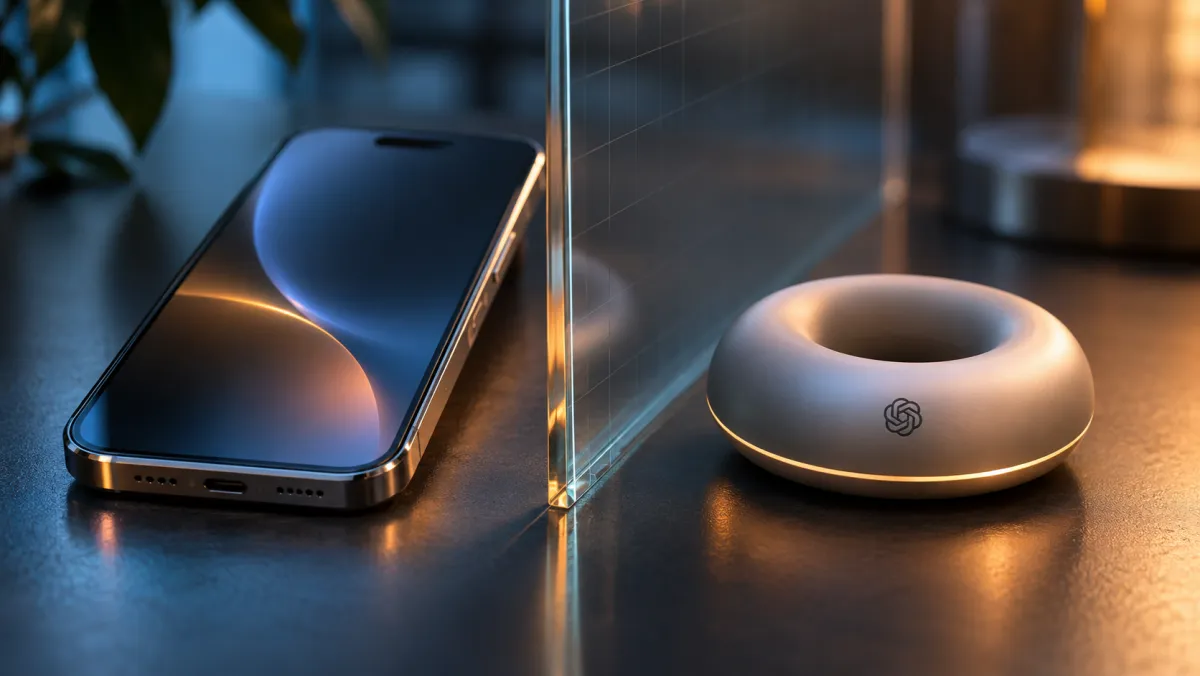
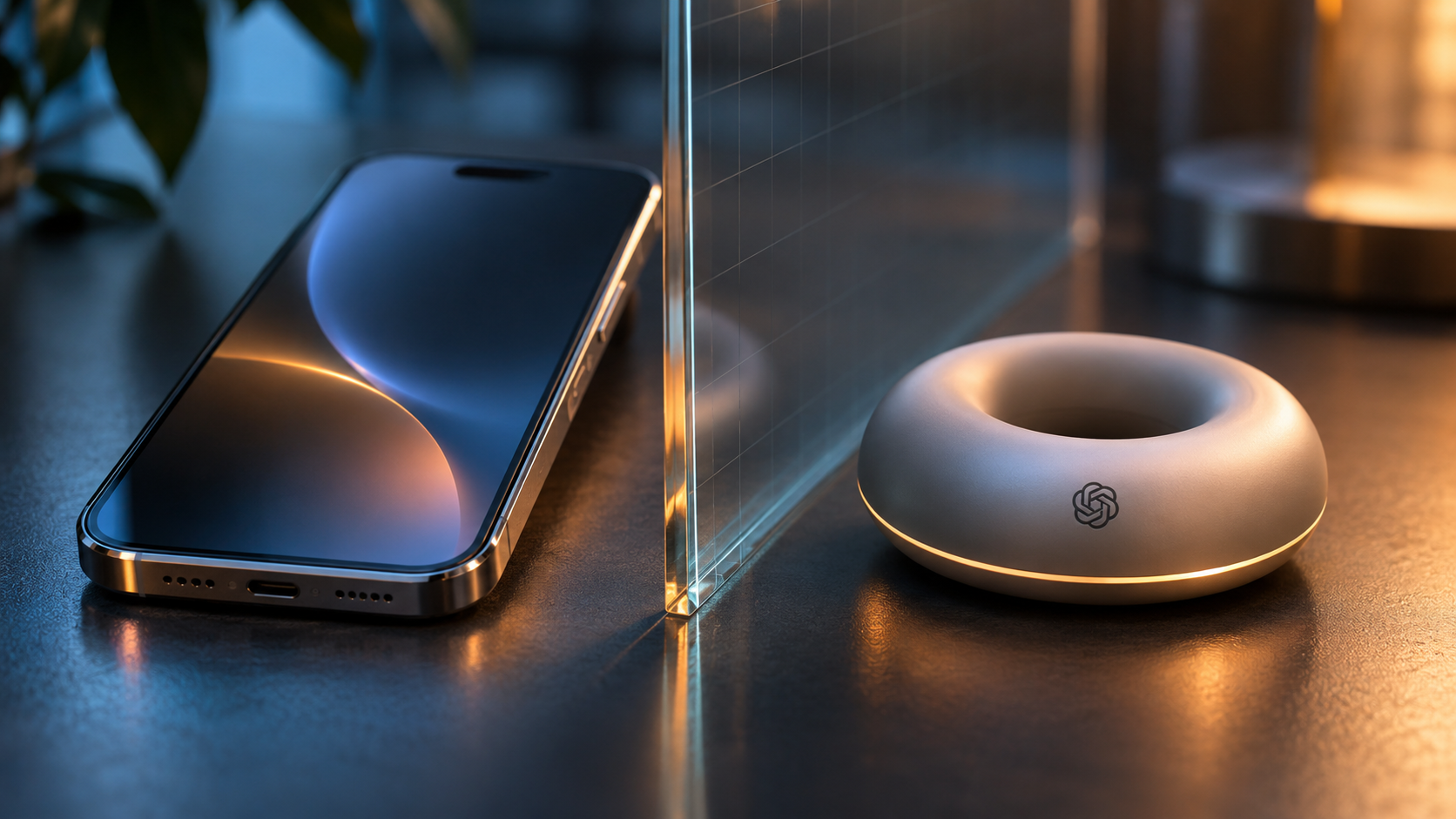
That roughly matches what has leaked. Bloomberg reported a doughnut-shaped, screenless smart speaker the size of a hockey puck, with a camera and sensors, priced between $300 and $400, expected in 2027. Jony Ive's LoveFrom studio designed it, carrying forward the portable logic Ive used on the iMac G3: battery-powered, one-handed, placed on a nightstand or kitchen counter rather than fixed in one spot like a HomePod.
But Fadell did not address the obvious comparison. A phone already sits in the user's pocket with a microphone, a camera and GPS. What a new device adds is not more sensor types. It adds the right to use those sensors continuously and the state of being always on. Fadell combined two different things: Apple's privacy wall and the product decision to be always listening. The first is a restriction. The second is a design choice.
Edge compute is the more practical motive
Fadell also mentioned something that Chinese coverage largely skipped, and it is more grounded than bypassing Apple.
He said OpenAI wants to move part of its AI compute from the cloud onto the user's device, a shift toward edge computing. For simple tasks, a laptop or phone has enough local compute, and there is no need for a round trip to a server. But OpenAI cannot convince Apple to let its devices run OpenAI's compute workloads.
That motive runs on a separate track from data collection. Data collection makes answers better. Edge compute makes answers cheaper and faster. The second is closer to the unit economics.
It also lines up with OpenAI's chip effort. Project Mercury, its in-house inference chip, targets a 50% to 60% reduction in inference cost. A local device that handles high-frequency, low-complexity requests would take pressure off the cloud and cut the cost of every short conversation. If the hardware only collected data, it would not need a custom inference chip. The chip exists because the device is meant to compute, not just listen.
The timeline says the form factor is still open
Fadell's guess is a reasonable external observation, but the OpenAI timeline is earlier than his description implies.
In a February 2026 court filing, OpenAI confirmed its first hardware device would not ship before the end of February 2027. Brockman said in July 2026 that the company was building a family of devices and would move soon, without a date. A product that ships in 2027 can still change shape. Fadell's stripped-down phone is one plausible form. It is not a roadmap.
That gap matters for how the story should be read. Fadell is describing the constraints OpenAI faces, not the product OpenAI has built. The constraints are real. The privacy wall is real. The phone's human-oriented design is real. But the device that resolves those constraints is still being designed.
P.S. Fadell and Altman disagree about why OpenAI needs hardware, and the disagreement is useful. Fadell's answer points at Apple. Altman's answer points at the phone itself. Fadell's own mention of edge compute points at something neither of them emphasized: the device may exist less to see more than to compute closer.
Frequently Asked Questions
Q: What did Tony Fadell say about OpenAI's hardware?
A: At Web Summit Lisbon on November 26, 2026, he said OpenAI needs its own device because Apple will not give a third-party app access to contextual sensors like GPS, cameras and microphones. He described the device as a stripped-down smartphone without a screen.
Q: How does Sam Altman's explanation differ?
A: Altman has said Apple's privacy limits are not the main motivation. His argument is that phones and laptops were designed to render interfaces for humans, and the AI then reads that interface instead of accessing the raw data. The phone is the wrong host because of its human-first design, not just because of Apple's rules.
Q: What is edge compute and why does it matter here?
A: Edge computing means running AI tasks locally on the device instead of sending every request to the cloud. Fadell said OpenAI wants to move simple tasks onto the user's hardware to cut latency and cost. This aligns with OpenAI's Project Mercury inference chip, which targets a 50% to 60% cost reduction.
Q: What is known about the device itself?
A: Bloomberg reported a doughnut-shaped, screenless smart speaker the size of a hockey puck, with a camera and sensors, priced between $300 and $400, expected in 2027. It is designed by Jony Ive's LoveFrom studio.
Q: When will OpenAI ship the device?
A: OpenAI confirmed in a February 2026 court filing that the first device would not ship before the end of February 2027. Brockman said in July 2026 that a family of devices is being developed but gave no date.
Q: Why does the timeline matter for Fadell's description?
A: Because Fadell is describing the constraints, not the product. The privacy wall and the phone's human-first design are real problems. The device that solves them is still being designed, and its final form may differ from Fadell's guess.