
On November 27, 2026, AMD published a second version of its CAE-FastWAM kernel package that adds a runtime for LeRobot, Hugging Face’s robotics framework. AMD reports that the updated package produced a block of robot actions in a median of 17.4 milliseconds on one Instinct MI355X, against 224.8 milliseconds for LeRobot’s default path. The update brings existing optimized GPU code into another framework. It does not release a new robot policy or show a robot completing a job 13 times faster.
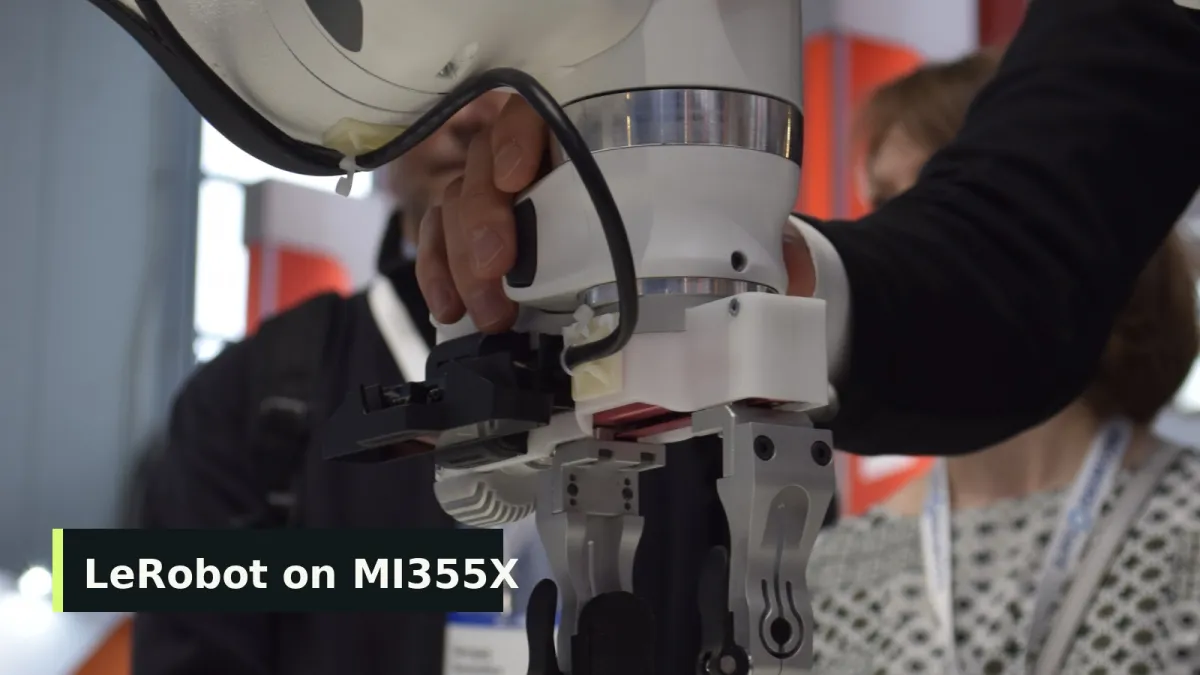
Cover photo: A Franka Emika arm demonstration at CeBIT 2017, not AMD’s benchmark setup. Ims / Wikimedia Commons, cropped and labeled under CC BY-SA 4.0.
What moves over to LeRobot
CAE-FastWAM is a robot policy that turns visual observations, instructions and robot state into a sequence of actions. The first version of the kernel package was pinned to AMD’s Faster Action Models source tree. Version 2 can instead run part of a LeRobot policy that is already loaded, without requiring that separate source tree. The release commit says the four optimized modules came from version 1. The change is in where that code can run, not in the model or accelerator.
The runtime replaces three stages: the visual encoder’s handling of the first frame, the video model’s preparation of context, and the iterative calculation that produces the next block of actions. LeRobot still handles what goes into the model and how the output is decoded into actions. For a team already working in LeRobot, the point is to keep the framework and supported policy while opting into the faster GPU path. There is no claim that these kernels will speed up a different LeRobot policy.
The benchmark times a decision, not a robot
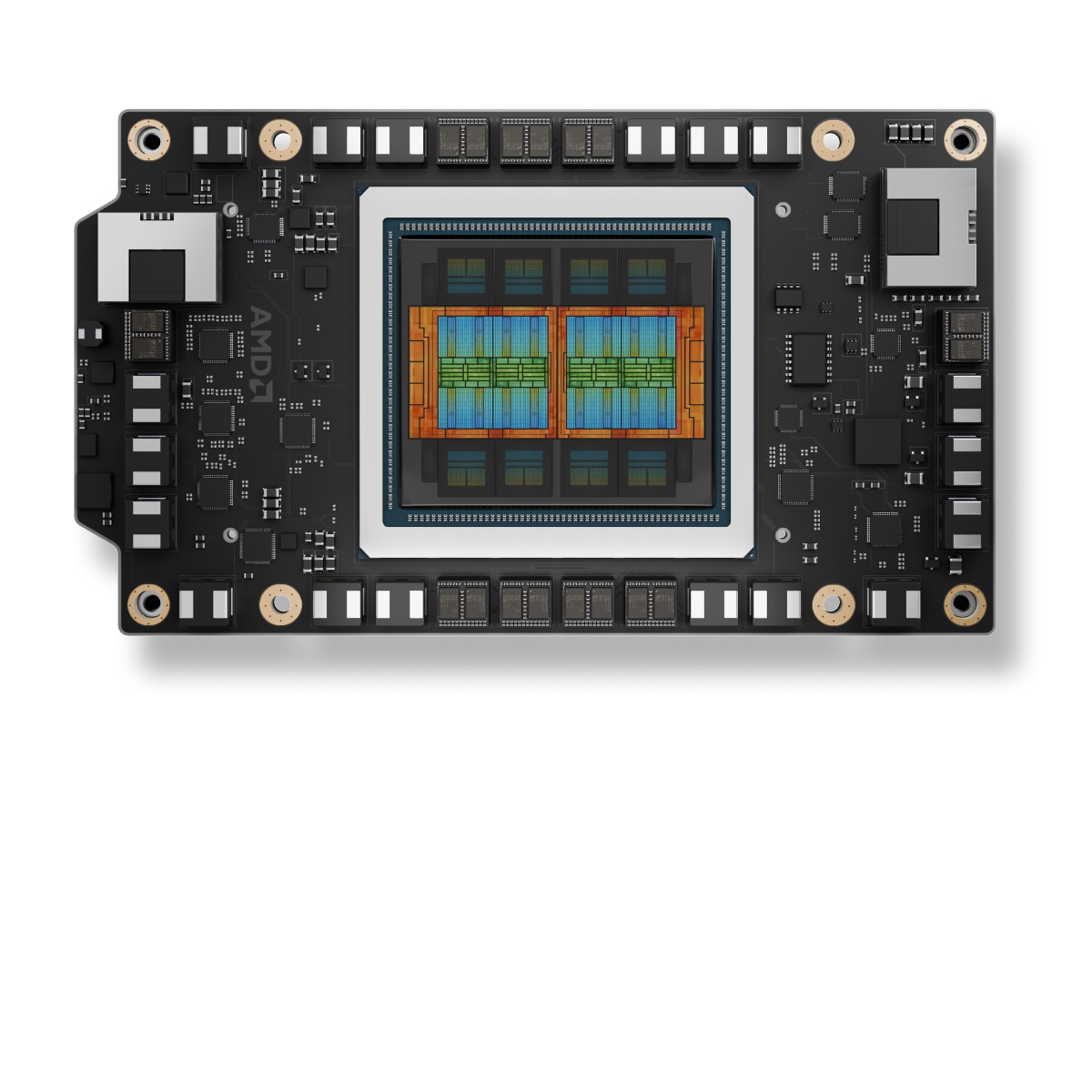
AMD Instinct MI355X product image. Source: AMD. Not the benchmark setup.
AMD’s validation report says both LeRobot paths used the same policy, one MI355X, a batch size of one and ten denoising steps. AMD ran two fresh processes per path, each with 25 warm-up calls and 40 timed calls. The comparison uses the median of each path’s two process medians. Every timed decision returned a block of actions. The clock did not run from a camera capturing an image to a gripper finishing a movement, and it did not include the calls needed to warm up the runtime.
LeRobot’s own compiled mode did not build in AMD’s validation environment. The 12.9× comparison is therefore against LeRobot’s default path, not against a successfully tuned compiled LeRobot baseline. The separate 13.6-millisecond figure on AMD’s kernel card is for its other runtime, outside LeRobot. Substituting that number would mix results from different software paths.
AMD also ran both paths across four LIBERO simulation suites, with ten tasks per suite and two episodes per task. Both paths succeeded on 76 of 80 episodes using the same seeds. That checks for a drop on this workload, but it is a small simulated comparison, not an independent replication or a test on a physical robot. The equal totals hid a difference: AMD’s path completed two more episodes in the spatial suite and two fewer in the goal suite. That is too small a sample to conclude that the runtime makes either set of tasks easier or harder, but the two paths did not succeed on exactly the same episodes.
The faster path keeps more in memory
In that validation, the optimized runtime allocated 28 GB of GPU memory after warm-up, versus 11 GB for LeRobot’s default path, with the text encoder unloaded. AMD reports a 33 GB peak for the optimized path. Part of the cost comes from keeping its own copy of the weights and fused caches. A team sizing a shared inference server should budget for memory as well as time per decision; neither figure says how many simultaneous robots the server can support.
This optimization is inference-only. The release notes specify one runtime per process and say the optimized runtime and the original package’s installation mode cannot be used inside the same process. These constraints make the release easier to try in a controlled evaluation than to drop into an existing service that uses multiple policies.
The published results apply to the MI355X and the matched bfloat16 LeRobot checkpoint. This is not a general speed promise for any Radeon card, even if it has enough memory. The runtime checks the GPU architecture and policy layout before loading. The package is available under Apache 2.0; the LeRobot-format checkpoint is downloaded separately.
The practical follow-up is to measure the decision and the robot loop separately. Faster policy inference can leave more time for sensor capture, communication and control. It cannot tell a team how much time is saved on its own machine, or whether shorter waits improve the outcome. AMD has made the optimized path easier for a particular group of developers to try. Whether it makes their robots better is still a separate experiment.
Frequently Asked Questions
Q: What did AMD release?
A: Version 2 of the CAE-FastWAM kernel package adds an optimized runtime for the matching LeRobot policy on the Instinct MI355X.
Q: What does 17.4 milliseconds measure?
A: The median warm time to generate one block of actions, at batch size one and ten denoising steps in AMD’s test.
Q: What is the comparison baseline?
A: LeRobot’s default path on the same GPU. LeRobot’s own compiled mode did not build in AMD’s test environment.
Q: Did the robot complete more tasks?
A: Both paths succeeded on 76 of 80 simulated LIBERO episodes. AMD did not present a physical robot speed comparison in this validation.
Q: What is the trade-off?
A: The faster path used 28 GB of GPU memory after warm-up against 11 GB for the default, with the text encoder unloaded.