
On November 28, 2026, South Korea’s GS Group broke ground on its AI data center campus in Donghae, on the country’s east coast. The ceremony, scheduled for 11:30 a.m. Korea Standard Time at the Bukpyeong Second General Industrial Complex, marked a move from planning to construction. The government’s science ministry briefing describes the project starting that day as the 1.2-gigawatt first phase. The first facility that actually goes into construction is considerably smaller: 100 megawatts, Yonhap reported from Donghae.
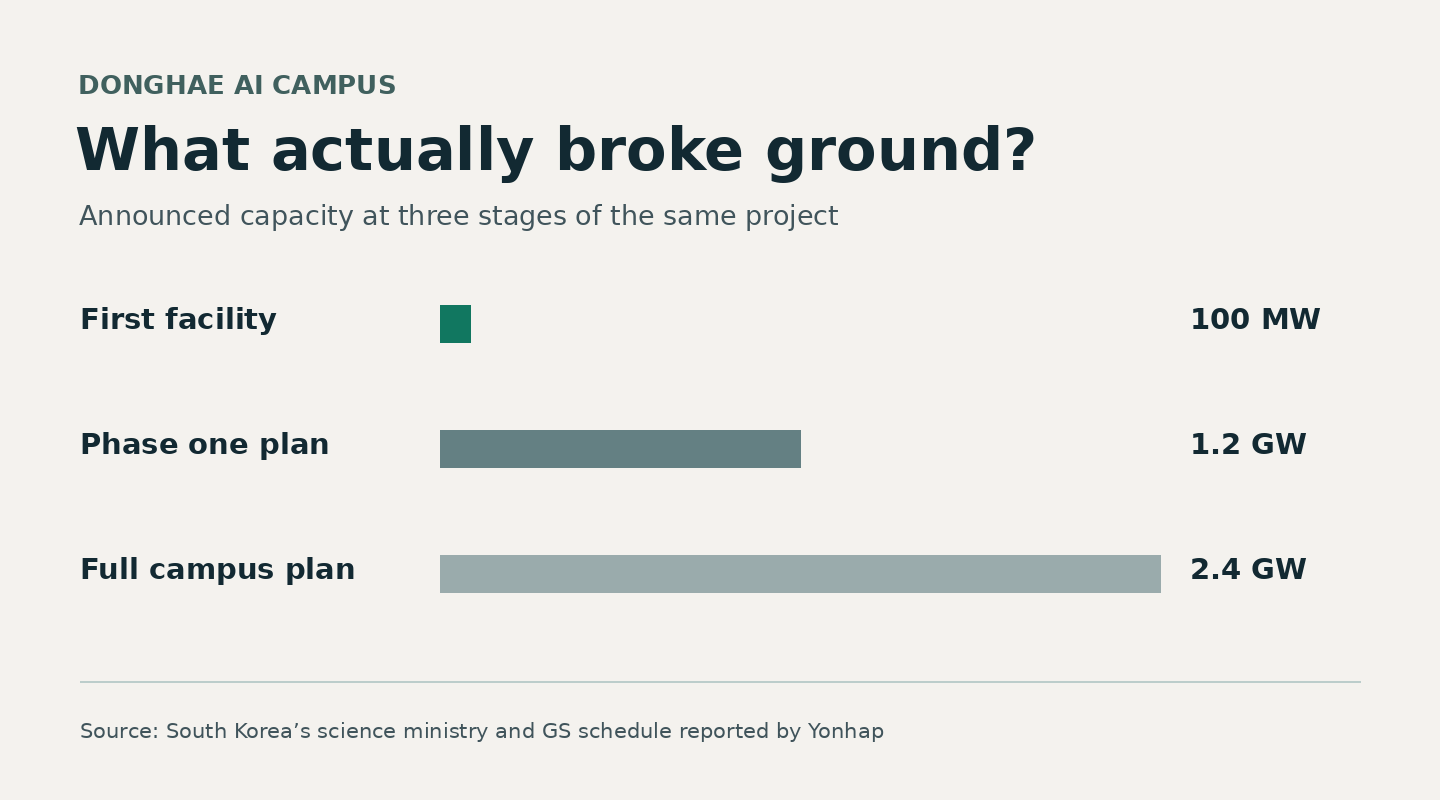
The distinction matters because three different numbers describe the same site, not three estimates of the power available today. The first building is 100 MW. The initial phase is planned at 1.2 GW. The eventual campus plan, announced in June, is 2.4 GW. At the groundbreaking, none of that translated into a new computing service available to developers.
Cover photo: Gangwon Office, via Wikimedia Commons, KOGL Type 1, cropped. The photograph shows the city, not the data center site.
The first building is one-twelfth of phase one
GS plans to finish the first 100 MW center in the second quarter of 2028, according to the company schedule reported by Yonhap. It then expects to complete the other facilities in stages, with completion and operation of the first phase targeted for 2029. The first building alone represents just over eight percent of the phase-one plan and just over four percent of the eventual campus.
That makes the groundbreaking a meaningful checkpoint, but not proof that the entire site will be ready on the same schedule. A later building needs its own construction work and a power supply that can support it. For an AI company weighing where to deploy a large training job, completion of a data hall does not tell it what accelerators it can reserve, how soon it can connect them, or when the operator can deliver usable capacity. The announcement did not give a GPU model, a firm inventory or a customer booking window.
The company’s site plan makes the distinction more tangible. GS expects roughly 700 MW across three areas inside the industrial complex and another 500 MW at an additional site. That is a buildout across multiple facilities, not a single 1.2 GW building. The opening block is the part with the clearest near-term construction milestone.
Dates also describe different milestones. The second quarter of 2028 is a target to finish a building. The 2029 date concerns the wider first phase. Neither date tells readers when the full 2.4 GW campus will be running. Treating all three milestones as one event obscures the part that is new: GS has started the first build.
The coast gives GS a power option, not a finished cooling design
GS chose the Bukpyeong industrial site in part for the east coast’s existing power production base. In the ministry briefing it also cited the possibility of using seawater for cooling in the future. That is a siting consideration, not a statement that the first building has a seawater cooling system or a prediction of how much water it will use.
An industrial site with nearby power generation can be attractive, but proximity does not establish that power is already available to a data hall at the promised scale. Gangwon Province helped with the power-system impact assessment, industrial-site planning changes and construction permits following a July agreement with GS and Donghae. Those are steps toward a build, not substitutes for commissioning the electrical and cooling systems.
The campus is also a test of a regional policy: Seoul is trying to locate substantial AI infrastructure outside the capital area. At Donghae, GS paired the construction plan with proposals to recruit locally and work with regional universities on training. The ministry identified jobs such as server, network, security and facility operations. These are plans, not already filled roles, but they give the city a more concrete standard to judge than a ribbon-cutting alone.
What to watch once the ceremony is over
KTV’s recording of the event includes GS AI Infra’s presentation of the construction and local development plans. The next evidence worth watching will be less ceremonial: completion of the first building, confirmation that the necessary power is available, and details about the computing equipment it will house. These are separate checks, and each answers a different question.
For now, the simplest reading is also the most useful. Donghae has a 100 MW build underway, a 1.2 GW first-phase target, and a 2.4 GW campus plan. The project will matter to AI users when those buildings become powered computing capacity with known equipment and a delivery date. Saturday’s news is that the first part has moved into construction, not that the whole campus has moved into service.
P.S. Ask for a date and an operating status next to each capacity number. A construction start, a finished building and an operating data center are not interchangeable.
Frequently Asked Questions
Q: What started construction in Donghae?
A: The first 100 MW facility in GS Group’s planned AI data center campus.
Q: Is 2.4 GW already available?
A: No. It is the planned capacity of the full campus. Phase one is planned at 1.2 GW.
Q: When does GS expect the first building to be complete?
A: The company schedule targets the second quarter of 2028, with completion and operation of the wider first phase targeted for 2029.
Q: Will the first center use seawater cooling?
A: GS identified potential use of seawater as a reason the site was attractive. The announcement did not confirm that design for the first building.
Q: Which chips will the facility offer?
A: The groundbreaking announcement did not name the accelerators, confirm inventory or give a date for customer access.