
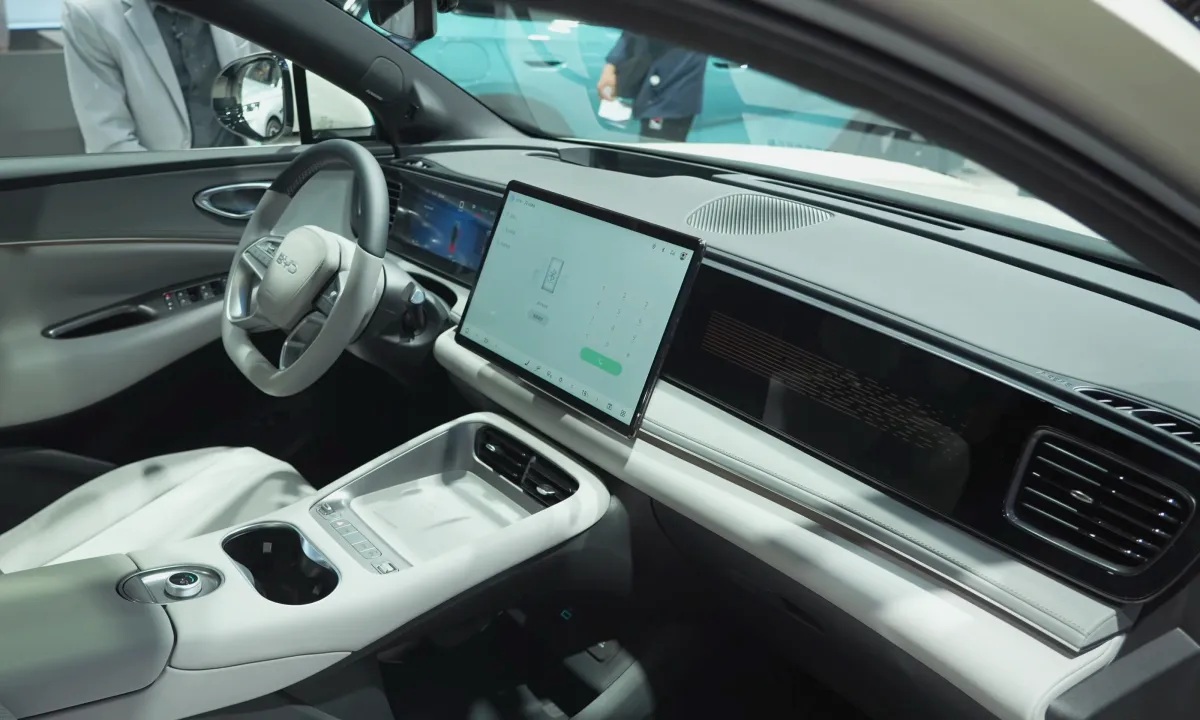
On November 27, Alipay introduced version 3.0 of its in-car assistant at the Guangzhou Auto Show. The company presented a workflow that turns a spoken request into an order or a payment, with voiceprint verification available after the user grants permission. IT Home reported from the show that the services include food ordering, parking, and charging. The announcement did not come with a complete list of cars that can use all of them. Cover photo: iMoD Official, CC BY 3.0 (Auto Shanghai, 2025).
Alipay says it has secured design-in agreements with more than 80 auto brands. That's a measure of how many brands have agreed to integrate the technology, not how many have turned it on. For a driver, the more useful questions are whether their exact model gets it, which services work where they drive, and what the car asks them to confirm before spending money.
The car can do more than find a place to stop
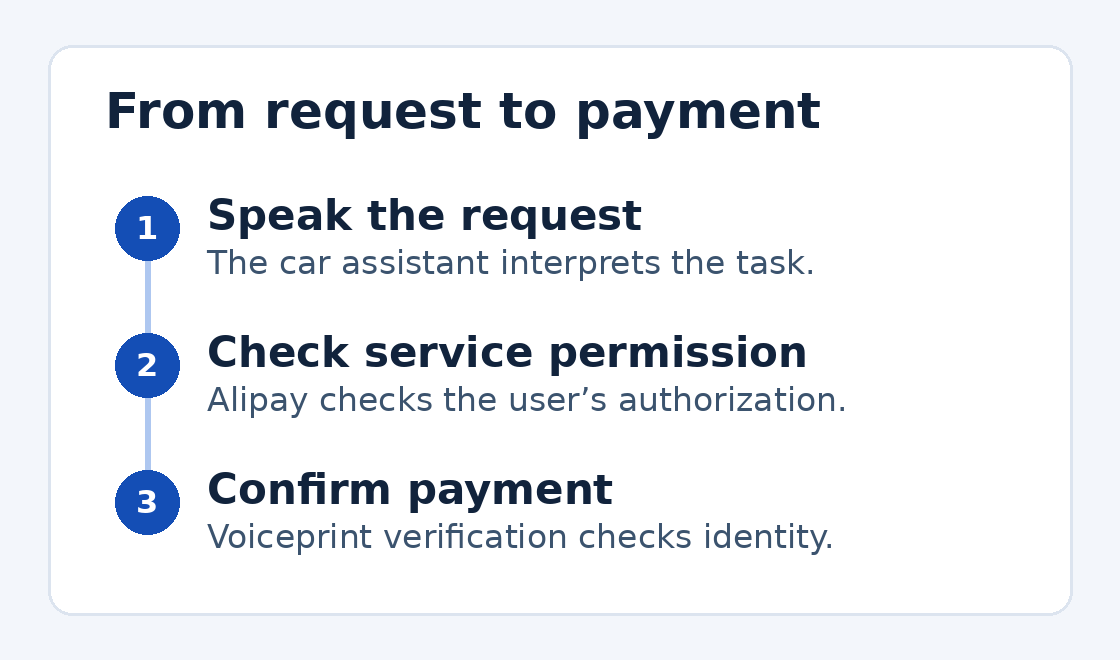
Asking for a charger and paying to use one are different jobs. A voice interface can return a list of nearby stations without holding a payment credential. To complete the transaction, the system has to pass the driver's intent to a service, identify what should be paid for, and verify who is authorizing the payment. Getting the first step right doesn't guarantee the next two.
At the show, Alipay product executive Yang Pengyi described a system that combines intent recognition, connected services, account authorization, and voiceprint payments. Guangzhou Daily reported his presentation, which also identified refueling, tolls, and ticket purchases as use cases. That list describes the scope of the product, not a promise that every merchant, station, or toll road works with it.
Voice ordering and payment aren't new to Alipay's car integrations. In September, Li Auto described voice-triggered fuel and ticket payments. In October Alipay announced a separate agreement with Tesla in China to integrate parking payments into the touchscreen, as the South China Morning Post reported. Neither example establishes that those vehicles get every 3.0 feature. Guangzhou was about a broader integration and a more explicit permission model, not the first time someone could order food from a car.
A voiceprint is not a blank check
Alipay says users can view, change, or revoke the approval they give the assistant. Its APASS authorization system separately protects service accounts and credentials, according to the launch coverage. Voiceprint verification is the identity check described for payment confirmation. The two serve different purposes: one limits which actions the assistant can take; the other helps determine whether the person approving a payment is the authorized user.
A useful real-world test would be whether the cabin clearly reads back the amount and merchant, then stops if the person changes their mind. A shared car raises equally practical questions: Can a passenger start an order someone else must approve? How does the feature behave when music is playing or when two people speak? And does the car offer a conventional way to check the charge and resolve a mistake?
Those aren't reported failures, and the launch coverage doesn't establish the answers. It also doesn't publish independent measurements for noisy cabins or a full breakdown of data retention by automaker. Until those details are available, the right distinction is between what Alipay says its authorization system does and what a specific vehicle has demonstrated in ordinary use.
Look for a model and an update, not a brand logo
Alipay named BYD, Li Auto, Chery, Deepal, and BAIC's Arcfox among the brands with related vehicles moving through production and delivery. It also said companies including Zeekr would begin over-the-air updates after the show. The Beijing News's on-site coverage reported that BAIC would be among the first to adopt the wider Alipay Inside Car offering and named the Xingtan 5X as a planned integration. None of those statements supplies a universal update date or proves that an existing car has received voice payment.
The rollout is worth watching because it puts the payment layer inside a service the driver may already know as the automaker's assistant. That can reduce the friction of switching from dashboard to phone. It also makes the handoff between automaker, account provider, and merchant more consequential: when an order is wrong, the driver needs to know which screen shows it and who can fix it.
For now, a model-specific release note is more useful than the alliance's partner count. It should tell a driver which actions have actually arrived, whether they are available in the places that driver goes, and exactly when the system asks before it pays.
P.S. The next meaningful milestone isn't another partner announcement. It's a named vehicle update that spells out which payments work, how owners confirm them, and how they turn them off.
Frequently Asked Questions
Q: What did Alipay announce at the Guangzhou Auto Show?
A: It introduced Car Assistant 3.0, an in-car service and payment integration with voiceprint verification for authorized payments.
Q: Do more than 80 brands already offer it to drivers?
A: No. Alipay described design-in agreements with more than 80 brands. That is not an installed base or a list of vehicles with all features live.
Q: Will Zeekr get the features through an update?
A: Alipay named Zeekr among brands planning updates after the event, but the launch coverage did not give a date for every model.
Q: Does a spoken request always authorize a purchase?
A: Alipay describes user-granted service permissions and voiceprint verification for payment confirmation. The coverage does not document every vehicle's confirmation flow.
Q: Is this a new self-driving feature?
A: No. The update concerns in-cabin services and payment, not control of the vehicle.