On November 25, 2026, OpenAI CEO Sam Altman said on X that the company is testing Private Inference with a small group of customers. OpenAI had previewed the feature at DevDay on September 29. Its product page labels it alpha and places it in the API workflow. Neither source names the participating customers or gives a wider release date.
The privacy question moves inside the request
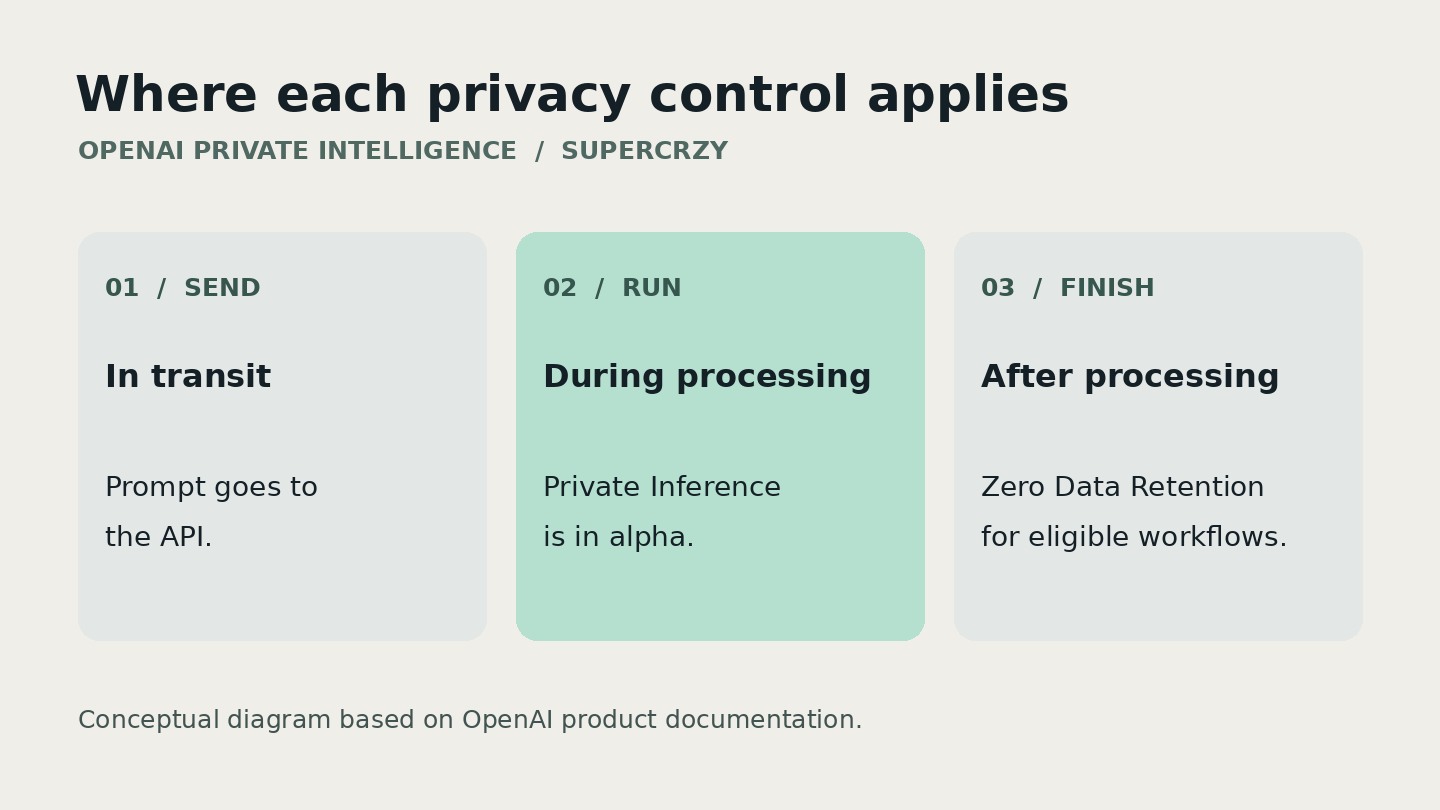
A confidential contract might be encrypted on its way to an API and discarded after the response. Neither tells a buyer what protects it in the middle, when the model reads it. OpenAI says Private Inference uses confidential computing and other controls to protect prompts and responses during processing.
The model is not running on the customer’s own machine. The company’s diagram places the protected processing inside OpenAI’s environment. For teams evaluating the alpha, the question is what they can verify about that environment, not just whether their app connects over HTTPS.
What zero retention does, and what it doesn’t
Zero Data Retention concerns whether OpenAI keeps prompts or responses after processing for eligible API workloads. Private Safety Processing concerns automated safety reviews without giving OpenAI personnel access to underlying content. The DevDay announcement describes that combination separately from Private Inference.
A team with a no-retention requirement and one that needs evidence of protection during processing are asking different questions. An existing no-retention agreement is not on its own evidence that requests use the new alpha.
The trial is not an availability announcement
OpenAI hasn’t said which models and endpoints the alpha supports, nor given a price or a wider rollout date in the announcement. It has an interest form, not a sign-up path that guarantees access.
The practical test is whether a customer can verify the protection applies to the request they will send. That includes asking what evidence exists for the selected endpoint, and whether related steps such as tool calls or file handling fall inside the same boundary. The announcement does not settle those questions.
P.S. Look for a customer-verifiable description of where the protection starts, where it stops, and what happens when a request falls outside it.
Frequently Asked Questions (FAQ)
Q: Has OpenAI launched Private Inference to everyone?
A: No. Altman described a small customer test; the product page labels it alpha.
Q: What is it designed to protect?
A: OpenAI says it is designed to protect prompts and responses while a model processes them.
Q: Does it replace Zero Data Retention?
A: No. Zero Data Retention concerns retention after processing; Private Inference concerns protection during processing.
Q: Does the model run on the customer’s machine?
A: No. OpenAI places it in its own API environment.
Q: Which models and endpoints are included?
A: The announcement does not name them. OpenAI provides an interest form.