
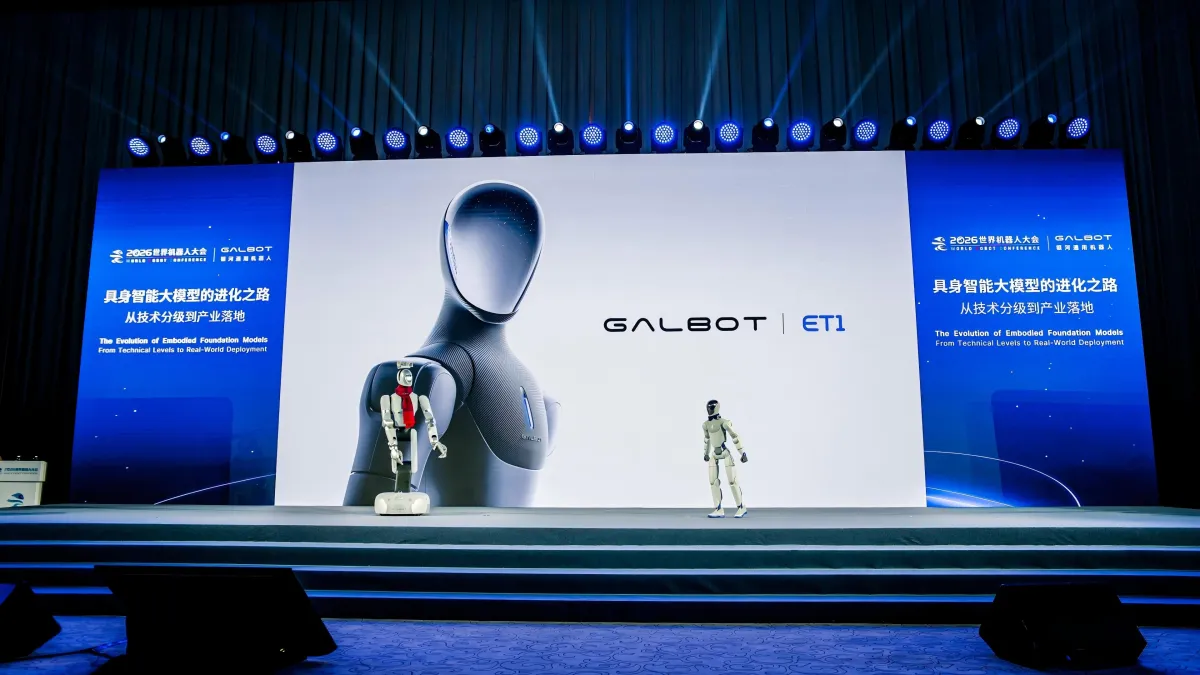
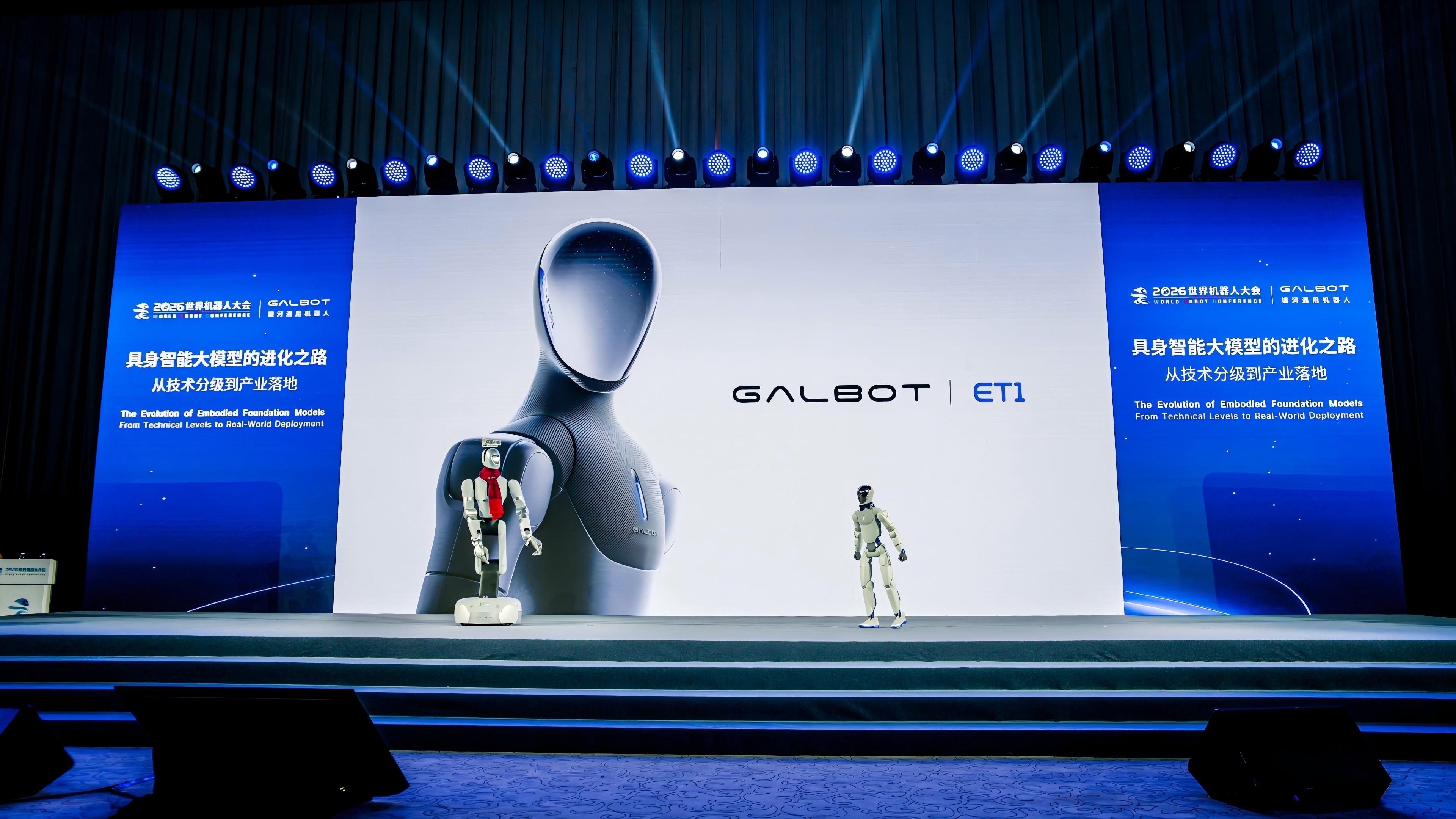
At the World Robot Conference on August 19, Galaxea Robotics unveiled Galbot ET1, a bipedal humanoid it calls the world's first autonomous learning embodied AI agent. But the real story isn't the robot. It's the brain behind it. Galaxea's AstraBrain drives bipedal, wheeled, and heavy-load robots from a single foundation model—a feat the industry has never pulled off before.
The "Galaxy Star Kid" stands out for its small, lightweight frame and fabric-like surface finish. But the hardware is secondary to what's inside: the AstraBrain-Agent, a "physical world native agent" designed for real-time multimodal interaction and movement. The robot observes its surroundings, understands human language commands, and dynamically plans its next moves, without relying on motion capture or pre-scripted action sequences.
The demonstration that caught the most attention was a dance routine: ET1 tracked a human dancer's real-time movements, matching difficult floor moves and even handstands. This is not a pre-programmed performance. The robot is interpreting and responding to dynamic visual inputs on the fly.
One Foundation Model, Three Robots
Galaxea's approach is fundamentally different from the rest of the industry. Most robotics companies build one model for one robot in one scenario. Galaxea is betting on "one brain, many bodies."
AstraBrain uses a "brain-bridge-cerebellum" architecture: the brain (WAM, or World-Action Model) handles perception and planning; the cerebellum (WBC, Whole-Body Control) governs real-time movement; and the bridge translates high-level intentions into physical actions. The same foundation model drives Galbot G1 in retail, Galbot S1 in heavy industrial material handling, and the new ET1 in bipedal tasks.
In industrial settings, S1 has been running 24/7 for over three months on CATL's production lines—unassisted, with zero teleoperation. That's the first time a humanoid robot has been deployed autonomously in a new-energy manufacturing line at this scale. Galaxea has also partnered with Bosch, SAIC, and Hyundai, among others. Robots are entering factories for quality inspection, material handling, and sorting—all powered by the same model.
The Robot Learns by Watching. No Data Labeling Required.
The breakthrough that makes ET1 "autonomous learning" possible is the WAM-TTT framework, which Galaxea released in July. It allows robots to adapt to new environments during deployment using only a few minutes of human demonstration video—no robot data required, no manual annotation needed. The model freezes its main parameters and writes new task information into a temporary memory module.
The results are dramatic. In cross-environment tests, WAM-TTT achieved a 75.6% skill retention rate after deployment, compared to just 15% for In-Context Learning. On nine unseen home tasks—folding clothes, clearing tables, turning bottles—WAM-TTT outperformed every other method tested.
One demonstration at WRC showed the robot being interrupted mid-task. A cup was taken away; a target was blocked. The robot paused, re-planned, and continued. That's the difference between "following a script" and "understanding a task."
The Robot Brain Race Has Replaced the Body Race
Galaxea's announcement signals a shift in the robotics industry. For years, the competition was about hardware: more degrees of freedom, stronger torque, better dexterity. Those advantages are real, but they are also diminishing. The new frontier is generalization: can the same intelligence drive different bodies, in different environments, on different tasks, without retraining?
Galaxea is not the only company working on this. But it is the first to demonstrate that a single foundation model can govern bipedal, wheeled, and industrial robots across retail, factory, and home scenarios. Competitors like Figure, Tesla (Optimus), and Unitree may have stronger hardware, but they have not yet shown the same degree of cross-body, cross-scenario generalization.
The industry consensus is forming: the ceiling for humanoid robots increasingly depends on the brain, not the body. The more bodies a brain enters, the more real-world data it accumulates, and the higher the next robot's starting point becomes.
P.S. Galaxea announced it will open its simulation platform, data acquisition tools, embodied foundation model, and reinforcement learning post-training pipeline to technology partners and developers. In embodied AI, scale comes from data diversity. Opening the ecosystem means more participants, more scenarios, more edge cases—and a faster path to general intelligence. The race is no longer about who builds the best body. It's about who builds the brain that learns from every body.
Frequently Asked Questions
Q: What is Galaxea's Galbot ET1?
A: Galbot ET1 is a bipedal humanoid robot unveiled at the World Robot Conference on August 19, 2026. Galaxea calls it the world's first "autonomous learning embodied AI agent." It's powered by AstraBrain, a foundation model that drives multiple robot types.
Q: How is Galaxea's approach different from other robotics companies?
A: Most robotics companies build one model for one robot in one scenario. Galaxea is building "one brain, many bodies"—a single foundation model that drives bipedal, wheeled, and heavy-load industrial robots across different environments without retraining.
Q: What is AstraBrain?
A: AstraBrain is Galaxea's foundation model for embodied AI. It uses a "brain-bridge-cerebellum" architecture: the brain (WAM, World-Action Model) handles perception and planning; the cerebellum (WBC, Whole-Body Control) governs real-time movement; and the bridge translates intentions into physical actions.
Q: What is WAM-TTT and why does it matter?
A: WAM-TTT (World-Action Model with Test-Time Training) is a framework that allows robots to adapt to new environments during deployment using only a few minutes of human demonstration video—no robot data required, no manual annotation needed. It achieved a 75.6% skill retention rate compared to just 15% for other methods.
Q: What real-world deployments has Galaxea achieved?
A: Galaxea's S1 heavy-load robot has been running 24/7 for over three months on CATL's production lines—unassisted, with zero teleoperation. This is the first time a humanoid robot has been deployed autonomously in a new-energy manufacturing line at this scale. Galaxea has also partnered with Bosch, SAIC, and Hyundai.
Q: How does ET1 learn new tasks?
A: ET1 learns by watching. It can observe a human demonstration (even from a phone video) and adapt to new tasks without requiring motion capture, pre-scripted action sequences, or manual data labeling. The model freezes its main parameters and writes new task information into a temporary memory module.
Q: What did the WRC demonstration show?
A: ET1 tracked a human dancer's real-time movements, matching difficult floor moves and even handstands—without pre-programmed trajectories. In another demonstration, when a cup was taken away mid-task, the robot paused, re-planned, and continued. This shows the difference between "following a script" and "understanding a task."
Q: How does Galaxea compare to competitors like Figure, Tesla, or Unitree?
A: Galaxea is the first to demonstrate that a single foundation model can govern bipedal, wheeled, and industrial robots across retail, factory, and home scenarios. Competitors like Figure, Tesla (Optimus), and Unitree may have stronger hardware, but they have not yet shown the same degree of cross-body, cross-scenario generalization.
Q: What does "one brain, many bodies" mean in practice?
A: The same AstraBrain foundation model drives Galbot G1 in retail (product handling), Galbot S1 in heavy industrial material handling (running 24/7 at CATL), and the new ET1 in bipedal tasks. The hardware changes; the intelligence stays the same.
Q: What is Galaxea's open ecosystem strategy?
A: Galaxea announced it will open its simulation platform, data acquisition tools, embodied foundation model, and reinforcement learning post-training pipeline to technology partners and developers. In embodied AI, scale comes from data diversity—more participants, more scenarios, and more edge cases lead to a faster path to general intelligence.