On November 26, Robbyant published LingBot-Navi’s inference code and model weights, alongside a dataset of reconstructed scenes. It gives robotics teams a way to test a useful idea: Can a machine find something it saw earlier, even when it can no longer see it?
The release has two boundaries worth reading before downloading. The model and the scene data come with different permissions. And while the project ships a simulated demonstration, that demonstration is not the same as driving a robot safely through a busy room.
The Robot Can Use What It Saw in Another Room
Suppose a robot passes two near-identical chairs. One is beside a pink vase, and the other is beside a striped vase. When someone asks for the chair by the striped vase, the robot needs to connect the instruction to something that may be out of view. Robbyant uses that distinction in its object-grounding examples.
LingBot-Navi attaches visual information to surfaces reconstructed from earlier camera views. The system stores that memory in blocks, then uses the current image and a text instruction to locate a target, estimate its own position or suggest a route. The Navigation Transformer starts from Qwen3.5-4B. A separate Local Planner follows the route in the project examples.
There is a difference between retaining a sequence of pictures and knowing how those pictures relate in space. In Robbyant’s demo, six camera segments supply 387 frames for building a reusable representation. Later examples query that representation rather than trying to solve each instruction from the current frame alone.
The Model and the Dataset Come With Different Terms
Both sets of model weights, the Navigation Transformer and the Local Planner, are listed under Apache 2.0. The inference repository also uses Apache 2.0, with notices for third-party work. Teams can study and adapt the model under those terms without assuming the same permission applies to every resource linked in the project.
The dataset is licensed separately under CC BY-NC-SA 4.0. Its 511 reconstructed scenes include 475 for training and 36 for testing, across seven venue types. Individual third-party objects in the test archive retain their own licenses. A team building a commercial product should plan to use data it has permission to use rather than treating the training scenes as part of the Apache grant.
The documented setup calls for x86-64 Linux, Python 3.10 or newer, and an NVIDIA GPU. The spatial-memory example uses LingBot-Map 1.0. The separate Map 2.0 release is not a prerequisite for the documented recipe.
The Demo Does Not Test Collisions
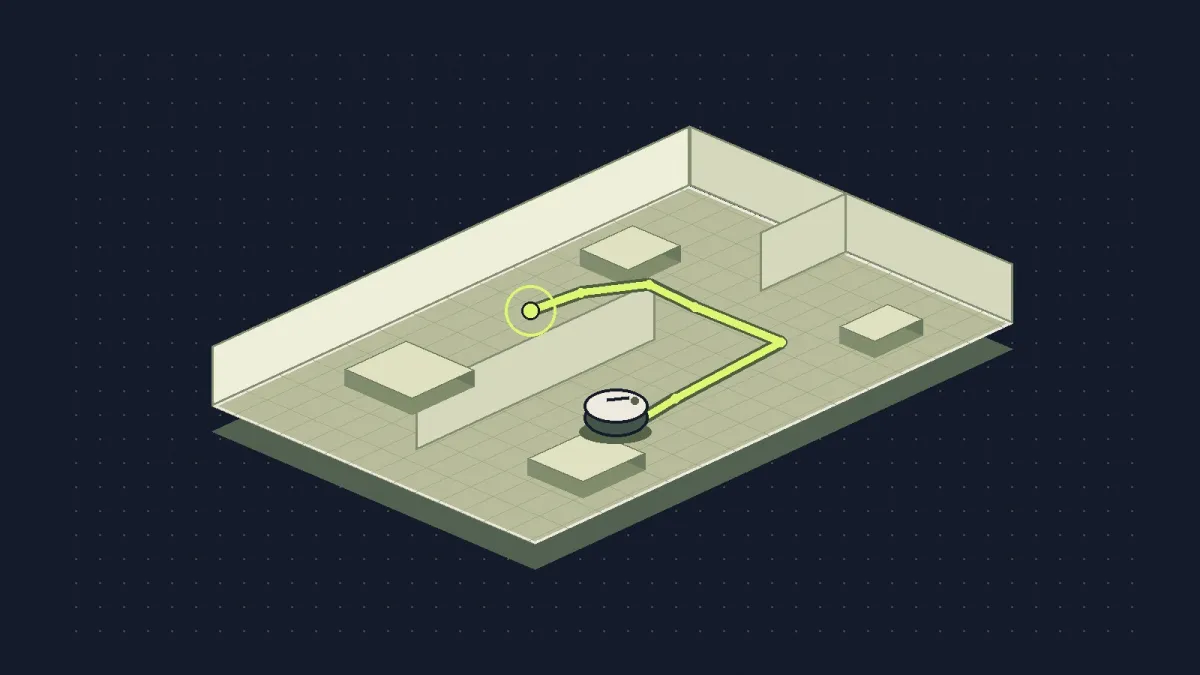
Robbyant shows a simulated rollout that stops 3 centimeters from the endpoint of its predicted route. The reference point is the end of the planned path, not necessarily the correct destination. The example uses rendered views and kinematic updates without collision physics.
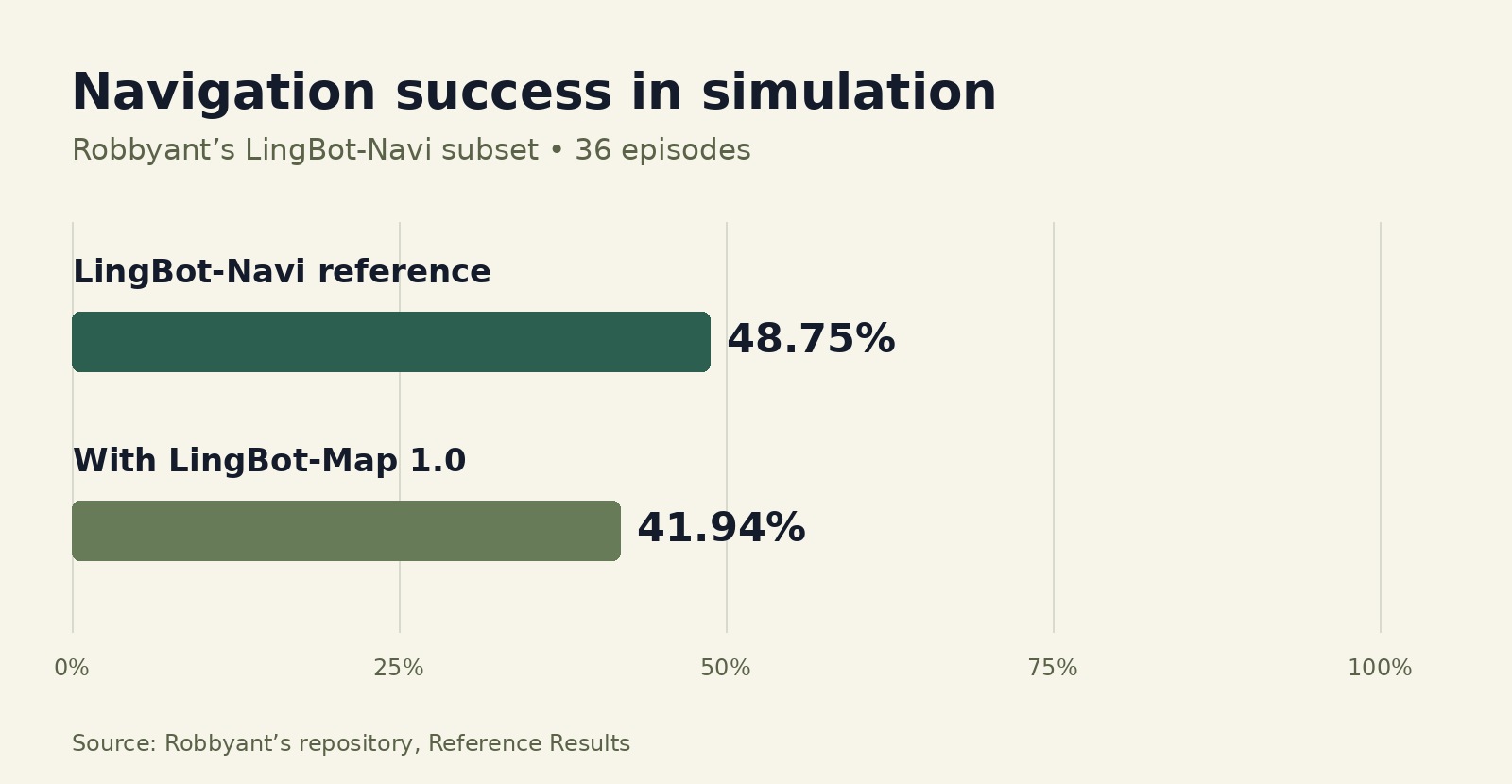
The repository reports 48.75% success for its reference configuration and 41.94% for the configuration labeled with LingBot-Map 1.0 on that subset. Its GOAT rows use a different setup and should not be read as a direct comparison.
That makes the release useful for a narrower task: testing when previous observations help a robot navigation system and where the map stops being reliable enough to guide it.
P.S. For a first test, put two similar targets in different rooms. Ask for one after it leaves the camera’s view, then move it and repeat. Log whether the system finds the right object, not just whether it gets to the end of its route.
Frequently Asked Questions
Q: What did Robbyant release?
A: Inference code, two sets of model weights, examples and a dataset for building and testing spatial memory in robot navigation.
Q: Can I use the weights commercially?
A: Both weight sets use Apache 2.0, which permits commercial use subject to its terms. The separately licensed dataset is noncommercial.
Q: Does the sample require LingBot-Map 2.0?
A: No. The repository documents LingBot-Map 1.0 for the spatial-memory demo and the named evaluation configuration.
Q: How many scenes are in the dataset?
A: Robbyant lists 511 reconstructed scenes: 475 for training and 36 for testing.
Q: Does the release prove a robot can navigate a crowded site?
A: No. The featured simulation does not model collisions, and the benchmark numbers are for that test setup.