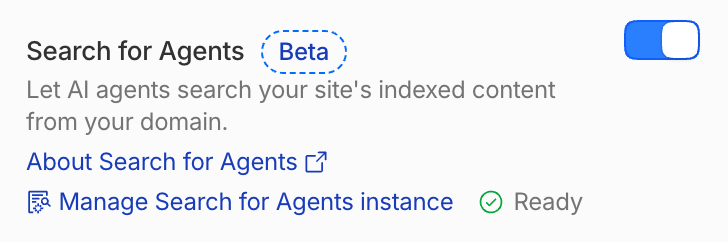
On November 25, 2026, Cloudflare introduced Search for Agents, a beta that turns a website into a searchable source for AI agents. When a site owner enables it, Cloudflare builds an index, adds discovery metadata to the site, and exposes a search endpoint on the site's own domain. An agent can send a question and receive relevant excerpts in Markdown, along with their source references.
The useful distinction is what comes back. This is a search result, not a second chatbot's answer. The agent that asked the question still has to read the excerpts, choose among them and decide what to tell the user.
The right answer can sit below the wrong result
We asked Cloudflare's public documentation endpoint how long a scheduled Worker can run. The first result, scored 1.000, documented a field that records execution time. The second was an introduction to scheduled handlers. The third, scored 0.932, included the platform limits table and answered the question: a Cron Trigger has a 15-minute wall-clock limit.
That is one query, not a benchmark. But it shows why the score and the source both matter. An agent that takes the first excerpt and stops could miss the answer even though Cloudflare's index had the right page. An agent that checks the source and reads down the list has a better chance of getting a precise result without guessing.
One toggle still means running an index
According to Cloudflare's documentation, the default setup discovers pages through sitemaps and links, uses both keyword and vector search, and syncs on a 24-hour interval. Subdomains are off by default. The service returns at most ten chunks by default, so publishers should test questions their readers actually ask, especially where similar pages disagree or a policy has changed.
The beta is available on all plans for domains in a Cloudflare account, but ingestion, index storage and queries count toward applicable limits and pricing. Cloudflare also says requests remain subject to the site's AI Crawl Control and web application firewall settings. The toggle makes an entry point easier to provide; it does not guarantee clients will discover it, use it or get the latest result.
This is site search, not search-engine distribution
Cloudflare already offers Markdown for Agents to give a client a readable copy of a specific page. Search for Agents tackles the step before that: finding the relevant page, or a useful excerpt, without knowing its URL. That is useful for documentation, where an answer may live several levels down.
Website owners should judge this feature on whether an agent can find and cite the right material from their site. It doesn't submit pages to Google, change Google's index, or promise referrals. The first test is a reader's question with a known answer. Compare the excerpts against the actual page and see what the agent does when the right answer isn't first.
P.S. For a site that publishes fast-moving news, test a newly revised page as well as a stable one. A good answer from last week is still the wrong answer if the policy changed yesterday.
Frequently Asked Questions
Q: What does Search for Agents return?
A: Relevant content from the site's index in Markdown, with source references. It does not generate an answer.
Q: Does it require a sitemap?
A: No. Default discovery uses both sitemaps and links, but Cloudflare says a sitemap is not required.
Q: Who can turn it on?
A: The beta is offered on all plans for domains onboarded to Cloudflare. Usage remains subject to AI Search limits and pricing.
Q: Will the results reflect a change immediately?
A: Don't assume they will. The documented default sync interval is 24 hours.
Q: Does it improve Google indexing?
A: The feature creates a separate search index for your own domain. It does not submit URLs to Google or guarantee rankings or referrals.