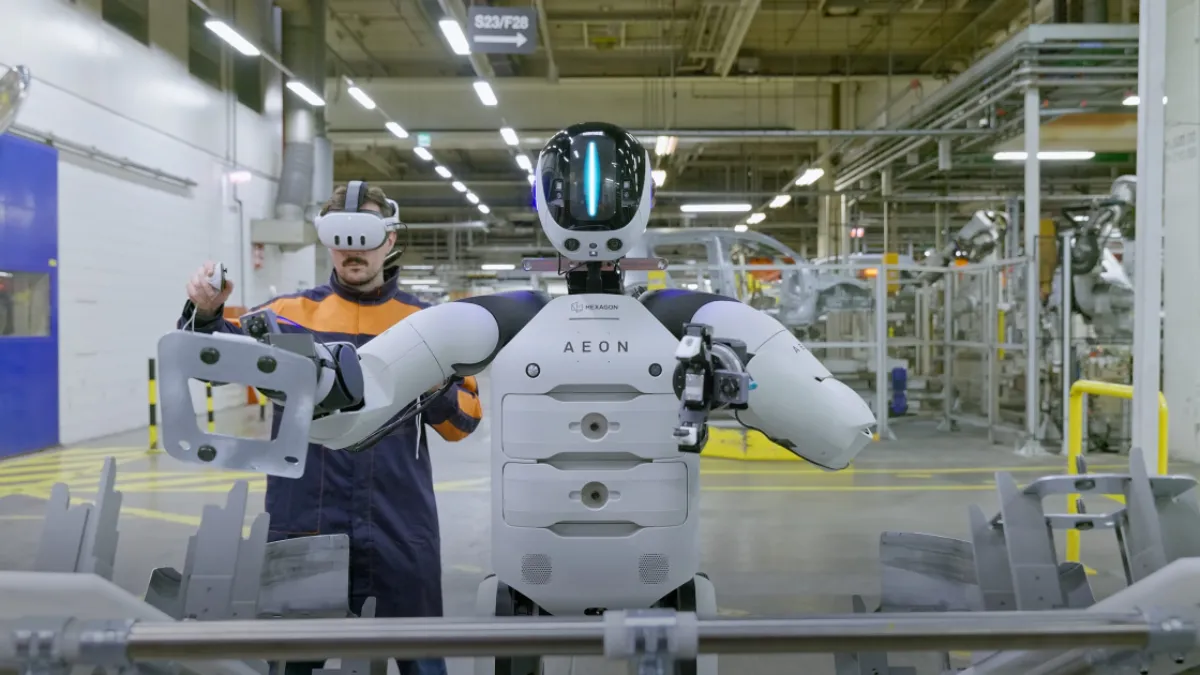
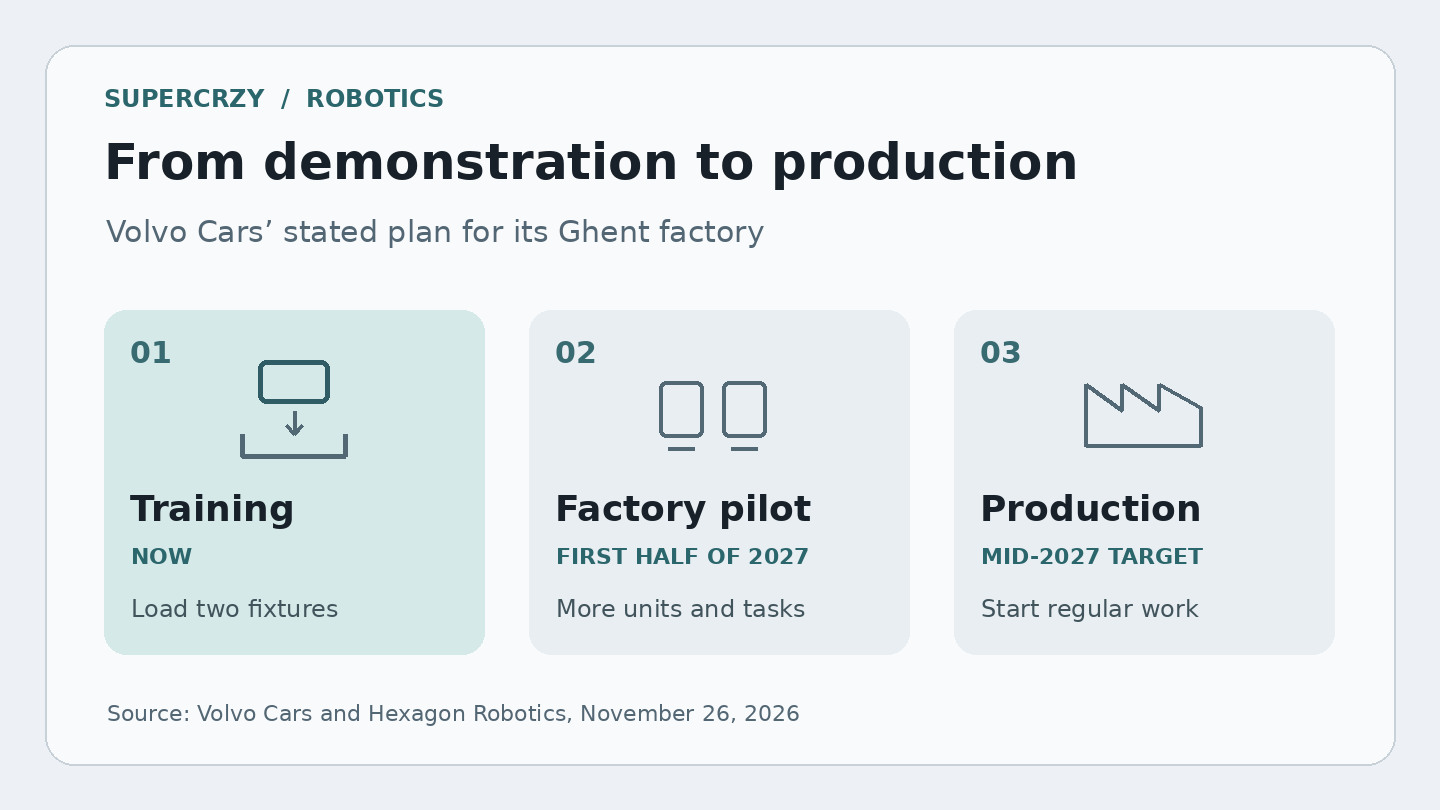
On November 26, 2026, Volvo Cars said it had brought Hexagon Robotics’ AEON humanoids into its Ghent plant in Belgium to train and validate them on factory tasks. The first assignment is narrow: placing components precisely into two fixtures. Volvo’s own team is teaching the robots alongside Hexagon ahead of a separate pilot in the first half of 2027.
Two fixtures make a better test than a showroom
Volvo says the team is using imitation learning: it shows AEON how to do the job rather than asking it to invent the motions from scratch. The task is fixed enough to check whether a part is correctly seated, but it also offers a baseline for the next step: handling multiple parts, moving through the work area and working with existing automation.
Those are separate tests. Correctly placing a component doesn’t show that a robot can reliably get the right component to the station, or recover when the part isn’t where it expects. Volvo hasn’t disclosed a placement success rate, cycle time, or how often a person has to intervene. Those figures would say more about readiness than the number of tasks in a demo.
The human shape stops at the wheels
AEON is 1.65 metres tall and weighs 60 kilograms, according to Volvo. It rolls rather than walks, and Volvo lists a top speed of 2.4 metres per second and a carrying capacity of 10 kilograms. Those are platform specifications, not measured speed or throughput on the Ghent task.
Factory arms are already good at repeating a defined motion in one place. What Volvo is testing is whether a machine can be taught to handle different jobs across existing workstations without rebuilding every station around it. Mobility only helps if the robot can move safely and return to productive work without adding more supervision.
Mid-2027 is a target, not a shift schedule
Hexagon says more AEON units are due in Ghent for the first-half 2027 pilot, with a goal of using the robots in actual production from midyear. The current milestone is training on site, not a production rollout or a claim that the robot has replaced a worker.
The useful comparison in the pilot will be one job done three ways: by an employee, by conventional automation where feasible, and by AEON. How often a part is placed correctly, how much worker time goes into recovery, and whether the job becomes less physically demanding are better measures than whether the robot looks human.
P.S. One number I’d ask Volvo for after the pilot: correctly seated parts per hour, including the time spent fixing misplacements and restarting the robot.
Frequently Asked Questions
Q: Where is Volvo Cars training AEON?
A: At its manufacturing plant in Ghent, Belgium, with Hexagon Robotics.
Q: What is the robot’s first assignment?
A: It is being trained to place components precisely into two fixtures, using imitation learning.
Q: Does AEON walk?
A: No. AEON moves on wheels. Volvo lists a height of 1.65 metres and a 10-kilogram carrying capacity.
Q: Is AEON already part of regular production?
A: Volvo describes the current work as training and validation. A wider pilot is planned for the first half of 2027.
Q: When could it enter production?
A: Volvo and Hexagon are targeting mid-2027. That is a goal, not a confirmed start date.