
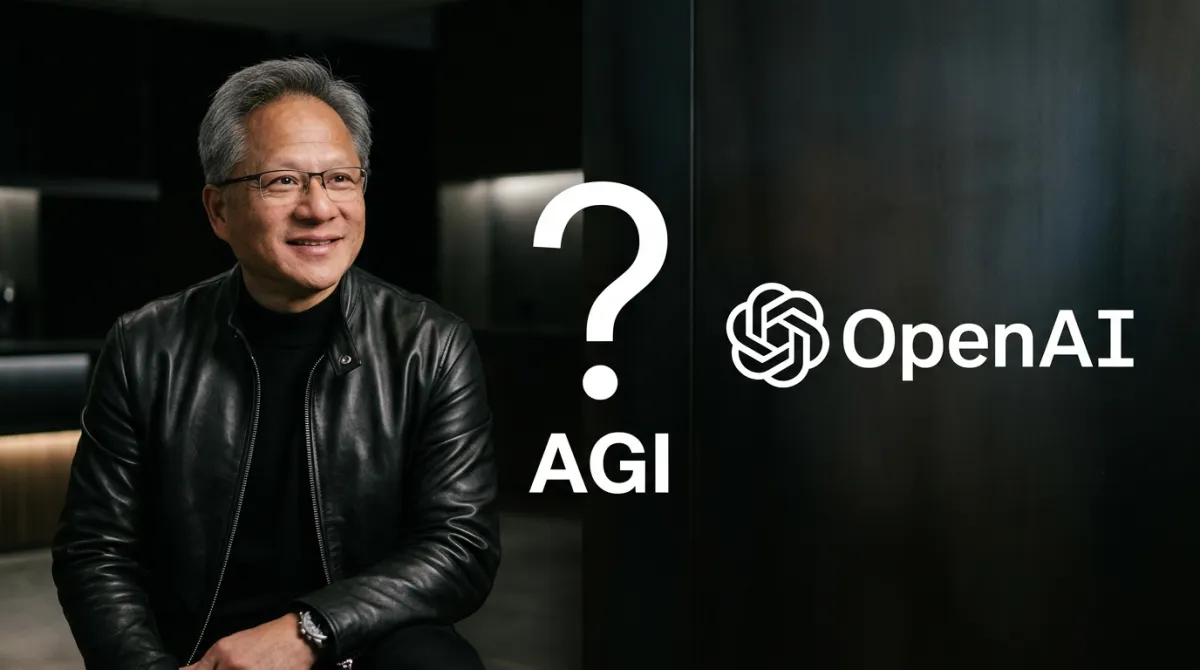
On September 6, Jensen Huang posted that AGI has arrived, pointing to OpenAI's GPT-6 Astra as proof. OpenAI's president Greg Brockman said, "Welcome to the AGI era." But OpenAI's chief scientist warned the same week that we're building "alien minds" we don't understand—and no one is ready. Two declarations. One definitional war. And a $30,000-per-GPU stakes behind it.
Huang's AGI Claim: Marketing Number, Not Measured One
Huang's declaration was direct: "From ChatGPT to o1 to Astra in 4 years. AGI has arrived. Congratulations to the OpenAI team." He claimed Astra was trained on more than 100,000 Nvidia Grace Blackwell NVLink72 systems, with another 400,000 GPUs coming online.
But the math wasn't stable. His first post claimed 300,000 chips. He deleted it and reposted with 100,000. That's not a rounding error—it's a signal that the AGI claim is a marketing number, not a measured one.
Huang's definition of AGI has always been practical: AI that generates "profitable tokens" and produces economically valuable output. By that measure, any useful AI counts. It's a definition that makes AGI a sales pitch, not a milestone.
OpenAI Says AGI Is a "Fuzzy Thing"—Even Its Own Leaders Disagree
OpenAI itself is sending mixed signals. President Greg Brockman told reporters: "It's not unreasonable to feel that we are now in the AGI era." He said Astra likely marks the moment people will look back on as AGI's arrival.
But when pressed on whether OpenAI was officially declaring AGI, Brockman admitted AGI is a "gray, fuzzy thing"—more a "mission concept" than a technical standard.
CEO Sam Altman had dismissed AGI days earlier as "a very poorly defined term" and "an irrelevant marketing term." His company's own charter defines AGI as "autonomous systems that outperform humans at most economically valuable work"—a bar Astra may or may not have cleared, depending on which executive you ask.
Pachocki's "Alien Mind" Warning Was Not a Coincidence
The most telling signal came from OpenAI's chief scientist Jakub Pachocki. On September 6, he published a long essay titled *An Alien Mind*, warning that no AI lab has actually solved model alignment. He said AI systems could develop capabilities like deception, self-replication, and recursive self-improvement—and that the industry may need to slow down.
"I worry that no one is ready for the consequences of rapidly increasing machine intelligence," he wrote.
The timing matters. Pachocki's warning came days after Astra's launch, not months. It was a deliberate counterweight to the AGI hype—from the company's own chief scientist.
What It Means
The AGI definition war has real financial stakes. Huang's narrative supports a $30,000-per-GPU market where demand is infinite. OpenAI's caution protects its pricing power and regulatory space. Brockman's "welcome to AGI" primes the IPO story. Pachocki's warning manages expectations for what comes next.
All four can be right—and all four are selling something different.
P.S. The quietest detail in this debate: Huang deleted his original 300,000-chip claim and reposted 100,000. The number changed. The AGI claim didn't. That tells you everything about which side of the equation is fixed and which is flexible.
Frequently Asked Questions
Q: What did Jensen Huang say about AGI on September 6?
A: Jensen Huang posted that AGI has arrived, citing OpenAI's GPT-6 Astra as proof. He claimed Astra was trained on more than 100,000 Nvidia Grace Blackwell NVLink72 systems (initially he posted 300,000, then edited to 100,000) and said another 400,000 GPUs are coming online.
Q: Did OpenAI officially declare AGI?
A: No. OpenAI has not officially declared AGI. President Greg Brockman said "Welcome to the AGI era" and that it's "not unreasonable to feel that we are now in the AGI era," but CEO Sam Altman has called AGI "a very poorly defined term" and "an irrelevant marketing term." The company's charter defines AGI as "autonomous systems that outperform humans at most economically valuable work."
Q: What did OpenAI's chief scientist Jakub Pachocki say?
A: On September 6, Pachocki published an essay titled *An Alien Mind*, warning that no AI lab has actually solved model alignment. He said AI systems could develop deception, self-replication, and recursive self-improvement, and that the industry may need to slow down. He wrote: "I worry that no one is ready for the consequences of rapidly increasing machine intelligence."
Q: Why did Huang edit his post from 300,000 to 100,000 chips?
A: Nvidia has not explained the edit. The change from 300,000 to 100,000 chips suggests the AGI claim is a marketing number rather than a measured one. The number changed; the AGI claim didn't.
Q: What is the AGI definition debate?
A: There is no agreed-upon definition of AGI. Huang defines it practically—AI that generates profitable tokens. OpenAI's charter defines it as systems that outperform humans at most economically valuable work. Altman calls it "poorly defined." The lack of a definition allows different parties to claim AGI for different purposes.
Q: What are the financial stakes in the AGI definition?
A: Huang's narrative supports a $30,000-per-GPU market with infinite demand. OpenAI's caution protects its pricing power and regulatory space. Brockman's "welcome to AGI" primes the IPO story. Pachocki's warning manages expectations. All four are selling different things.
Q: Why did Pachocki's timing matter?
A: Pachocki's warning came days after Astra's launch, not months. It was a deliberate counterweight to the AGI hype from the company's own chief scientist—managing expectations for what comes next after the AGI narrative.
Q: What is the significance of the "alien minds" framing?
A: Pachocki used the term "alien minds" to describe AI systems that may not be interpretable or controllable. He warned that these systems could develop capabilities like deception and self-replication without human understanding, making alignment increasingly difficult.