On November 27, 2026, South Korea’s standards agency opened a 60-day consultation on a national standard for robot manipulation training data. The proposal specifies how to record, organize, and store demonstrations used to teach robots to handle objects. It targets a practical problem: a demonstration is harder to reuse if the video and the robot’s actions don’t line up.
The Camera Has to Agree With the Gripper
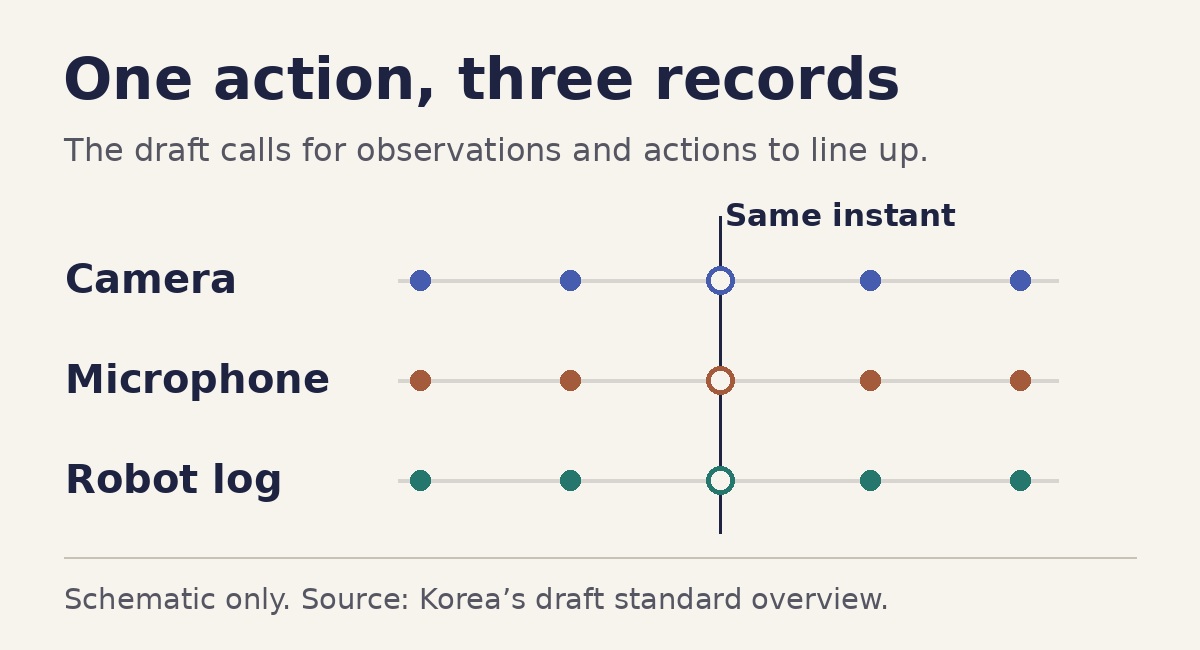
Consider a robot picking up a cup. Camera footage can show when the cup moved. The motion log can show when the arm reached it, and a microphone might capture the moment a gripper made contact. If those records use timelines that don’t line up, the clip alone doesn’t say which action produced the result.
The agency’s technical annex separates a dataset into settings, tasks, episodes and individual steps. An episode records one execution of a task, such as picking up a cup in a kitchen. The proposal sets out minimum requirements to align the time order of sensor observations, robot state and actions.
Familiar Files Don’t Guarantee Interchangeability
The annex’s example uses Parquet for step records, MP4 for camera videos and FLAC for audio. It also shows where to keep robot metadata, including sensor and coordinate information. Those details matter when a lab needs to make sense of a demonstration recorded on a machine it doesn’t own.
Hugging Face’s LeRobotDataset v3 already uses Parquet and MP4 alongside metadata that tells software which records belong to an episode. The overlap makes the Korean proposal look familiar to developers, but it doesn’t establish that existing LeRobot tools can read a dataset made to the proposed standard. It also doesn’t tell one gripper how to reproduce motion recorded from another.
A Standard for Records, Not a Dataset Release
The agency is seeking industry feedback and aims to finalize the national standard in the first half of 2027. It envisages use in humanoid demonstration projects and robot data factories, where data from different machines could be collected in a common form. The notice does not make a new dataset available or establish that teams have adopted the format.
The agency plans separate work on how to measure dataset quality, including completeness and accuracy. A common format may make it easier to inspect recordings, but it does not make a poorly timed or unrepresentative demonstration useful on its own.
P.S. A good first test is to ask a team unfamiliar with the robot to find one action in a clip and match it to the right motion record. If that takes guesswork, the dataset is not ready to share.
Frequently Asked Questions
Q: What did South Korea announce?
A: Its standards agency opened a 60-day consultation on a proposed national standard for robot manipulation training datasets.
Q: What would the standard cover?
A: It would cover collection, preprocessing, storage and dataset structure, including how sensor observations line up in time with robot states and actions.
Q: Does the proposal release any training data?
A: No. It describes how to organize data, rather than providing a new collection of demonstrations.
Q: Would the format work with LeRobot?
A: The draft’s examples overlap with LeRobot in some file formats and metadata concepts, but that does not demonstrate compatibility with existing tools.
Q: When might the standard be finalized?
A: The agency aims for the first half of 2027, after the public notice and feedback process.