On November 27, 2026, the OpenCode team invited users to try Rune, an early build of its next desktop coding-agent client. The new app is written in Rust, uses the team's native Rune interface framework, and does not start Electron. Development packages are available for macOS, Windows and Linux. This is a separate development channel, not an announcement that the regular OpenCode Desktop app is being retired.
The change is in the application around the agent. Most of the controls a developer touches during a coding session, including the conversation, terminal, file view and diff, have to be responsive regardless of which model the developer selects. A native rewrite can change how those controls feel without making the model itself write better code or respond to a remote request any faster. That distinction matters because the project advertises a broad speed and resource claim without presenting a comparable set of measurements in its README.
The browser starts only when you need it
The Rune repository describes a native application that starts without Chromium. It still includes a browser pane, but that pane fetches a separate component based on the Chromium Embedded Framework the first time it is needed. If a developer only opens the app to work through suggestions, inspect diffs and check terminal output, the embedded browser does not have to run for that work.
If the job is to build or inspect a web interface, the browser is still part of the experience. An honest comparison would measure time to open a workspace separately from time to open the browser for the first time, then measure memory with the browser idle and active. Those are different workloads; testing only an empty app would miss the cost of a feature some developers use daily.
Removing Electron does not mean all builds are tiny, either. Development build 503, published on November 28, lists a Linux arm64 AppImage of about 205 MiB on its release page. That is the size of one downloadable artifact, not the app's memory footprint. It also cannot be used to infer the equivalent size on an Intel Mac or a Windows PC.
The agent’s work stays in view
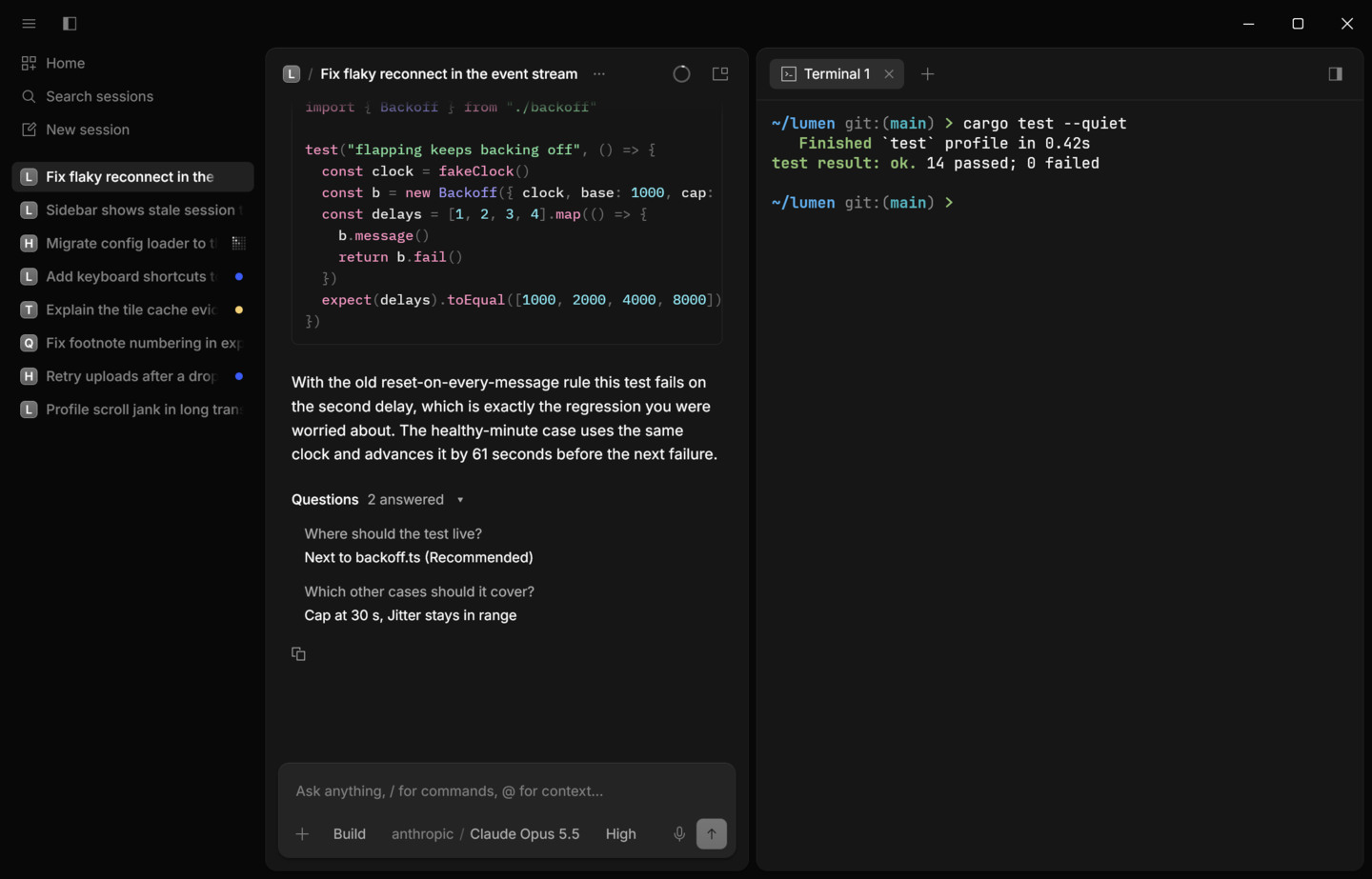
Anomaly’s Rune demo puts the Ghostty-VT terminal beside the agent session. Official project screenshot.
The native client bundles a Ghostty-VT based terminal, a source view with syntax highlighting, and a split diff layout. Rune draws certain interface elements and vector diagrams with the GPU. In practical terms, the rewrite aims to handle the things a developer inspects while an agent is working, not just the input box where the developer submits a prompt. A conversation may be only one part of an agent run: the user still wants to review the file changes, see what the terminal printed and decide what to do next.
For a window with several ongoing runs, perceived responsiveness depends on more than startup. Switching back to a long conversation while a terminal streams output is the sort of everyday interaction that can reveal whether the interface work pays off.
There is also a web target built around WebGPU in the repository. That is a different way of delivering the same app code, not evidence that every desktop feature is available through a public browser product. For the November 27 preview, the concrete thing readers can use today is the development download for their operating system.
Try the dev build as a separate tool
According to the installation notes, the dev build has its own application identity, and test builds from individual pull requests can be installed alongside it. The repository offers Apple Silicon and Intel packages for macOS, x64 and Arm64 installers for Windows, and AppImage, DEB and RPM packages for x64 and Arm64 Linux. The project says the macOS and Windows dev builds update automatically.
The useful test is not whether a window opens faster once. Try the same project on the same computer, hold the model and provider constant, open a long agent session, and compare how easily you can switch files, review the same diff, and follow a running terminal. If browser previews are part of your work, open the same local site in both clients. Record how long each job takes and any cases where a familiar shortcut or panel behaves differently. We did not run those tests for this story.
That makes Rune worth a look for developers who already spend much of the day in OpenCode. The public build makes the native approach available to try; it does not yet establish that the new client is ready to replace anyone's daily setup.
P.S. Compare the terminal and diff before the model output. Those are the parts this rewrite actually changes.
Frequently Asked Questions
Q: Is Rune replacing OpenCode Desktop right away?
A: No. The team described this as an early version and is distributing it on the development channel.
Q: Which operating systems have builds?
A: The development download list covers macOS, Windows and Linux, with separate packages for the architectures listed by the project.
Q: Does Rune use Chromium?
A: It does not start Chromium with the app. The optional browser panel loads a separate Chromium Embedded Framework component on demand.
Q: Does the rewrite make the model answer faster?
A: The rewrite changes the desktop client. It does not establish any improvement in the response speed of a model or an API provider.
Q: Is the development build the same as the stable client?
A: No. It is a separate development build. Check the release notes before making it your only client.
Cover illustration by SUPERCRZY, using the official OpenCode wordmark. Inline screenshot: © 2026 Anomaly, MIT License.