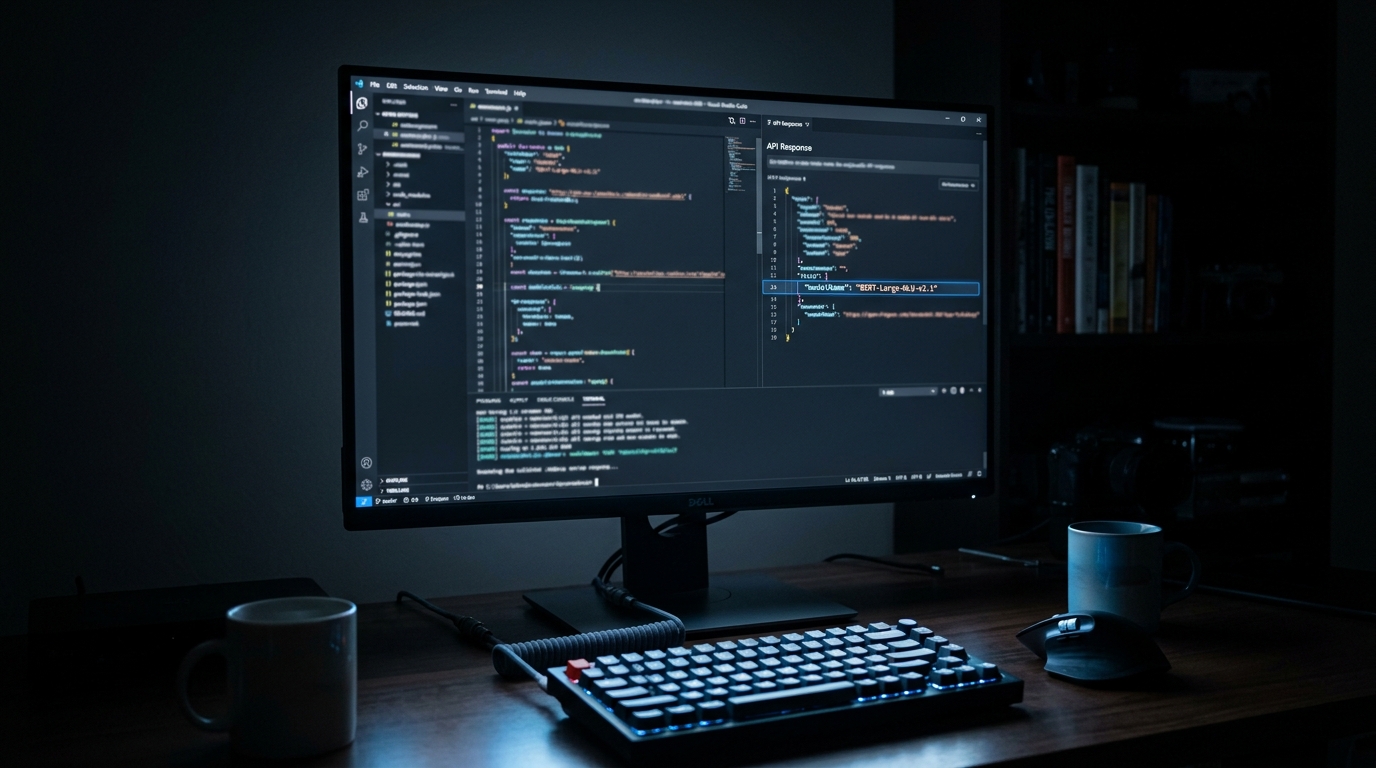
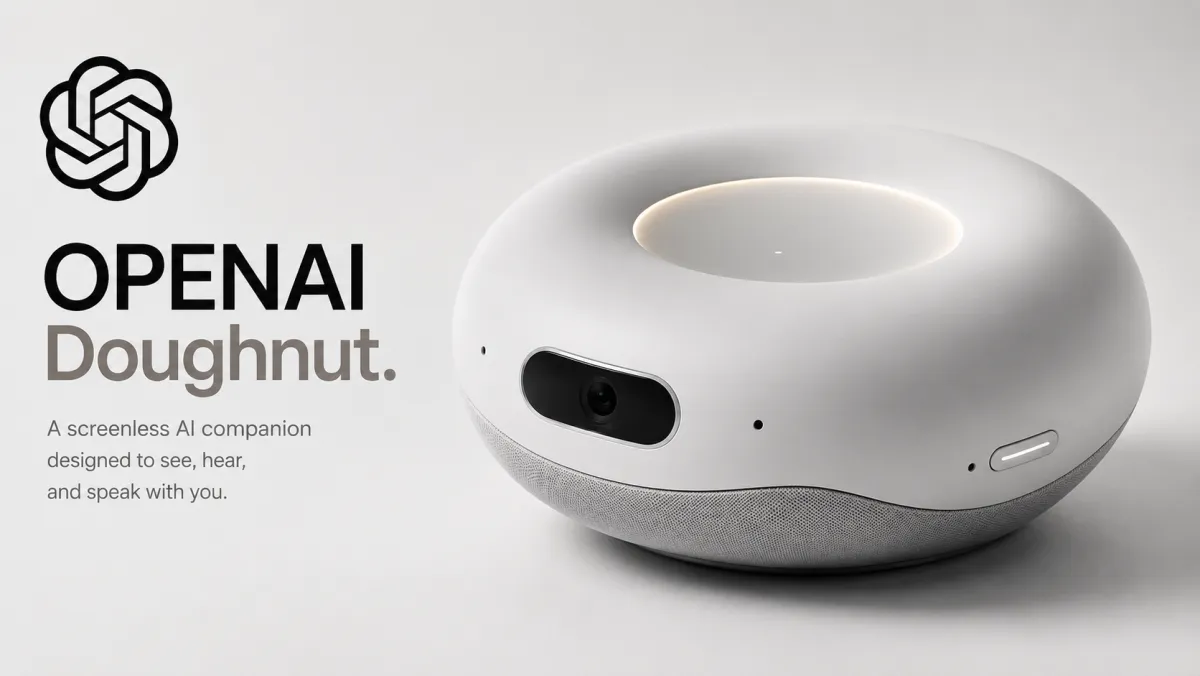
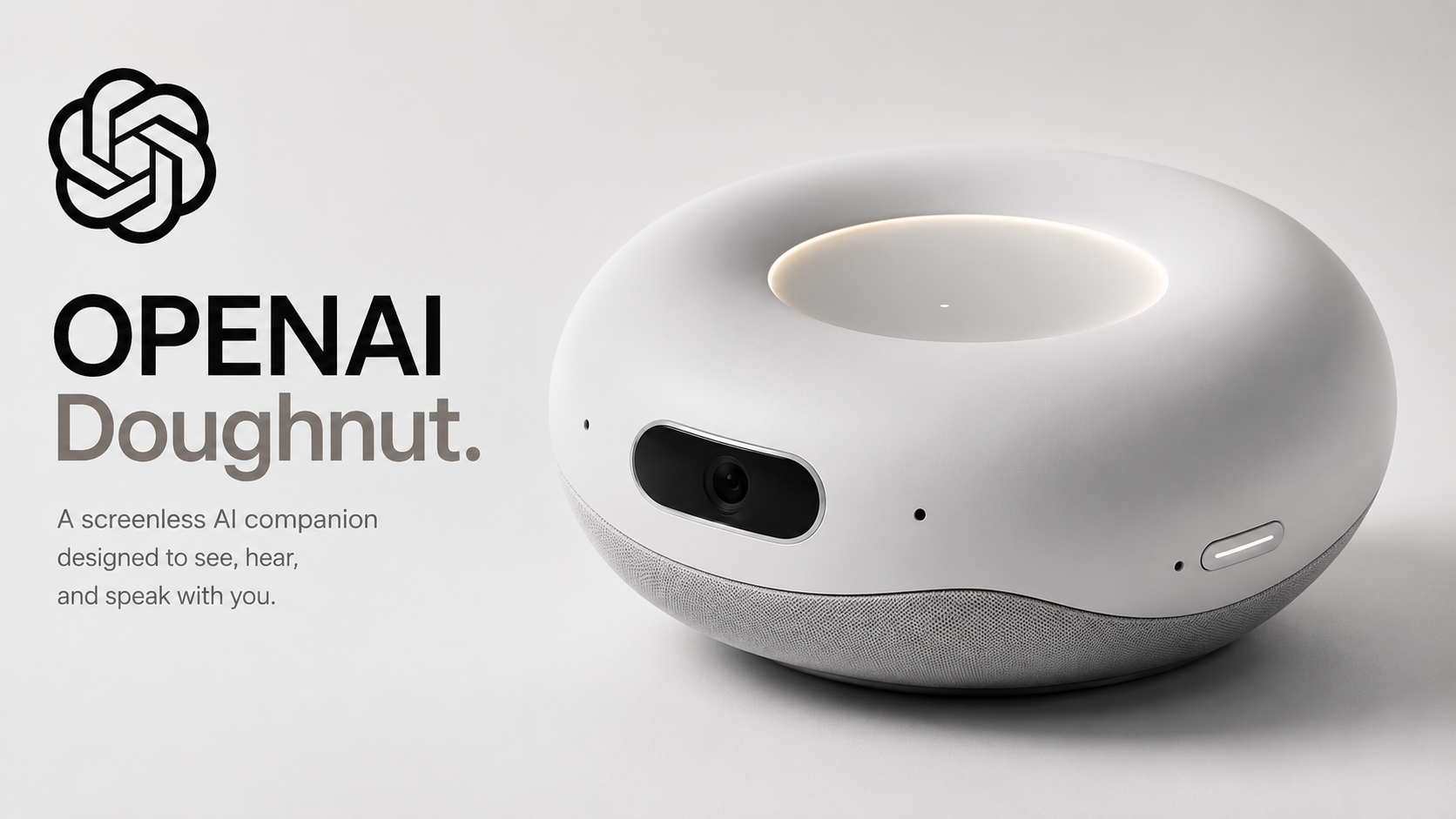
OpenAI's first consumer hardware looks like a doughnut, fits in one hand, has no screen, and will cost between $300 and $400. Mark Gurman of Bloomberg broke the story on August 7: the device, developed with former Apple design chief Jony Ive's LoveFrom studio, is planned for a 2027 release. It has moving parts, lights, a camera, and sensors. It runs on OpenAI's most advanced models. And the company is framing it as an "AI-first computer" — not a smart speaker.
This is not about smart speakers. This is about what comes after the phone.
OpenAI's hardware strategy has been hiding in plain sight. The company's head of hardware, Richard Ho, said at a Stanford event earlier this year: "You have to design hardware for where the model is going, not where it is today." The doughnut is that bet in physical form. Long-term, OpenAI wants to build a device business that could one day replace the smartphone. The doughnut is described as a "gentle way to get into the market" — the first of many devices. This isn't a speaker company making a speaker. It's a model company making a container for its best model — a direct pipeline from OpenAI's intelligence to the user, bypassing iOS, Android, and app stores.
The interaction model is the giveaway. No screen. No apps. No keyboard. The user speaks; the device responds. It learns over time and personalizes its conversation. If the smartphone era was about "an app for everything," the AI era OpenAI is betting on is about "a model for everything, delivered through voice." This is the hardware equivalent of removing the middleman. And Apple knows exactly what that means.
On July 10, Apple filed a 41-page lawsuit against OpenAI, accusing it of systematically stealing trade secrets to build its hardware business. The complaint is brutal: "OpenAI's nascent hardware business is built upon an extremely unstable foundation that has rotted at its core due to its unlawful reliance on misappropriated trade secrets."
The details are cinematic. OpenAI's chief hardware officer, Tang Tan, a 24-year Apple veteran who worked on iPod, iPhone, and Apple Watch, is accused of asking Apple employees in interviews to bring actual components — batteries, SiP packages, motherboards — to "show and tell." Another defendant, Chang Liu, allegedly discovered he still had access to Apple's internal network after leaving and downloaded dozens of confidential files, including a 1,000-page technical document on motherboard manufacturing. He messaged a colleague still at Apple: "LOL I still have access to the internal network storage."
Apple also claims OpenAI directed a long-time Apple supplier to develop a metal finishing process similar to Apple's, while misleading the supplier into believing OpenAI had Apple's permission. OpenAI denies all of it, calling the allegations "vague and overbroad." The company says an internal investigation found no misuse of Apple trade secrets.
But the lawsuit isn't really about trade secrets. It's about a fundamental clash: OpenAI was Apple's AI partner. Then it decided to build hardware. Now it's a competitor — and one that has already hired over 400 former Apple employees. Apple's lawsuit is an attempt to slow OpenAI down. OpenAI's response — that it's "building something new, something Apple has never built" — is a statement of intent.
The irony: the doughnut shape and the battery-powered, portable smart speaker concept are not products Apple has ever released. Apple has HomePod — but not a portable, screenless, AI-first version. OpenAI is moving into territory Apple hasn't staked out yet, and Apple is trying to fence it off with litigation.
The 2027 release date is the most revealing detail in the entire report. In AI, a 2027 product means OpenAI is designing for a model that doesn't exist yet — but one it can see coming. Richard Ho put it bluntly: the hardware team knows "what the model will look like six to nine months from now." The doughnut isn't for today's ChatGPT. It's for the model that will exist in 2027 — one capable of sustained, multi-turn, context-aware conversation that feels like talking to a human.
This is also a defensive play. OpenAI's model lead over Google and Anthropic is shrinking. Hardware gives it a moat: a direct channel to users that doesn't depend on Apple or Google's operating systems. If the model is the brain, the device is the body — and owning both means owning the full stack.
But 2027 is also a risk. AI hardware has a terrible track record: Humane's AI Pin flopped. Rabbit R1 flopped. Both were built for models that weren't ready. OpenAI's bet is that by 2027, the models will be ready — and Jony Ive's design will make people want to carry a doughnut-shaped device around their home. The question isn't whether the hardware works. It's whether users want a new device category at all. OpenAI is betting that when AI is good enough, the form factor stops mattering — and the interaction model becomes the product.
The numbers are real. Jony Ive is real. The lawsuit is real. But none of it matters if the model in 2027 isn't miles ahead of what's on your phone today. OpenAI is designing for a future it hasn't built yet — and betting that when it gets there, the doughnut will be the only thing that makes sense.
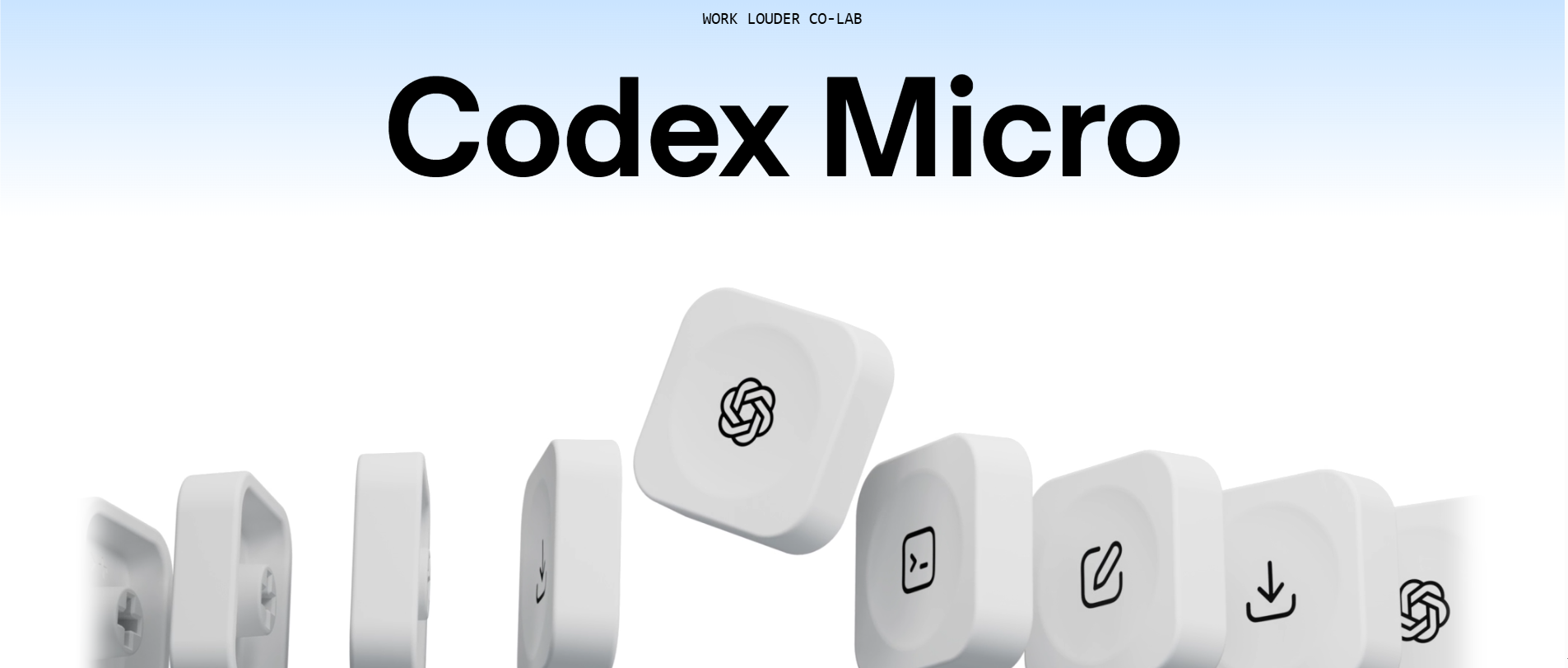
P.S. The doughnut is OpenAI's first consumer hardware — but not its first. (That's a $230 keyboard called the kbd-1.0-codex-micro, launched earlier with Work Louder.) A keyboard is a peripheral; a doughnut is a statement. And Apple's lawsuit suggests they took it as one.
Frequently Asked Questions
Q: When will OpenAI's first hardware device actually launch?
A: OpenAI is targeting a 2027 consumer release, according to Bloomberg's Mark Gurman. The company is designing for a model that doesn't exist yet — but one its hardware team says it can see coming. Richard Ho, OpenAI's head of hardware, said the team knows "what the model will look like six to nine months from now."
Q: How much will the OpenAI device cost?
A: Internal discussions have set a target price between $300 and $400. The device is positioned as a premium consumer product, with high-end materials and Jony Ive's LoveFrom studio handling the design.
Q: What does the device actually do?
A: It's a voice-first, screenless AI computer. No apps, no keyboard, no display. Users speak to it; it responds using OpenAI's most advanced models. Over time, it learns user preferences and personalizes interactions. The company's long-term goal is to build a device that could eventually replace the smartphone.
Q: Why is Apple suing OpenAI over this device?
A: Apple filed a 41-page lawsuit on July 10, accusing OpenAI of systematically stealing trade secrets to build its hardware business. Specific allegations include: OpenAI's hardware chief (a 24-year Apple veteran) asking Apple employees to bring components to interviews; another former employee downloading confidential files after leaving; and OpenAI directing a long-time Apple supplier to develop a metal finishing process similar to Apple's. OpenAI denies the allegations, calling them "vague and overbroad."
Q: Isn't this just another smart speaker?
A: No. OpenAI explicitly frames it as an "AI-first computer" — not a smart speaker. The device is battery-powered, portable, and designed to be carried around the home by hand. Unlike a speaker that sits in one place, this device moves with the user. The interaction model is also fundamentally different: it's designed for sustained, context-aware conversation, not just voice commands.
Q: What happened to previous AI hardware like Humane's AI Pin and Rabbit R1?
A: Both flopped. The common diagnosis was that they were built for models that weren't ready. OpenAI is betting that by 2027, its models will be capable enough to make the form factor work — and that Jony Ive's design will make people want to carry it.
Q: Is OpenAI planning more hardware beyond this device?
A: Yes. The doughnut is described as a "gentle way to get into the market" — the first of multiple devices. OpenAI's long-term ambition is to build a device business that could one day offer an alternative to smartphones.
Q: How does this affect OpenAI's relationship with Apple?
A: OpenAI was Apple's AI partner. Now it's building hardware that competes directly with Apple's ecosystem. The lawsuit is the public face of that fracture. Beyond the legal fight, the tension could impact OpenAI's ability to hire experienced Apple engineers — over 400 former Apple employees already work at OpenAI, and the lawsuit may make suppliers more cautious about working with them.