On September 13, The Wall Street Journal reported that OpenAI acquired Glass Imaging, a Los Altos camera software startup, in a deal valuing the company above $300 million. Glass Imaging had raised roughly $30 million in total funding and carried a valuation near $100 million in its last round.
The acquisition is OpenAI's third in recent months, following an internet talk show and an open-source developer tools startup. It lands as OpenAI prepares for an IPO expected in 2027, and as it builds a consumer device with Jony Ive's design firm — a partnership that began with a $6.5 billion acquisition in 2025.
The price gap tells the strategy. Ive's team cost $6.5 billion to design what the device looks like. Glass Imaging cost less than 5% of that to determine whether it can see.
Two Engineers Who Left Apple to Escape the Physics
Ziv Attar and Tom Bishop founded Glass Imaging in 2019. Both were Apple engineers. Both worked on Portrait Mode, the computational photography feature that made the iPhone 7 Plus's dual-camera system feel like a single intelligent lens.
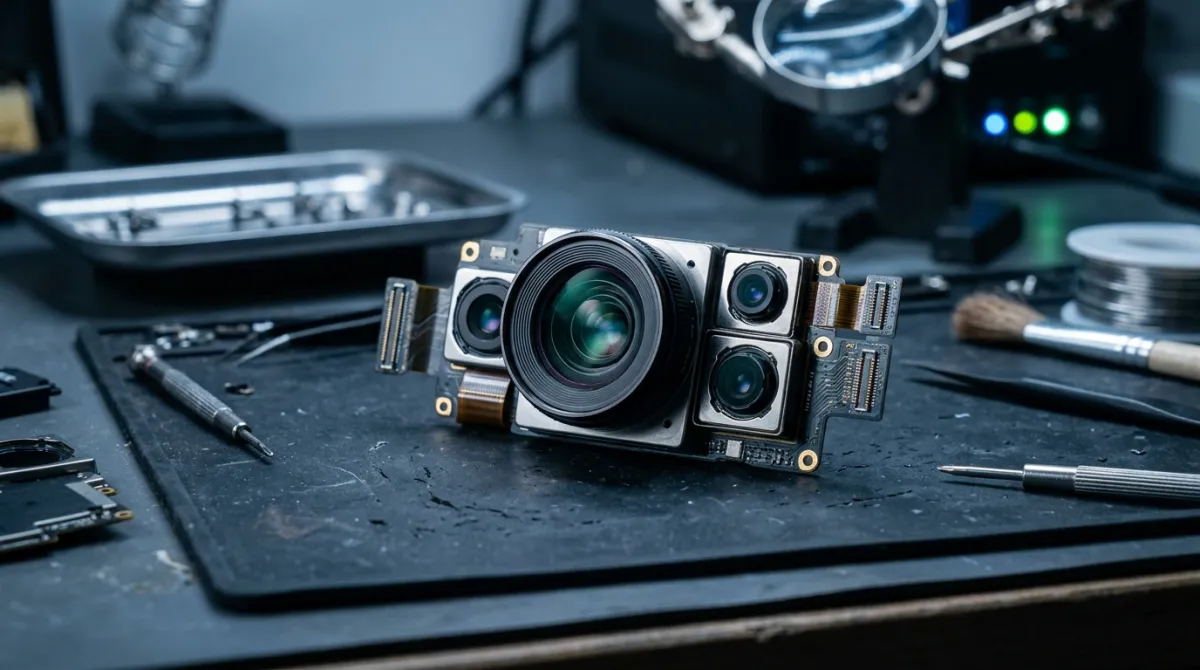
They left because they believed the hardware path had run out of room. A phone is thin. The lens is small. The sensor is small. Every flagship works around the same physical ceiling. The industry's answer was more hardware: extra lenses, periscope zoom, thicker sensor stacks. Each addition costs space and money, and the visible gain from one generation to the next keeps shrinking.
“Adding more lenses to a phone is an uphill battle,” they said in 2022. They wanted to rethink cameras “without being constrained by iPhone business requirements”.
Their answer was GlassAI, a neural image signal processor. Instead of retouching a finished photo, it processes bursts of raw sensor data at the moment the shutter fires. One network handles demosaicing, denoising, sharpening, and multi-frame fusion in a single pass. Each camera module gets its own trained neural network, tuned to that specific lens-and-sensor combination's optical flaws.
The company claimed the approach could boost camera performance by “10 times” — a figure published without disclosed test conditions. What is documented: the software shipped in Honor's 600 series phones, using a 200MP main sensor to achieve zoom quality without a dedicated telephoto lens.
The Real Target Isn't the Smartphone Camera
Glass Imaging's technology was never designed for phones alone. The company said in May 2025 it was building licensable IP spanning smartphones, drones, and wearables. The same restoration networks that fix a phone sensor's noise can serve a drone's stabilization or a wearable's always-on camera.
That breadth is what makes the acquisition fit OpenAI's device roadmap. The company is building a consumer device with Ive — reportedly a screenless, pocketable AI companion, with glasses and speakers also under consideration. A model that acts on the physical world needs clean input. Noisy, smeared, low-light frames tax every inference that follows. Repairing them after capture throws away detail the sensor already recorded.
GlassAI runs on edge AI chips already shipping inside phones and wearables. No new silicon required. That makes it plumbing, not a photography feature. It sits between the lens and the model, and whoever owns it owns the quality of everything downstream.
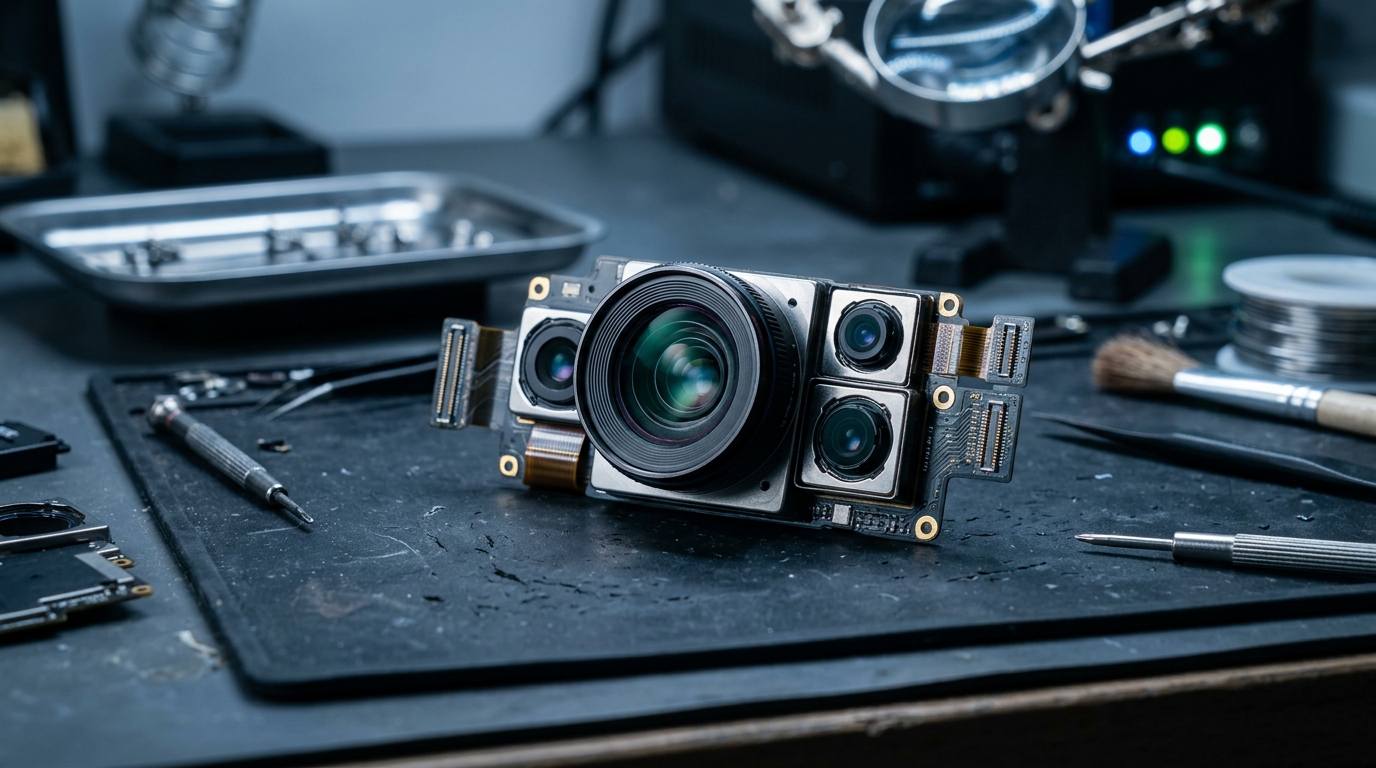
The competitive implication is sharper than a product announcement. Apple built Portrait Mode from the same engineering lineage that now sits inside OpenAI. Apple has monetized imaging through sensor and lens upgrades across successive iPhone generations. Sony, whose image sensors anchor most flagship phones, and the camera-module suppliers that assemble them, earn revenue on the physical stack.
If imaging quality migrates into a licensable AI layer, the value shifts from components toward software. The component vendors lose pricing power first. Apple loses a reason to upgrade.
Three Buys, One Stack
OpenAI's hardware moves now read as a vertical integration play rather than scattered acquisitions.
The Jalapeño chip, developed with Broadcom over a nine-month design-to-tape-out cycle, is a custom inference ASIC built from scratch for LLM workloads. It targets gigawatt-scale deployment by the end of 2026. That's the compute.
The $6.5 billion io Products acquisition brought Jony Ive and his design team in as creative leads for the device's form factor. That's the interface.
Glass Imaging supplies the imaging stack — the neural ISP and the two engineers who know how to make small cameras produce detail that doesn't exist in the raw sensor data. That's the perception.
Chips for thinking. Design for interacting. Cameras for seeing. The device OpenAI is building needs all three. It has now bought all three.
P.S. OpenAI has not said whether Glass Imaging's technology will appear in the Ive device, in a separate product, or elsewhere. But the company paid triple Glass Imaging's last valuation roughly 16 months after its Series A — a price that suggests someone wanted the technology off the board before a competitor could license it. Apple has not commented on the acquisition.
Frequently Asked Questions
Q: What did OpenAI acquire?
A: OpenAI acquired Glass Imaging, a Los Altos camera software startup, in a deal valuing the company above $300 million. The Wall Street Journal reported the acquisition on September 13, 2026.
Q: Who founded Glass Imaging?
A: Ziv Attar and Tom Bishop, both former Apple engineers who worked on Portrait Mode for the iPhone 7 Plus. They founded the company in 2019.
Q: Why did they leave Apple?
A: They believed smartphone camera hardware had hit a physical ceiling. In 2022 they said adding more lenses was “an uphill battle” and wanted to rethink cameras “without being constrained by iPhone business requirements”.
Q: What is GlassAI?
A: A neural image signal processor that processes bursts of raw sensor data at the moment the shutter fires. One network handles demosaicing, denoising, sharpening, and multi-frame fusion in a single pass, with each camera module getting its own trained network.
Q: How much does it improve image quality?
A: Glass Imaging claimed “10 times” improvement, but published that figure without disclosed test conditions. The software shipped in Honor's 600 series phones, achieving zoom quality without a dedicated telephoto lens.
Q: Why does this matter beyond phones?
A: The company said in May 2025 it was building licensable IP for smartphones, drones, and wearables. The same restoration networks that fix phone sensor noise can serve drone stabilization or a wearable's always-on camera.
Q: How does this fit OpenAI's device plans?
A: OpenAI is building a consumer device with Jony Ive. A model that acts on the physical world needs clean input. GlassAI sits between the lens and the model, improving the quality of everything downstream.
Q: What does OpenAI's hardware stack look like now?
A: The Jalapeño chip (with Broadcom) handles compute. The io Products acquisition brought Jony Ive for interface design. Glass Imaging supplies the perception layer. Chips for thinking, design for interacting, cameras for seeing.
Q: What does this mean for Apple and Sony?
A: Apple built Portrait Mode from the same engineering lineage that now sits inside OpenAI. If imaging quality migrates into a licensable AI layer, value shifts from components toward software — component vendors lose pricing power first, and Apple loses a reason to upgrade.
Q: What has OpenAI not said?
A: Whether Glass Imaging's technology will appear in the Ive device, a separate product, or elsewhere. Apple has not commented on the acquisition.