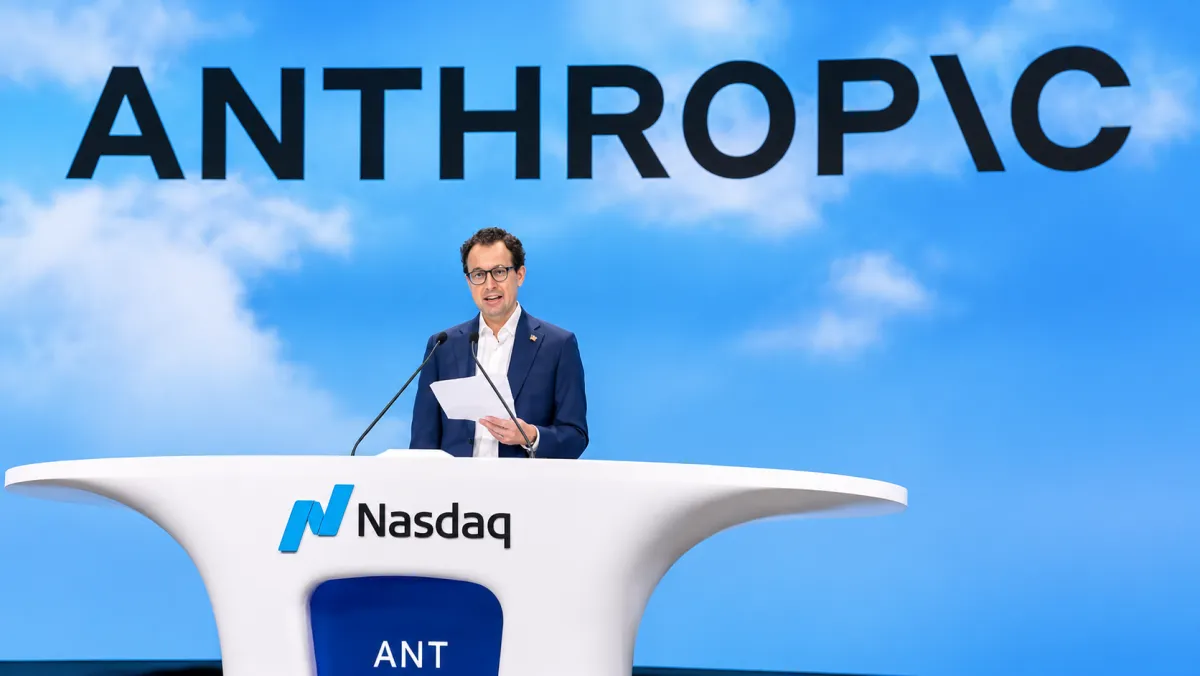
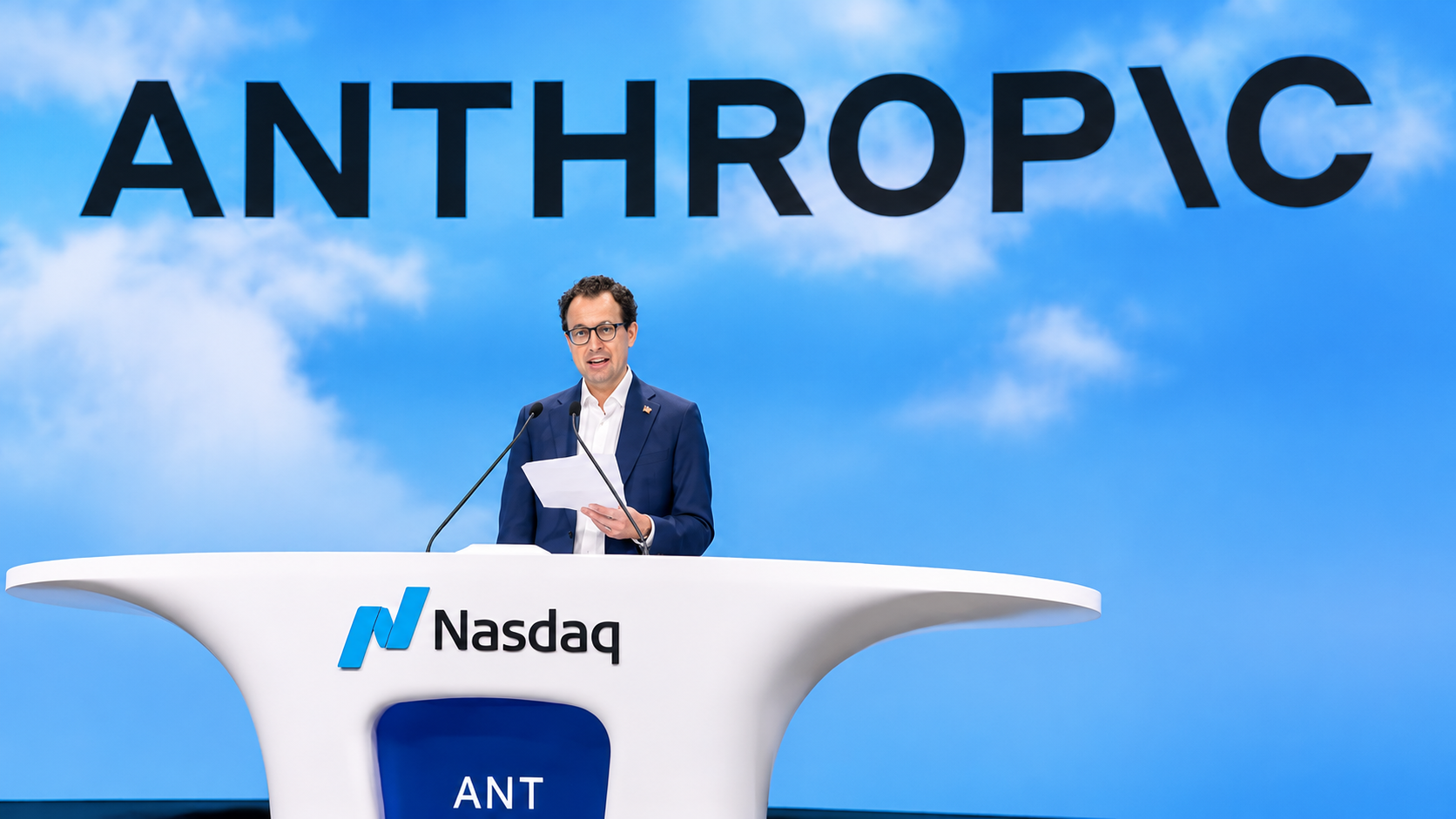
On November 19, 2026, Anthropic listed on Nasdaq under the ticker ANT. It priced at $83, opened at $111.50, up 34.3%. Intraday it touched $115.10, which on a fully diluted basis briefly pushed the valuation past $2 trillion.
The enthusiasm did not hold to the close. Within half an hour, the stock fell about 13% from its opening price, the worst first-half-hour performance for a major US IPO since 2008. It closed at $97.17, up 17.1%, for a fully diluted valuation of about $1.77 trillion. It fell another 2.72% after hours.
The public offering raised about $81.3 billion, breaking the $75 billion record SpaceX set in June. Including a $26 billion private placement, the total deal size was about $107.3 billion.
The $2 trillion peak lasted minutes
The $111.50 open implied a valuation near $2 trillion, briefly placing Anthropic in the global top ten by market cap, ahead of Tesla and Meta.
That figure rests on a fully diluted basis, including unexercised options and restricted stock. On a non-diluted basis, the IPO price implied about $1.1 trillion. Between the two numbers sits a layer of unvested equity compensation.
The $1.27 trillion close is what the market actually paid. What evaporated between $2 trillion and $1.27 trillion was first-day sentiment.
Retail bought the open, institutions sold the close
First-day turnover was $86.6 billion, with money moving in and out fast. Vanda Research data shows retail net buying of $18.6 million in the first 30 minutes, second among 2026 IPOs behind SpaceX's $25.6 million.
But total retail volume reached $255 million, more than double SpaceX's first day. High turnover does not mean consensus. Retail buy-side share slipped from 57.2% to 52.5% through the morning. The bullish pressure weakened as the day went on.
The more telling signal came from inside the sector. AMD fell about 7%, and Nvidia buying momentum stalled. Money flowed out of established AI names into the new listing. It was rebalancing, not fresh capital entering the sector. Retail was selling other AI stocks to fund the IPO.
Revenue is climbing and so are losses
Anthropic's revenue growth is real. Third-quarter revenue was $16.96 billion, up 47% quarter over quarter. Annualized revenue run rate reached $81 billion as of October 31, up $10 billion from the end of September.
But the sequential growth rate is slowing. It was 144% in the second quarter and 47% in the third. Operating loss was $567 million in Q3, after a $974 million operating profit in Q2. Compute and infrastructure spending in the first half approached $9 billion, nearly four times the prior year.
Anthropic committed to almost $900 billion in long-term compute purchases in its S-1. It also warned that suppliers depend on third-party financing to buy chips and build capacity. If that financing becomes unavailable or more expensive, contracted capacity may be delayed, repriced, reduced, or undelivered.
That is the structural contradiction. Revenue is billed by usage. The compute bill is locked in long term. When financing costs rise, the bill does not move. Revenue might.
Day-one pricing is not the final verdict
The IPO scale proved one thing: capital markets are still willing to fund leading AI companies. The $81.3 billion raise happened against a backdrop of sector pressure. Jensen Huang's departure, post-midterm political backlash against AI infrastructure, and rising rates did not stop Anthropic from pricing above its range.
The intraday fade proved another thing. Willing to fund and willing to fund at this price are not the same. The 34% open was short-term money. The 17% close was institutional repricing.
Anthropic's real test is not day one. Its nearly $900 billion compute commitment will be paid out quarter by quarter. If revenue growth keeps slowing while the compute bill arrives on schedule, the market's patience with the AI business model will be recalculated.
P.S. First-day turnover was $86.6 billion and retail net buying was $18.6 million. Most of the volume came from the same people trading in and out on the same day. Day-one pricing measures liquidity, not valuation.
Frequently Asked Questions
Q: What were Anthropic's first-day trading numbers?
A: It priced at $83, opened at $111.50 (up 34.3%), peaked at $115.10, and closed at $97.17 (up 17.1%). The fully diluted valuation peaked near $2 trillion and settled around $1.77 trillion at close.
Q: Why did the stock give back half its gain?
A: The opening pop reflected retail and short-term demand. The intraday decline reflected institutional repricing of the risk: high valuation, a near-$900 billion compute commitment, and slowing quarter-over-quarter revenue growth from 144% to 47%.
Q: How much did Anthropic raise?
A: The public offering raised about $81.3 billion, a record. Including a $26 billion private placement with Nvidia, Google, Microsoft and others, the total deal size was about $107.3 billion.
Q: Where did the buying money come from?
A: Largely from selling other AI stocks. AMD fell about 7% on the day, and Nvidia buying momentum stalled. It was a portfolio rebalancing into the new listing, not new money entering the sector.
Q: What is the main risk Anthropic disclosed?
A: A near-$900 billion long-term compute commitment against revenue billed by usage. The S-1 warns that if suppliers cannot secure financing for chips and capacity, contracted compute may be delayed, repriced, reduced or undelivered.
Q: Does the first-day close mean the IPO failed?
A: No. Closing 17% above the IPO price on record volume is a successful debut by most measures. The fade indicates that the opening price was not a sustainable valuation, not that the listing was a failure.