On September 2, Meta released Muse Spark 1.3, its most powerful model yet. It's live on the Meta Model API and Muse Code, with a "max reasoning" variant still in safety testing. CEO Mark Zuckerberg separately promised an open-weight version is coming "soon." Meta's fourth flagship release since April arrives at the fastest cadence the company has ever held.
Muse Spark 1.3 Now Ties GPT-5.6 Sol at 62 Points
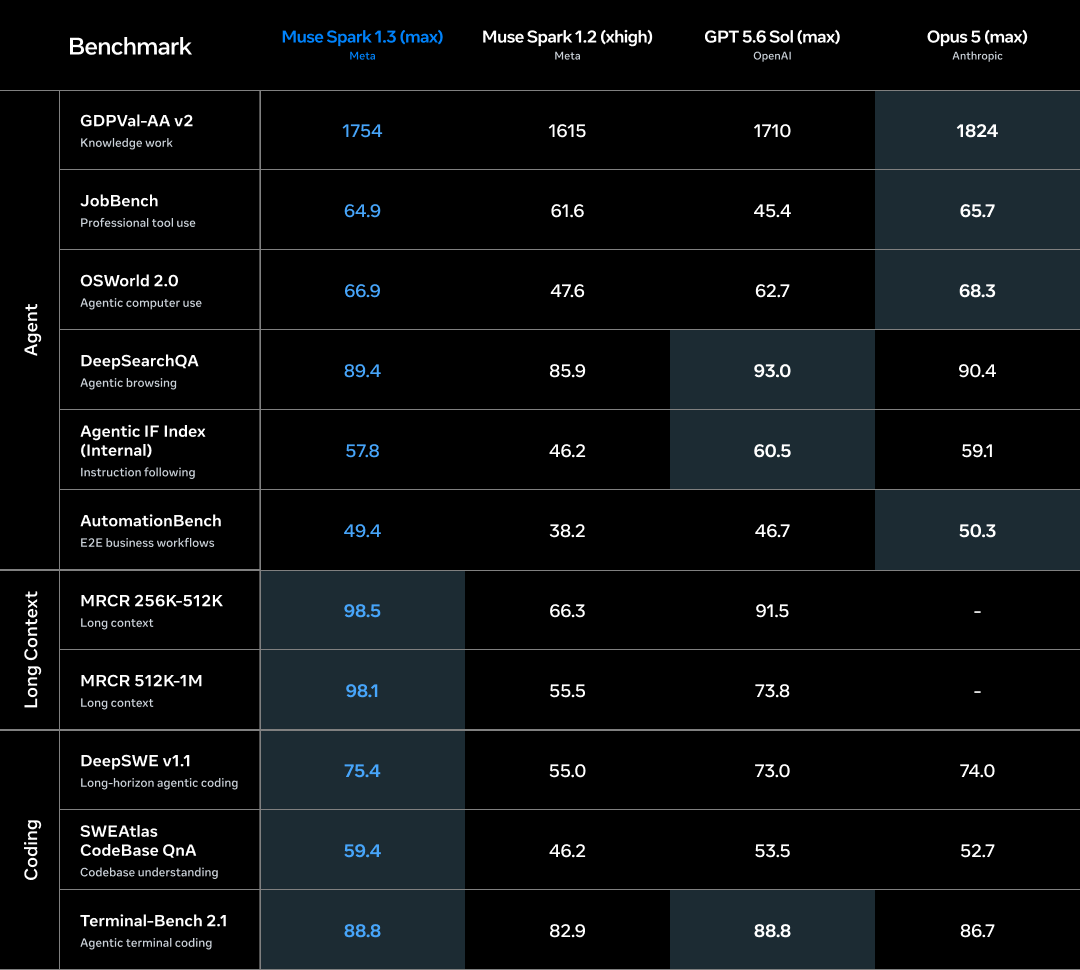
Meta claims Muse Spark 1.3 is its largest performance jump to date. The benchmarks show real progress:
Benchmark | Muse Spark 1.3 (max) | GPT-5.6 Sol | Opus 5 |
|---|---|---|---|
DeepSWE v1.1 | 75.4 | 73.0 | 74.0 |
Terminal-Bench 2.1 | 88.8 | 88.8 | 86.7 |
MRCR 512K-1M | 98.1 | 73.8 | — |
AutomationBench | 49.4 | 46.7 | 50.3 |
Muse Spark 1.3 max scores 62 on Artificial Analysis's Intelligence Index, second only to Claude Fable 5.1 and Opus 5. Meta's AI lead Alexandr Wang claims the model "ties the best result on the board" on Terminal-Bench 2.1.
21x Cheaper Output—If You Trade Your Prompts
The pricing strategy is where this launch departs from the usual model release. Muse Spark 1.3 maintains the standard pricing of Muse Spark 1.2: $1.25 input, $4.25 output per million tokens. But the Contributor tier—same model, same weights—costs $0.10 input and $0.20 output. That's a 21x discount on output.
The difference is a single clause: send prompts through Contributor, and Meta may use them to train its models. The standard SKU carries no such data right. Wang described the pricing as "aggressive" and said a "meaningful double-digit percentage" of developers already opt into the Contributor program.
It's a data-acquisition program dressed as a pricing tier. Every developer who takes the discount becomes a training-data supplier who pays for the privilege.
Tool Calls Drop 20%, Token Usage Drops 25%
Meta positioned 1.3 as a model that works better over long, multi-step tasks. The improvements matter for agentic coding: tool calls drop 20%, token usage drops 25%. The model asks clarifying questions when prompts are ambiguous, seeks human help when stuck, and confirms before consequential actions.
The shift mirrors a broader industry trend. Artificial Analysis updated its Intelligence Index to weight agentic workloads more heavily, and Muse Spark 1.3's xhigh version scored 61—tying GPT-5.6 Sol. On Tau3-Bench Banking, the xhigh version improved from 35% to 47%; Terminal-Bench 2.1 climbed from 80% to 85%.
Meta just joined the top tier of frontier models while maintaining a pricing structure that undercuts its competitors—if developers are willing to trade their data. The Contributor tier changes the economic calculus. A developer building agentic workflows can now access frontier-level capability at near-cost pricing, with the understanding that their prompts and completions will feed Meta's training pipeline.
The open-weight version Zuckerberg promised adds another dimension. When it arrives, developers will be able to run Muse Spark 1.3 on their own infrastructure, eliminating API costs entirely. Meta is betting that cheap access—whether through data-sharing discounts or open weights—will build an ecosystem that eventually pays off in distribution.
P.S. The quietest detail in the launch is the "max reasoning" variant still in safety testing. If 1.3 xhigh already ties GPT-5.6 Sol at 61 points, the max version, once released, could push Meta past both OpenAI and Anthropic. The open-weight promise suggests Meta knows exactly how to keep developers paying attention—even before it ships its best work.
Frequently Asked Questions
Q: What is Meta's Muse Spark 1.3?
A: Muse Spark 1.3 is Meta's most powerful AI model, released on September 2, 2026. It matches Claude Fable 5.1 and beats GPT-5.6 Sol on coding benchmarks. It's available through the Meta Model API and Muse Code.
Q: How does Muse Spark 1.3 perform on benchmarks?
A: It scores 62 on Artificial Analysis's Intelligence Index, second only to Claude Fable 5.1. On Terminal-Bench 2.1, it ties GPT-5.6 Sol at 88.8. On DeepSWE v1.1, it scores 75.4, ahead of both GPT-5.6 Sol (73.0) and Opus 5 (74.0).
Q: What is the Contributor tier?
A: The Contributor tier offers the same model at much lower prices—$0.10 input and $0.20 output per million tokens, compared to $1.25/$4.25 standard pricing. In exchange, Meta may use developer prompts and completions to train its models.
Q: How much cheaper is the Contributor tier?
A: Output costs are 21x cheaper ($0.20 vs $4.25 per million tokens). Input costs are 12.5x cheaper ($0.10 vs $1.25).
Q: What improvements does Muse Spark 1.3 bring for agentic workflows?
A: Tool calls drop 20%, token usage drops 25%. The model asks clarifying questions when prompts are ambiguous, seeks human help when stuck, and confirms before consequential actions.
Q: Is there a more powerful version coming?
A: Yes. A "max reasoning" variant is still in safety testing and has not yet been released. The current xhigh version already ties GPT-5.6 Sol at 62 points.
Q: Will Muse Spark 1.3 be open-sourced?
A: CEO Mark Zuckerberg has promised an open-weight version is coming "soon."
Q: What is Meta's strategy with Muse Spark 1.3?
A: Meta is betting on cheap access—through data-sharing discounts and open weights—to build an ecosystem that pays off in distribution. The Contributor tier is a data-acquisition program dressed as a pricing tier.
Q: How does this compare to Meta's previous releases?
A: This is Meta's fourth flagship release since April, arriving at the fastest cadence the company has ever held. The performance jump is described as Meta's largest to date.
Q: What is the significance for the AI market?
A: Meta has joined the top tier of frontier models while undercutting competitors on price—if developers are willing to trade their data. The Contributor tier changes the economic calculus for developers building agentic workflows.