On November 26, 2026, the llama.cpp team released a public AMD benchmark dashboard that separates prompt processing from output generation and lets users see what happens as context grows. One result shows why that matters: after a 32,768-token prompt, the same 27-billion-parameter model generated 4.96 tokens per second on a Radeon 8060S with Flash Attention off and 10.73 with it on.
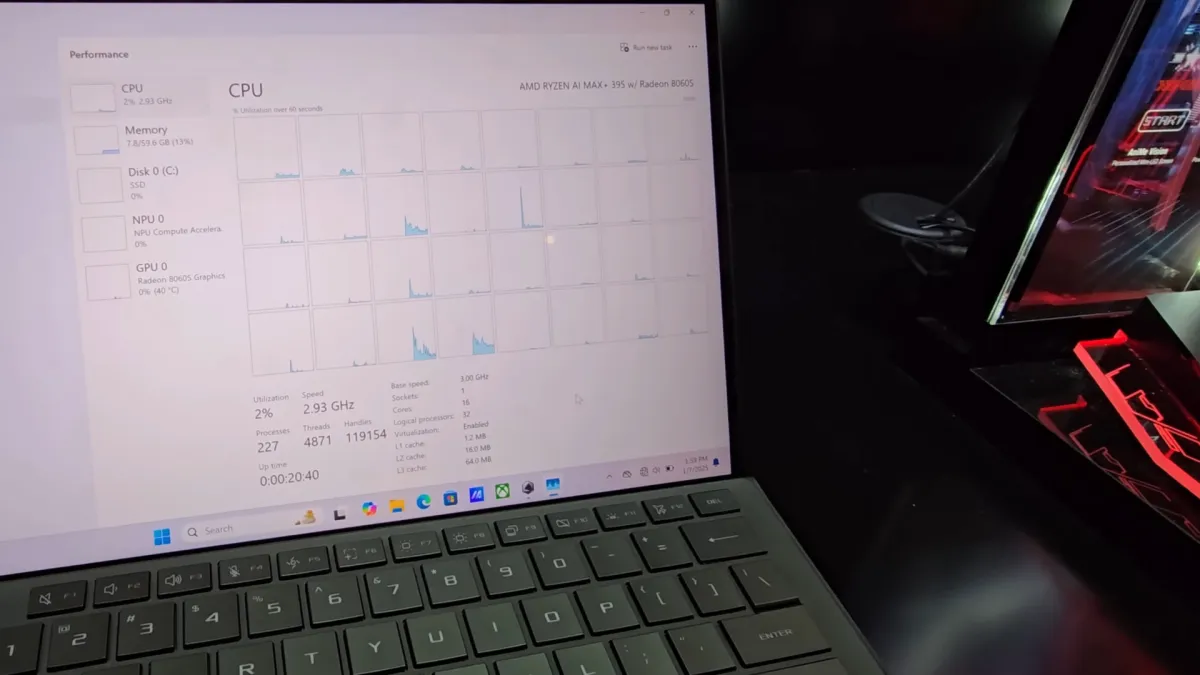
Cover: A Ryzen AI Max+ 395 laptop at CES 2025, not the benchmark system. Image: Geekerwan, CC BY 3.0, cropped and resized.
The empty-context score is not the whole story
The default dashboard splits two jobs: processing 512 input tokens and producing 128 output tokens. Both start without any pre-existing context. These are useful baselines, but neither tells you what happens after a local model has been given a long document or a large chunk of a codebase.
The Context scaling tab measures output generation against an already populated context. It lets developers ask a more useful question: how fast will the model respond once the information it needs is already in memory? That number is still not the time to first token, because the prompt has already been processed in this particular test.
One setting made a large difference
In the team's Radeon 8060S results, the increase from 4.96 to 10.73 tokens per second was about 2.16×. For the Radeon AI Pro R9700S, the comparable change within the same GPU was from 18.13 to 28.17, about 1.55×.
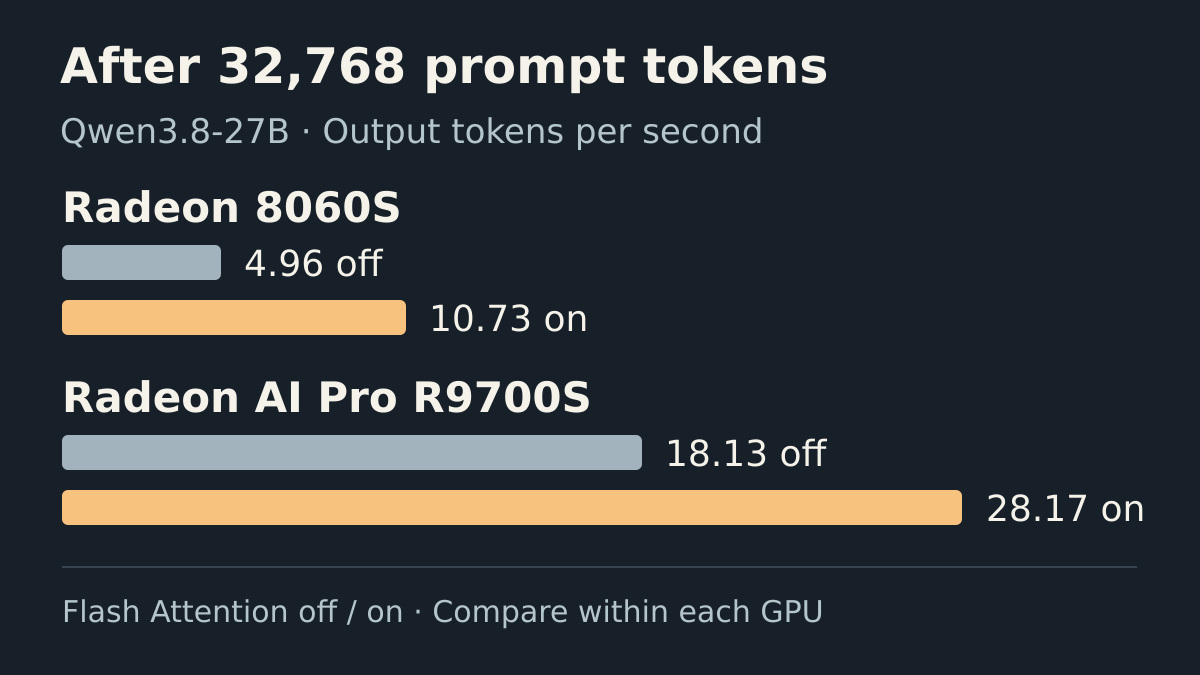
Both pairs used llama.cpp build b12765, ROCm, the same Qwen3.8-27B UD-Q4_K_M model file and a 16-bit key/value cache. They measure 128 generated tokens after 32,768 tokens of context. Flash Attention changes how the attention calculation moves data through memory. It was not introduced by this dashboard, and the numbers do not establish an across-the-board speedup.
A tool for choosing what to test locally
The value here is the visible test configuration. Developers can inspect the raw results and track changes across builds before repeating the workload on their own machine. Compare each GPU with itself first; the two systems are not a controlled hardware shootout.
The test does not score answer quality, time to first token on a long prompt or the power needed to produce an answer. The llama.cpp team says AMD supplied the test infrastructure and helped validate the setup. This is a reading of their public data, not a SUPERCRZY hands-on benchmark.
P.S. If a local model feels slow on a long file, measure prompt processing and output generation separately. A higher decode rate does not tell you how long the first token takes.
Frequently Asked Questions
Q: What is new?
A: A public llama.cpp dashboard for comparing AMD benchmark results by device, model, build and quantization.
Q: Which AMD GPUs are in the dashboard?
A: The Radeon 8060S and Radeon AI Pro R9700S are the two listed options at launch.
Q: Is Flash Attention a new feature in this release?
A: No. It is an existing optimization that the dashboard lets users compare on and off.
Q: Does the 10.73 figure include reading the prompt?
A: No. It measures output generation after the 32,768-token context is already populated.
Q: Does this benchmark measure answer quality?
A: No. The results discussed here measure throughput, not accuracy, latency to the first token or power use.