On November 26, 2026, Kioxia said it had used 144 of its XD8 SSDs in an NVIDIA GB200 NVL72 system to test a flash tier for GPU workloads. The rack had about 1.1 petabytes of raw SSD capacity. Kioxia says the design could support 2 trillion vectors at 512 bytes each. It did not add 1.1 PB of high-bandwidth memory to the GPUs.
Cover: An NVIDIA GB200 NVL72 system at Computex 2024, not the test rack. Image: Geekerwan, CC BY 3.0, resized.
The numbers fit on paper
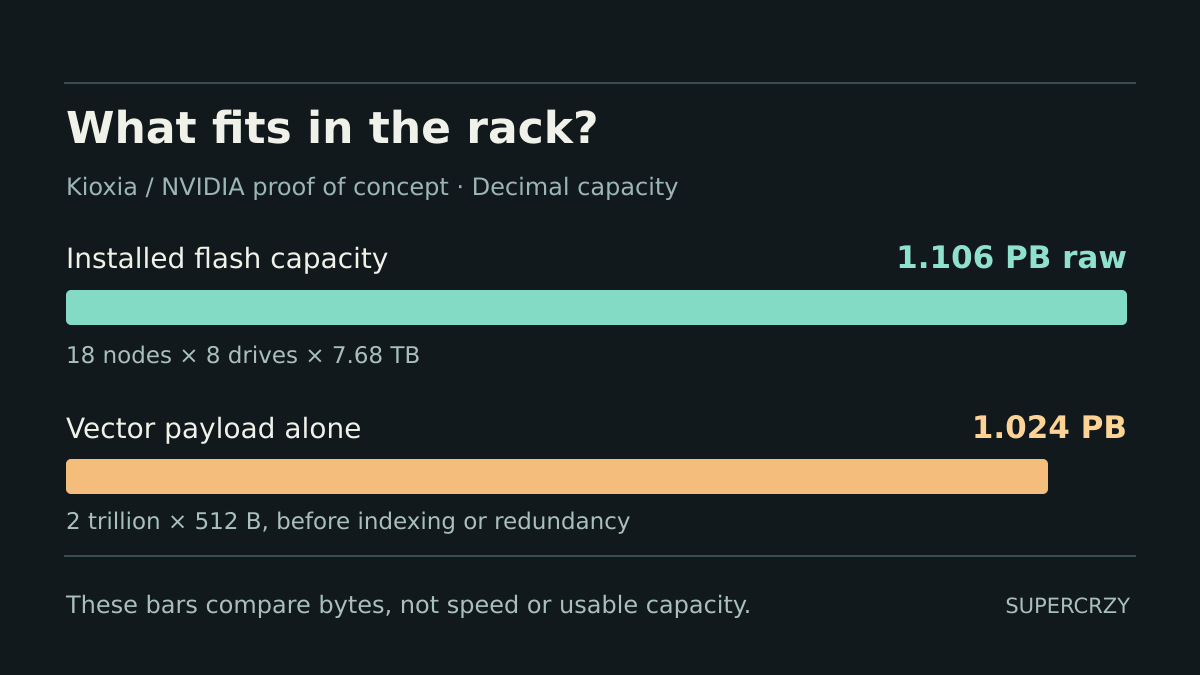
The prototype used 18 nodes, each connected to eight 7.68 TB drives. Multiply the three numbers and the rack contains 1.106 PB of raw flash in decimal units. Two trillion 512-byte vectors would account for about 1.024 PB before index structures, redundancy or other overhead.
That makes the proposed scale easier to interpret. The 1.1 PB figure is installed raw capacity, not a statement about how much an application can use after formatting or how much data the GPUs can read at once. And the vector count is a stated potential, not a published benchmark of searching 2 trillion entries.
Flash changes where the data can live
NVIDIA's SCADA library gives the GPU system access to data on NVMe drives, including small 512-byte reads. The practical appeal is that the full dataset need not live in high-bandwidth memory just to make selected records available to the GPUs. That can matter to a vector database or a graph neural network that touches only part of a much larger dataset at a time.
But HBM and flash still do different jobs. Frequently accessed data can benefit from staying in fast memory; reaching out to flash for it over and over may erase the gain from adding capacity. The proof of concept does not report end-to-end query latency, an application throughput comparison or how often an actual workload falls back to storage. It answers a capacity question before it answers a performance question.
The faster drive was not in this rack
In a separate announcement, Kioxia said the upcoming GP2 SSD delivered over 18 million random-read operations per second in its testing at a 512-byte block size. It expects up to 28 GB/s for sequential reads. Those are two different measures, and neither is a rack-scale result. Evaluation samples are expected to reach select customers at the end of 2027.
The distinction matters because the proof of concept used XD8 drives, not GP2s. A buyer cannot take the prototype's capacity, multiply it by a GP2 spec, and infer application performance. What Kioxia and NVIDIA have shown is a way to make a much larger corpus accessible from a GPU system. Whether that makes a particular system faster still depends on how it reads the data.
P.S. The number to ask for next: 99th-percentile query latency on the same dataset, with and without the flash tier, at a fixed query rate and recall target.
Frequently Asked Questions
Q: Did the NVIDIA rack gain 1.1 PB of HBM?
A: No. It gained approximately 1.1 PB of raw capacity across SSDs, a separate storage tier.
Q: Which drives were used in the test?
A: The proof of concept used 144 Kioxia XD8 NVMe SSDs rated at 7.68 TB each.
Q: What does the 2 trillion vector figure represent?
A: Kioxia's estimate of the scale the design could support at 512 bytes per vector. It is not a published search benchmark.
Q: Was the GP2 the drive in the prototype?
A: No. GP2 was announced separately. The prototype used XD8 drives.
Q: When can customers evaluate the GP2?
A: Kioxia expects to start shipping evaluation samples to select customers at the end of 2027.