
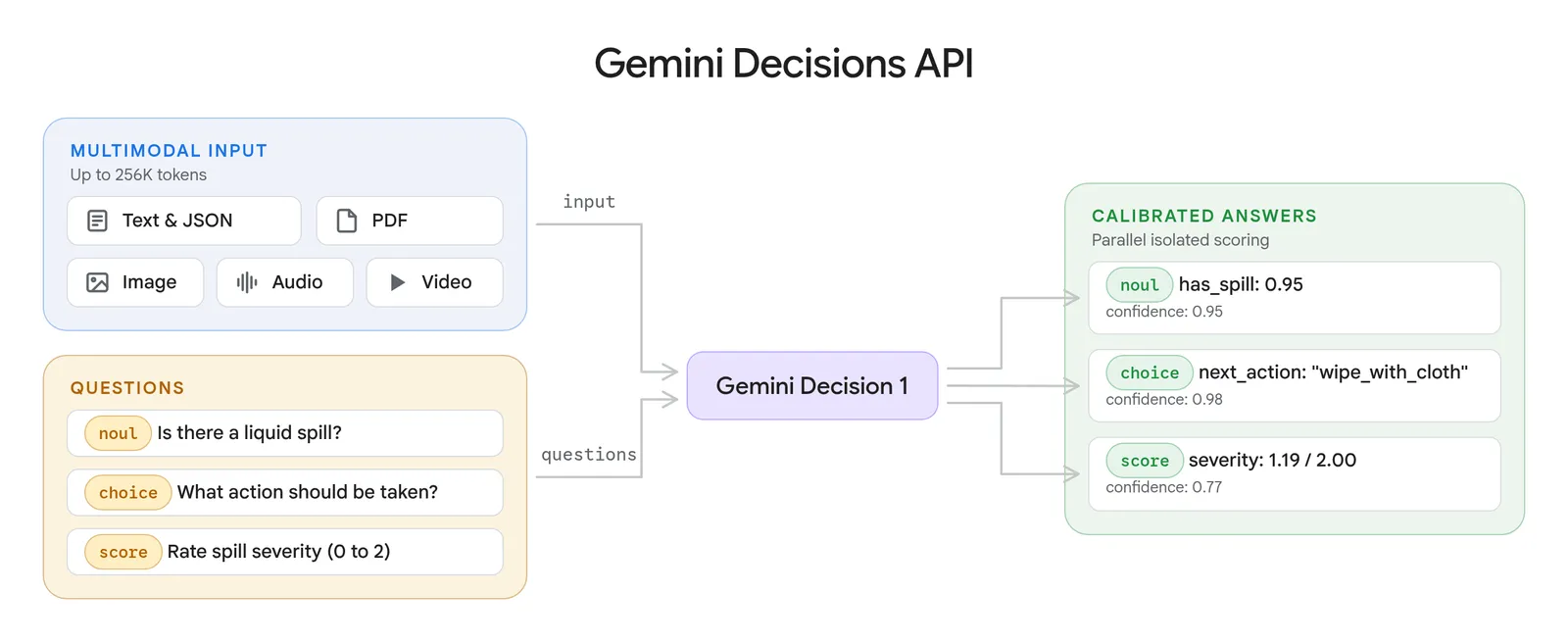
On November 11, 2026, Google launched the Gemini Decisions API, powered by a new model called Gemini Decision 1. It does not generate text token by token. It takes a multimodal input and a set of candidate options, scores them in one forward pass, and returns probabilities and confidence scores. The pricing is $0.10 per million input tokens, and output tokens are not billed at all.
The same week, Business Insider reported that Google is internally testing a separate model codenamed Hydrogen, described by an employee as very capable, fast and efficient, positioned like the Flash line for speed and cost.
The two stories point in different directions. Hydrogen is a faster generator. Decision 1 is not a generator at all.

It does not decode tokens
The architectural difference is the point. Generative models produce an answer by decoding one token at a time. Decision 1 skips that process entirely. It evaluates a closed set of options and returns a score.
Google's blog describes the output as probabilities and confidence scores, with median model compute of 50 to 100 milliseconds and end-to-end latency of 150 to 250 milliseconds for inputs up to 16K tokens. The API supports yes/no questions, multiple choice with up to 255 options, and rubric-based scoring. A single request can carry up to 1,000 independent questions against the same shared input.
Each question is evaluated independently. If one decision depends on another, the application handles the dependency in code or makes a follow-up call. This is not a reasoning model that works through a chain of steps. It is a scoring engine for predefined choices.
Output is free, and that changes the math
The pricing structure is the part that will move adoption. Input is $0.10 per million tokens, and output is zero. VentureBeat worked through an example: a 4,000-token record plus 20 checks of 50 tokens each comes to about $0.50 per 1,000 records in a single request. Split into 20 separate calls that each resend the record, the cost is $8.10 per 1,000 records.
For an agent workflow, the implication is direct. An agent that checks whether a tool result satisfies a condition, or whether a request should route to a stronger model, makes that judgment on every step. With a generative model, every judgment produces output tokens and adds cost. With Decision 1, the judgment itself has no output cost. The only bill is the input.
Google is already using it this way internally. Gemini Notebook routes queries to different models and reasoning levels based on complexity, and Google reports up to 40% lower latency for routine queries because the routing step reserves expensive models for harder requests. Google Search uses the Decisions API to detect adversarial behavior and malicious content related to MCP tools.
It is not the cheapest, and it is not the leader on every benchmark
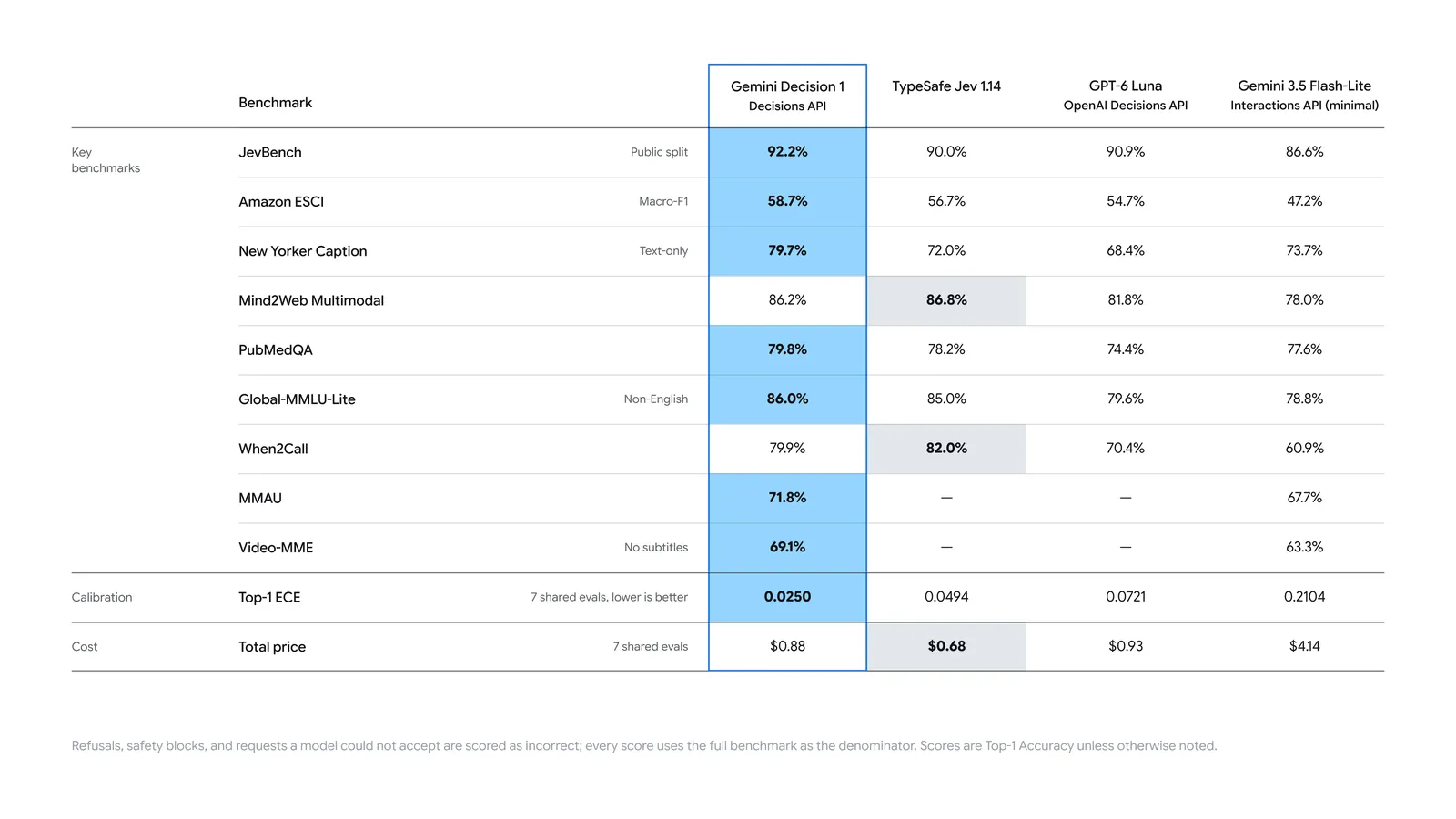
Google's launch benchmarks show Decision 1 leading five of seven tests that all four comparison models ran. It scored 92.2% on JevBench, ahead of GPT-6 Luna at 90.9% and Jev 1.14 at 90.0%. It had the lowest calibration error in Google's comparison, 0.0250 against Jev's 0.0494.
But Jev led on the browser-task benchmark Mind2Web Multimodal, 86.8% to 86.2%, and on When2Call, which tests tool-use decisions, 82.0% to 79.9%. And on price, Jev remains cheaper at $0.042 per million input tokens against Google's $0.10.
The independent Artificial Analysis Decision Index v2.1 placed Gemini Decision 1 at 66, in line with Jev 1.14 and Elephant 9B, and about 7 points behind Drex Max v1.1 and GLiDE v1.2. Google's own benchmark table is not the whole picture.
The category is forming, and Google is not first
Decision models are becoming a distinct product category. Jev arrived first. OpenAI has a GPT-6 Luna decision model priced at the same $0.10 per million input tokens with free output. Cloudflare has Clef. Google is joining a market that already has a leader on cost and a leader on some benchmarks.
What Google brings is native multimodal input across text, images, audio, video and PDFs in a single request, with up to 256K tokens of shared context. That matters for enterprise use cases like insurance claims, where a document, photos and a call recording need to be judged together. It also brings a formalized confidence score, which lets an application decide whether to accept the decision or escalate to a stronger model or a human.
The category is not a replacement for generative models. It handles the part of an agent's work that is a choice among options, not the part that is producing an answer. Google's own documentation says drafting an explanation or extracting an arbitrary invoice number still requires a separate generation or extraction step.
P.S. Decision 1 is not a faster Gemini but a different product category, priced so the judgment itself has no output cost. The bet is that agents will make more decisions if decisions are cheap.
Frequently Asked Questions
Q: What is Gemini Decision 1?
A: A model from Google that scores predefined options instead of generating text. It supports yes/no questions, multiple choice with up to 255 options, and rubric-based scoring, returning probabilities and confidence scores.
Q: How is it different from a normal Gemini model?
A: It does not decode tokens. It evaluates options in a single forward pass, with median model compute of 50 to 100 ms and end-to-end latency of 150 to 250 ms. It cannot write explanations or extract arbitrary text; those still require a generative model.
Q: How much does it cost?
A: $0.10 per million input tokens, with output tokens billed at zero. Jev remains cheaper at $0.042 per million input tokens.
Q: How many questions can one request handle?
A: Up to 1,000 independent questions against a shared multimodal input of up to 256K tokens, covering text, images, audio, video and PDFs. Each question is scored independently; dependent decisions require separate calls or code logic.
Q: What is confidence calibration and why does it matter?
A: Calibration measures how closely a model's confidence tracks its actual accuracy. Decision 1 had the lowest calibration error in Google's comparison, 0.0250 against Jev's 0.0494. A well-calibrated score lets an application decide when to accept a result and when to escalate.
Q: Is Hydrogen a separate model?
A: Yes. Business Insider reported Google is internally testing a model codenamed Hydrogen, positioned like the Flash line for speed and cost, with no public release date or pricing. It is a generator, not a decision model.